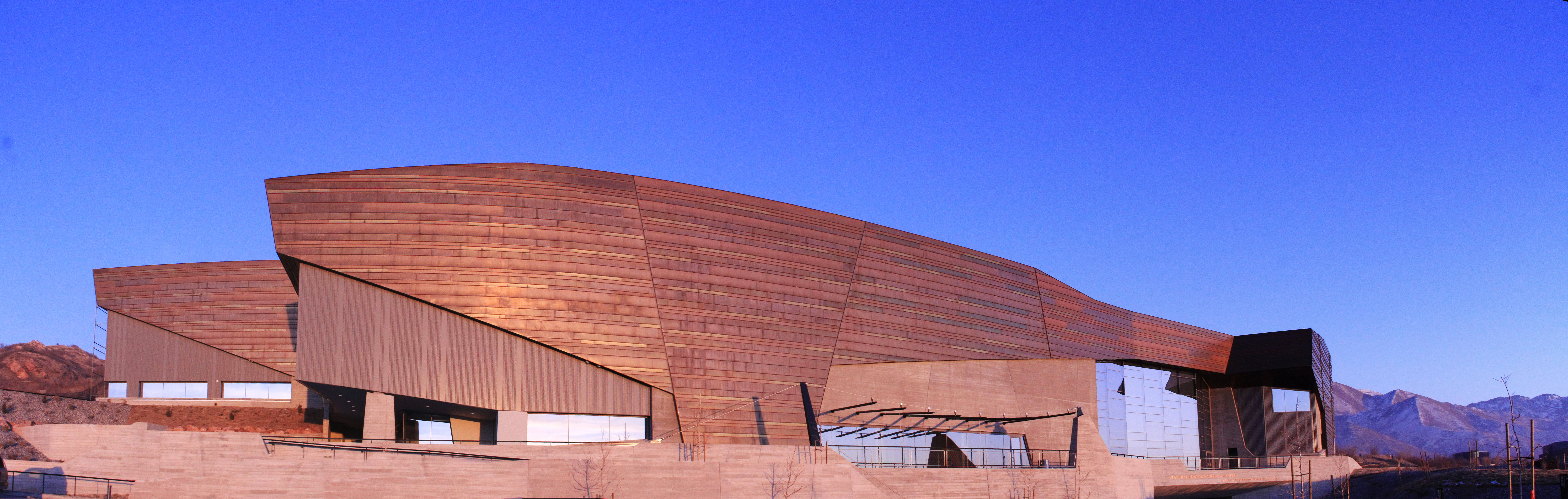
Natural History Museum of Utah
Somewhere in a quarry in central Utah, bones accumulated. For millions of years, the remains of Allosaurus after Allosaurus piled up in what would become the Cleveland-Lloyd Dinosaur Quarry, one of the most concentrated deposits of Jurassic-era predators ever found. Today, the best of those bones stand reassembled in Salt Lake City, where the Natural History Museum of Utah displays the largest collection of Allosaurus skeletons anywhere in the world. The museum itself rises from the foothills of the Wasatch Mountains like a copper-clad cliff, its terraced galleries climbing the hillside in a building that earned acclaim when it opened in 2011.
From Library Basement to Mountain Gallery
The museum's origins trace to 1959, when University of Utah faculty recognized they had a problem: natural history specimens scattered across campus, tucked into departmental closets and basement storage. By 1963, the Utah State Legislature officially established the Utah Museum of Natural History, and in 1969 it opened in the former George Thomas Library. For over four decades, visitors climbed those library stairs to see dinosaurs posed in what paleontologists now recognize as anatomically incorrect postures. The cramped quarters never quite matched the grandeur of the specimens. That changed in November 2011, when the museum moved to the Rio Tinto Center, a $102 million facility designed by Ennead Architects of New York City. The building climbs the foothill terrain, with each gallery stepping up the slope, until visitors reach the circular Native Voices gallery nestled into the hillside at the building's peak.
The Bone Hunter's Legacy
The Allosaurus collection exists because of one man's obsession. James Madsen spent the 1960s and 1970s excavating the Cleveland-Lloyd Dinosaur Quarry through the University of Utah's Cooperative Dinosaur Project. The quarry remains a scientific mystery: why did so many predatory dinosaurs die in this single location? Theories range from a prehistoric watering hole that became a death trap to a toxic spring that poisoned the carnivores. Whatever the cause, the result was a treasure trove. When the university ended funding in 1976, Madsen founded Dinolab, casting and selling dinosaur replicas to fund continued research. He died in 2009, but his decades of painstaking excavation gave the museum more Allosaurus material than any institution on Earth. The paleontology collection now includes 12,000 vertebrate specimens, 4,000 invertebrates, and 7,000 plant fossils.
Utah Through Deep Time
The museum's galleries walk visitors through Utah's geological story, from ancient seas to volcanic upheavals to the ice ages. The Past Worlds exhibition presents snapshots spanning hundreds of millions of years, when Utah cycled through tropical swamps, vast deserts, and shallow oceans. The Land gallery explores how the state straddles three distinct physiographic regions: the Middle Rocky Mountains, the Basin and Range, and the Colorado Plateau. Each shaped Utah's landscapes in radically different ways, from the fault-block mountains near Salt Lake City to the red rock canyons of the south. The Great Salt Lake gallery offers something most natural history museums cannot: a view of its subject. Looking west from the hillside building, visitors see the lake itself, a remnant of ancient Lake Bonneville that once covered much of western Utah during the Pleistocene.
Living Cultures, Active Research
Beyond the dinosaurs, the museum holds approximately 750,000 archaeological objects and ethnographic collections documenting Utah's human history. The Native Voices gallery, housed in that distinctive circular structure at the building's highest point, presents the traditions of Utah's indigenous peoples through their own perspectives. The First Peoples gallery puts visitors in the role of archaeologists, using scientific methods to interpret artifacts from the Great Basin's prehistoric inhabitants. As a University of Utah institution, the museum functions as both public attraction and research facility. Graduate students work with collections assembled from the university's anthropology, biology, and geology departments. The Youth Teaching Youth program trains middle school students from at-risk environments to teach younger children using museum materials, then offers those students internships as they advance through high school.
From the Air
The Natural History Museum of Utah sits at coordinates 40.764N, 111.823W in the foothills of the Wasatch Mountains, at the eastern edge of Salt Lake City. The copper-clad Rio Tinto Center building is visible from the air on the hillside above the university's Research Park. Nearby airports include Salt Lake City International (KSLC, 7 nm northwest) and South Valley Regional (U42, 12 nm south). The museum sits at approximately 5,000 feet elevation. Best viewed during clear weather when the Wasatch Range provides dramatic backdrop.