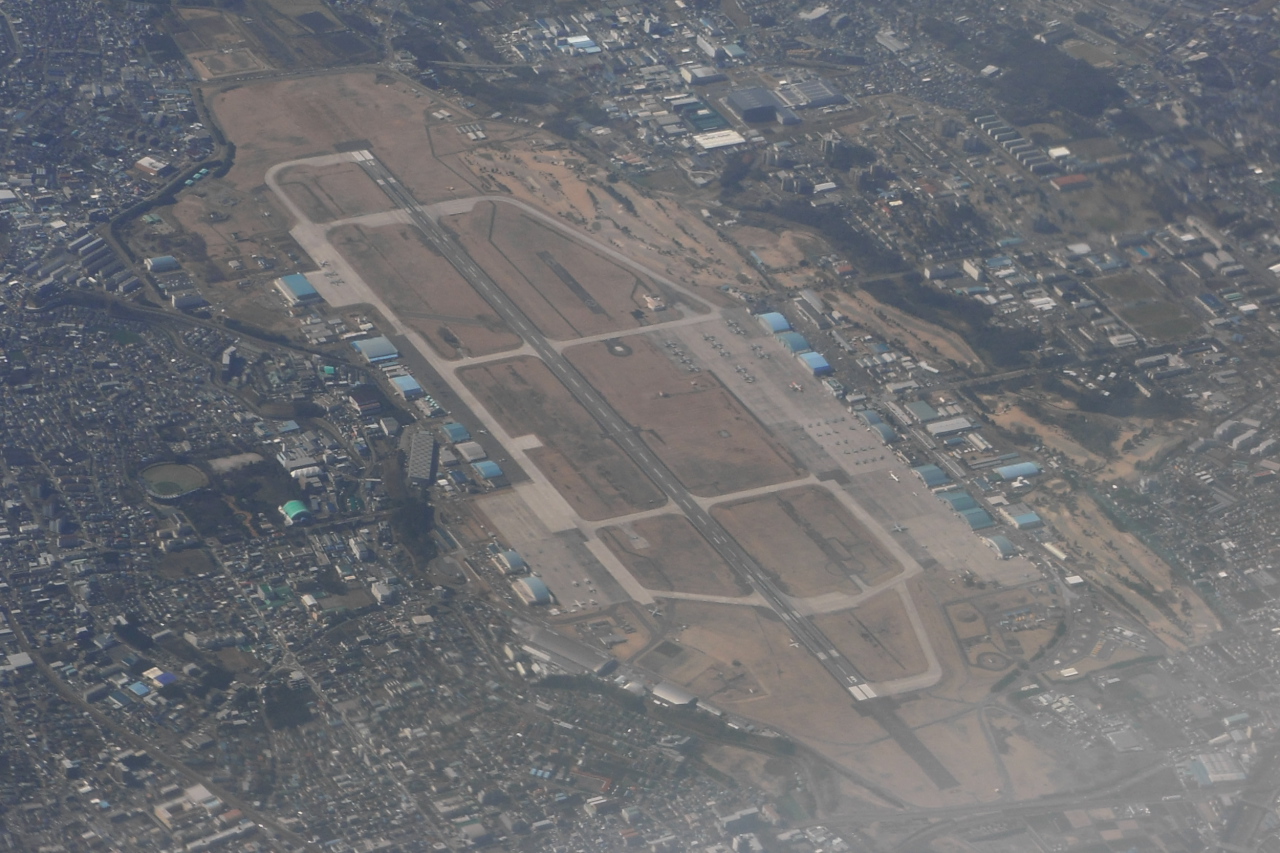
Naval Air Facility Atsugi: The Base That Isn't Where Its Name Says
General Douglas MacArthur stepped off his plane at Atsugi on August 30, 1945, to accept Japan's surrender. Two days earlier, an advance party had rolled a jeep-mounted control tower onto the airfield -- the first American vehicle to touch Japanese soil. The irony of the location ran deeper than anyone realized at the time. Just days before, Japanese pilots stationed at this very airfield had refused Emperor Hirohito's order to lay down arms, taking to the skies over Tokyo and Yokohama to drop leaflets urging civilians to resist the Americans. They eventually gave up. The base did not. Eighty years later, Naval Air Facility Atsugi remains the largest U.S. Navy air installation in the Pacific Ocean -- a joint Japanese-American operation that has generated Cold War intrigue, deadly crashes, massive noise lawsuits, and one of the strangest naming stories in military history.
A Name from Nowhere Nearby
Atsugi is not in Atsugi. The base straddles the cities of Yamato and Ayase in Kanagawa Prefecture, separated from the actual city of Atsugi by two other municipalities. When the U.S. Navy reopened the base in 1950, the three farming villages surrounding the airfield -- Yamato, Ayase, and Shibuya -- all shared names with far more famous places. Yamato is an ancient name for the Nara region. Ayase calls to mind a busy train station in northeast Tokyo. And Shibuya is one of the most recognized neighborhoods on Earth. The only town in the area that would not cause confusion was Atsugi, the nearest large settlement. So Atsugi it became, a name that has confused visitors and mail carriers ever since. The base itself dates to 1938, when the Imperial Japanese Navy built it as an airfield. American forces captured and refurbished it during the occupation, and Navy Seabees prepared it for full operations during the Korean War, reopening it in December 1950 as Naval Air Station Atsugi.
Spies, Assassins, and Cold War Shadows
Atsugi's most extraordinary Cold War chapter involves two men who never met there but whose paths both ran through the base. Starting in at least 1957, the CIA operated U-2 spy planes from Atsugi. One of these aircraft made local headlines when it ran low on fuel and made an emergency landing at a glider club's landing strip. That same U-2 was later piloted by Gary Powers on the mission that was shot down over the Soviet Union in 1960, provoking an international crisis. Meanwhile, a young Marine radar operator named Lee Harvey Oswald was stationed at Atsugi from September 1957 to November 1958, assigned to Marine Air Control Squadron 1. Oswald tracked aircraft on his radar screens at a base where some of the Cold War's most sensitive operations were underway. Five years later, he assassinated President Kennedy. The base served as a major naval air hub during both the Korean and Vietnam Wars, hosting fighters, bombers, and transport aircraft that projected American power across the western Pacific.
Crashes, Protests, and Poison Air
The cost of operating a major military airfield in one of the most densely populated regions on Earth has been measured in lives, lawsuits, and public fury. In 1964, a Marine F8U-2 Crusader from Atsugi crashed into Machida, Tokyo, killing four people on the ground and injuring 32. In 1977, an F-4 Phantom II crashed into a Yokohama residential neighborhood, killing two boys aged one and three. In July 1988, 20,000 people formed a human chain around the base to protest noise from night landings. Since 1976, residents have filed multiple lawsuits against the Japanese government over aircraft noise, with courts awarding billions of yen in damages -- 9.4 billion yen to nearly 7,000 plaintiffs in a 2015 ruling alone. Adding to the misery, a nearby waste incinerator called the Jinkanpo blew toxic emissions over the base throughout the 1990s. Servicemembers reported cancer and respiratory illness. The Japanese government ultimately purchased the incinerator for nearly 40 million dollars and shut it down in 2001.
The Wing Moves On
For decades, Atsugi housed all the squadrons of Carrier Air Wing Five, the air wing that deploys with the forward-deployed American carrier at Yokosuka Naval Base. That changed between 2017 and 2018, when the wing's fixed-wing aircraft -- Super Hornets, Growlers, and Hawkeyes -- relocated to Marine Corps Air Station Iwakuni in western Japan. The move had been debated since at least 2005 and was fiercely opposed by Iwakuni's local government, with voters rejecting the plan in a 2006 plebiscite. Construction delays pushed the timeline from 2014 to 2017. Today, Atsugi retains the wing's helicopter squadrons and hosts Helicopter Maritime Strike Squadron 51, which provides MH-60R Seahawk detachments to U.S. Navy warships out of Yokosuka. The Japan Maritime Self-Defense Force operates Fleet Air Wing 4 and Air Transport Squadron 61 from the same runways. Personnel from the base assisted with Operation Tomodachi after the 2011 Tohoku earthquake and tsunami. The base holds a spring open day, though the full Atsugi WINGS air show -- featuring a spectacular diamond-of-diamonds formation -- ended after 2000 due to noise complaints. The roar of jets has quieted somewhat, but Atsugi remains what it has been since MacArthur's boots hit the tarmac: a fulcrum where American and Japanese military power meets the daily life of millions of Japanese civilians.
From the Air
Located at 35.455N, 139.45E in the cities of Yamato and Ayase, Kanagawa Prefecture. NAF Atsugi (ICAO: RJTA) is a joint-use military airfield with a single runway oriented roughly north-south. The base is clearly visible from altitude as a large rectangular clearing amid dense suburban development southwest of Yokohama. Yokosuka Naval Base lies approximately 15 nautical miles to the southeast. Haneda Airport (RJTT) is roughly 20 nautical miles to the northeast. Exercise caution regarding restricted airspace around the facility. Best viewed at 3,000-5,000 feet AGL for the striking contrast between the airfield and surrounding urban density.