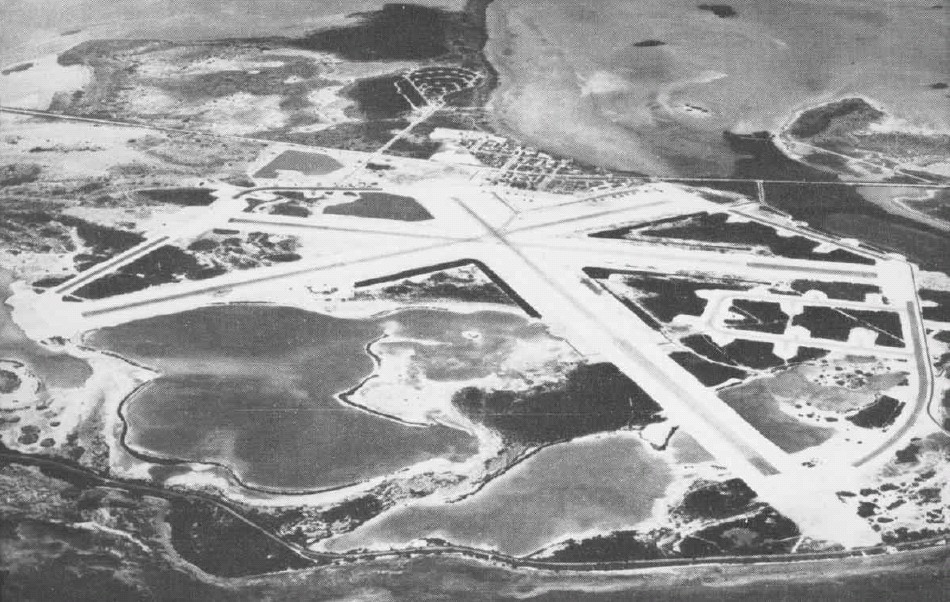
Naval Air Station Key West
On September 22, 1917, a Coast Guard lieutenant named Stanley Parker lifted a Curtiss N-9 seaplane off the waters near Key West and entered the base logbook as the first naval aviator ever to fly from the southernmost point in the United States. Three months later, Naval Air Base Key West was officially commissioned, and Parker became its first commanding officer. What began as a crude coastal patrol station -- seaplane ramps, a dirigible hangar, and temporary barracks thrown up on land leased from the Florida East Coast Railway -- has since grown into one of the Navy's premier air-to-air combat training facilities, a place where favorable year-round flying weather and vast overwater ranges have shaped American fighter pilots for more than a century.
Pirates, Battleships, and Biplanes
The Navy's presence on Key West predates aviation by almost a century. In 1823, a naval base was established to suppress piracy in the Florida Keys, where wealthy shipping merchants and their fleets made tempting targets. The base expanded during the Mexican-American War with the construction of Fort Zachary Taylor beginning in 1845. In 1898, the battleship USS Maine sailed from Key West to Havana, where it exploded at anchor and sank -- an event that plunged the nation into the Spanish-American War and brought the entire U.S. Atlantic Fleet to Key West. When World War I arrived, the base found its aerial calling. Pilots in slow Curtiss biplanes flew low over surfaced German submarines, armed with a single machine gun and hand grenades that gunners dropped into open conning towers. By 1918, the station was training student aviators in earnest, with more than 500 pilots earning their wings at Key West during the war.
U-Boats Within Sight of Shore
The interwar years nearly killed the station. After 1918, buildings were dismantled or destroyed, and the facilities sat largely idle through the 1920s and 1930s. But the government held onto the property -- a decision that proved prescient when the base was redesignated Naval Air Station Key West on December 15, 1940, just in time for America's entry into World War II. This time the threat was immediate and visceral. By 1943, German U-boats operated so close to the Keys that they were sinking Allied ships within sight of land. Submarine attacks peaked in May of that year, when 49 ships were torpedoed off the Florida coast. PBY flying boats, blimps, and land-based patrol aircraft launched from Key West and its satellite fields on Boca Chica Key, hunting the submarines that prowled the Gulf Stream. The attrition was relentless, and gradually the torpedo raids subsided.
Cold War Frontline
Ninety miles from Cuba, NAS Key West became a Cold War flashpoint. During the Cuban Missile Crisis of 1962, the Army rushed Nike Hercules and MIM-23 Hawk surface-to-air missiles into the Keys. The station's radar joined the Air Force's SAGE air defense network, and for tense weeks, Key West sat on the razor's edge of nuclear confrontation. In calmer times, the base became a magnet for fighter squadrons drawn by its superb weather and open-ocean training ranges. Reconnaissance Attack Wing One relocated from closing NAS Albany, Georgia in 1973, bringing ten squadrons of RA-5C Vigilante aircraft that deployed aboard Forrestal-, Kitty Hawk-, Enterprise-, and Nimitz-class carriers. Fighter Squadron 45 flew A-4 Skyhawks, F-5 Freedom Fighters, and F-16N Fighting Falcons as adversary aircraft, teaching Navy pilots to fight against enemy tactics. The tradition continues today with VFC-111, the Sun Downers, flying F-5N and F-5F jets in the aggressor role.
Where Every Service Comes to Train
NAS Key West's three runways on Boca Chica Field -- the longest stretching 10,001 feet -- support an extraordinary diversity of operations. The Key West Complex airspace extends south toward Cuba, west past the Dry Tortugas, and northwest over the Gulf of Mexico, covered by the Tactical Aircrew Combat Training System that tracks every maneuver for post-mission debriefs. Navy strike fighter squadrons, Marine Corps attack squadrons, and Air Force fighter units all rotate through for exercises. The base also hosts the U.S. Army Special Forces Underwater Operations School on Fleming Key and the headquarters of Joint Interagency Task Force South, which coordinates counter-narcotics missions across the Caribbean. At Trumbo Point, the old seaplane base, the tallest building on Key West island bears a painted "FLY NAVY" logo visible from the boulevard -- a fitting billboard for a station that has been shaping military aviators since a Coast Guard lieutenant coaxed a biplane off the water in 1917.
From the Air
NAS Key West (ICAO: KNQX) is located on Boca Chica Key at 24.58°N, 81.69°W, four miles east of downtown Key West. Three runways: 08/26 (10,001 ft), 04/22 (7,002 ft), 14/32 (7,001 ft). This is an active military installation -- civil aircraft should monitor approach frequencies and avoid the Key West Complex restricted airspace (W-174, W-465) to the south and west. Key West International Airport (KEYW) is the nearest civilian field, approximately 4nm west. The station's facilities spread across multiple annexes including Trumbo Point and the Truman Annex, all visible along the island's north shore. Recommended viewing altitude: 2,000-3,000 ft for a clear view of the runways, hangars, and the surrounding turquoise shallows of Boca Chica Channel.