Naval Air Station Pensacola Shooting
At 6:51 on the morning of December 6, 2019, gunfire erupted inside a classroom building at Naval Air Station Pensacola, the storied Florida base where generations of American pilots earned their wings. The shooter moved through two floors, firing as he went. Seven minutes later, Escambia County sheriff's deputies ended the attack, killing the gunman. Three young sailors lay dead. Eight more people, including three of the responding officers, were wounded. The attacker was not an outsider who had breached the perimeter. He was Mohammed Saeed Alshamrani, a 21-year-old second lieutenant in the Royal Saudi Air Force, in the United States as part of a Pentagon-sponsored training program that had brought more than 850 Saudi nationals to American military installations.
Three Careers Cut Short
The victims were all at the beginning of their naval careers. Airman Mohammed Sameh Haitham, 19, from St. Petersburg, Florida. Ensign Joshua Kaleb Watson, 23, a recent United States Naval Academy graduate from Enterprise, Alabama. Airman Apprentice Cameron Scott Walters, 21, from Richmond Hill, Georgia. Watson, despite being mortally wounded, managed to escape the building and reach first responders, providing them with a description of the shooter and details about his location inside the building. He died at the hospital. A wounded police officer, among the first on scene, helped others escape before his own injuries were treated. In the days that followed, a local artist began a mural at Pensacola's Graffiti Bridge to honor the victims and survivors.
Roots of Radicalization
Alshamrani had arrived in the United States in August 2017 for a training program scheduled to last three years, encompassing English-language instruction, basic aviation, and initial pilot training. Behind this outward purpose, investigators uncovered a darker trajectory. A Saudi government analysis revealed that Alshamrani appeared to have embraced radical ideology as early as 2015, two years before he set foot on American soil. A Twitter account linked to him expressed support for radical Islam, the Taliban, and hatred for the West. On the morning of the attack, a post from an account using the handle @M7MD_SHAMRANI appeared, declaring hatred for Americans and quoting Osama bin Laden and Anwar al-Awlaki. The night before, Alshamrani had hosted a dinner party where he and three fellow Saudi students watched videos of mass shootings in the United States.
An Act of Terror, Claimed and Confirmed
Two days after the shooting, the FBI declared it was treating the attack as a presumed act of terrorism. On January 13, 2020, the Department of Justice made it official, classifying the incident as terrorism motivated by jihadist ideology. Then came the claim no one wanted but many expected. On February 2, 2020, al-Qaeda in the Arabian Peninsula released an audio recording in which the group's emir, Qasim al-Raymi, stated they had directed Alshamrani to carry out the attack. The FBI corroborated these claims on May 18, 2020, the same day Attorney General Barr announced the bureau had unlocked the shooter's iPhone without Apple's assistance. The investigation also led to the expulsion of 21 Saudi military cadets from the United States, after reviews uncovered concerning social media activity and the possession of extremist material.
Reckoning and Response
The attack forced an uncomfortable reckoning with a decades-old program. Saudi Arabia is one of many allied nations that send military personnel to NAS Pensacola for training, a tradition rooted in security cooperation agreements meant to strengthen partnerships. Flight training for all Saudi Arabian students was immediately suspended pending the FBI investigation. Defense Secretary Mark Esper opened a separate review of the vetting procedures used to accept foreign nationals into U.S. military training programs. The King of Saudi Arabia called President Trump to express condolences, insisting the attacker did not represent the Saudi people. Governor Ron DeSantis was blunter, saying Saudi Arabia owed a debt given the attacker was one of their citizens. The shooting was later described as the first deadly terrorist attack on U.S. soil since September 11, 2001 that had been planned and directed from abroad.
From the Air
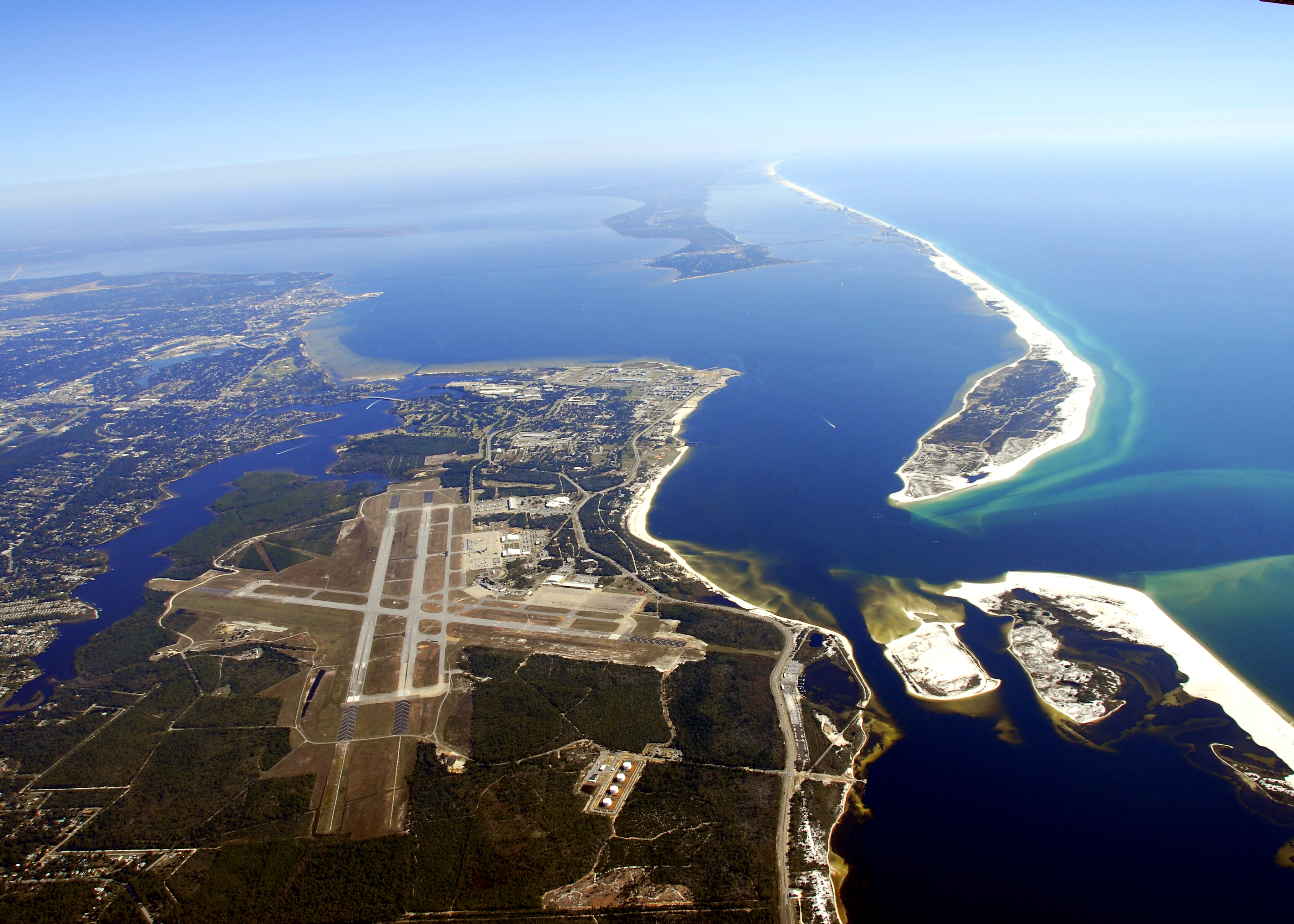
Located at NAS Pensacola (KNPA), 30.35N 87.27W, on Pensacola Bay in northwest Florida. The base is immediately identifiable from the air by its runway complex along the bay shore, with the distinctive Blue Angels hangar area. Forrest Sherman Field's parallel runways are prominent features. Nearby airports include Pensacola International (KPNS) 5nm northeast and Pensacola NAS/Forrest Sherman (KNPA). The city of Pensacola lies to the northeast, with Santa Rosa Island and the Gulf of Mexico to the south. Best viewed at 3,000-5,000 ft AGL.