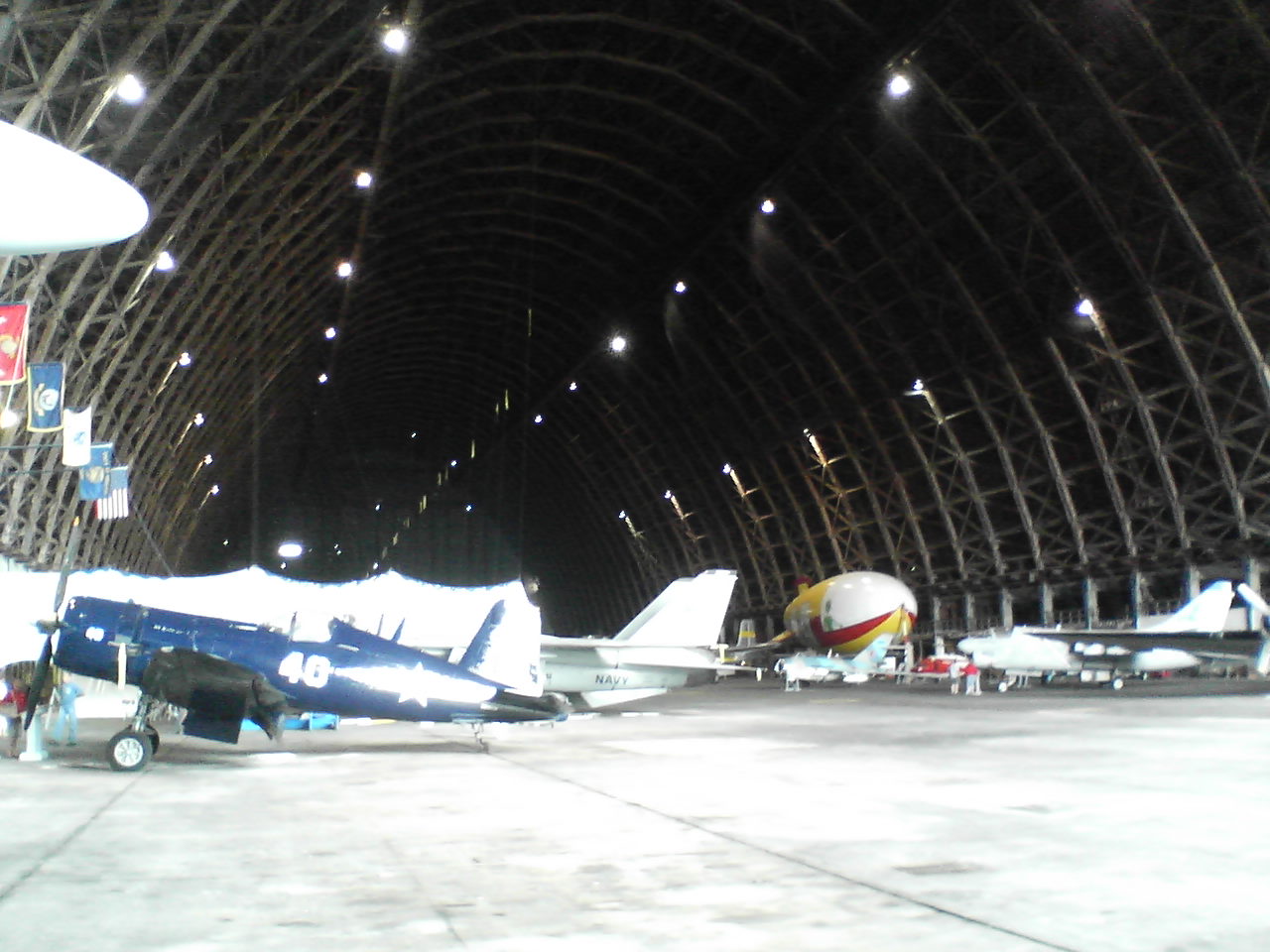
Naval Air Station Tillamook
The building is so large that fog once drifted through its open doors and condensed inside, forming clouds beneath a wooden ceiling fifteen stories overhead. Hangar B at the former Naval Air Station Tillamook stretches 1,072 feet long and 296 feet wide -- roughly seven acres under one roof -- and every beam, truss, and arch is made of wood. Not because the Navy wanted it that way, but because in 1942, steel was going to ships, tanks, and guns. The architects had to solve an extraordinary engineering problem: how to enclose enough volume to house six fully inflated blimps using nothing but Douglas fir and Sitka spruce. Their answer still stands on the Oregon coast south of Tillamook, defying gravity, weather, and eighty years of Pacific storms.
Blimps Against Submarines
The station existed because of a genuine threat. Japanese submarines prowled the Pacific coast during the early years of World War II, sinking merchant ships and even shelling a fuel depot near Santa Barbara, California. The Navy's response included lighter-than-air patrol: K-class blimps, each 252 feet long, slow but capable of hovering over a suspicious patch of ocean for hours with radar, depth charges, and machine guns. Naval Air Station Tillamook was commissioned in December 1942 as home to Squadron ZP-33, which operated eight K-ships out of two enormous hangars. The blimps flew anti-submarine patrols from the Columbia River to northern California, escorting coastal convoys and scanning for periscopes in the gray swells. No ship under blimp escort along this coast was lost to submarine attack during the war.
Cathedral of Douglas Fir
Wartime rationing forced an audacious choice. With structural steel allocated to warships and aircraft, the Navy's engineers designed Hangar B using glue-laminated wooden arches -- a technique that bent thin layers of timber into massive curved beams strong enough to span nearly 300 feet without interior columns. The result was a clear-span interior tall enough to hold a seventeen-story building, wide enough to park a Boeing 747 with room to spare, and long enough that you could lay the Eiffel Tower on its side inside with footage to spare. Two of these hangars were built side by side, each capable of sheltering six fully inflated blimps at once. The sheer volume of enclosed space created its own weather problems: temperature differentials between the sun-warmed roof and the cool interior could generate air currents strong enough to buffet the delicate gas bags.
Fire and Survival
The station was decommissioned in 1948, and for decades the twin hangars stood as silent monuments to wartime ingenuity on the dairy-farm flats south of Tillamook. Then, on August 22, 1992, fire took Hangar A. The blaze was visible for miles, a column of flame and smoke rising from seven acres of old-growth timber. The heat was so intense that firefighters could not approach. By morning, Hangar A was gone -- reduced to a field of ash and twisted metal fittings, with only the concrete foundation marking where it had stood. Hangar B survived. Listed on the National Register of Historic Places in 1989, just three years before its twin burned, the remaining hangar became the Tillamook Air Museum, filling its cavernous interior with vintage aircraft and aviation exhibits.
A Museum Under One Roof
Walking into Hangar B is a disorienting experience. The scale tricks your eyes -- aircraft that seem toy-sized from the entrance reveal themselves as full-scale fighters and bombers as you approach. The wooden arches soar overhead in repeated curves that give the interior the feel of an inverted ship's hull or a Gothic cathedral built by lumberjacks. For years the Erickson Group operated the museum and housed their private aircraft collection here, but in January 2016 they relocated to Madras, Oregon, taking their planes with them. The Tillamook Air Museum operated for years, filling the space with historical exhibits, restored aircraft, and the story of the blimp crews who patrolled these skies. In December 2025, a winter storm tore a 160-foot section of Hangar B's roof open, forcing an indefinite closure as the museum sought millions of dollars for repairs. The hangar itself remains the main attraction -- a reminder that when the country ran out of steel, its engineers turned to the forests of the Pacific Northwest and built something that has outlasted nearly every metal structure from the same era.
From the Air
Located at 45.42N, 123.80W on the flat coastal plain just south of Tillamook, Oregon. Hangar B is unmistakable from the air -- a massive rectangular structure with a curved roof dwarfing everything around it. The empty foundation pad of destroyed Hangar A is visible adjacent to it. Best viewed at 2,000-3,000 feet AGL. Nearest airports: Tillamook Airport (KTMK) is immediately adjacent to the site. Portland-Hillsboro (KHIO) approximately 55nm east. The Oregon Coast Range rises sharply to the east; approach from the west over Tillamook Bay for the best perspective on the hangar's scale against the surrounding dairy farmland.