NALF Santa Rosa: From Torpedo Bombers to Die Hard
Bruce Willis never actually saved Dulles International Airport. The fictional siege of "Die Hard 2" was filmed, in part, at a decommissioned naval airfield in Sonoma County wine country -- an airstrip built to train pilots for Pacific combat and repurposed, decades later, as a convincing stand-in for a major East Coast hub. That the Santa Rosa Air Center could pass for Dulles on camera says something about the scale of what the Navy built here during World War II: two 7,000-foot concrete runways, parallel taxiways, and an apron large enough to handle the steady rotation of 21 squadrons through training cycles. By 1990, when the film crew arrived, the facility had been abandoned by the military, briefly revived as a civilian airport, and was sliding toward permanent closure. Hollywood gave it one last moment in the spotlight before the lights went out for good in 1991.
Built for a Pacific War
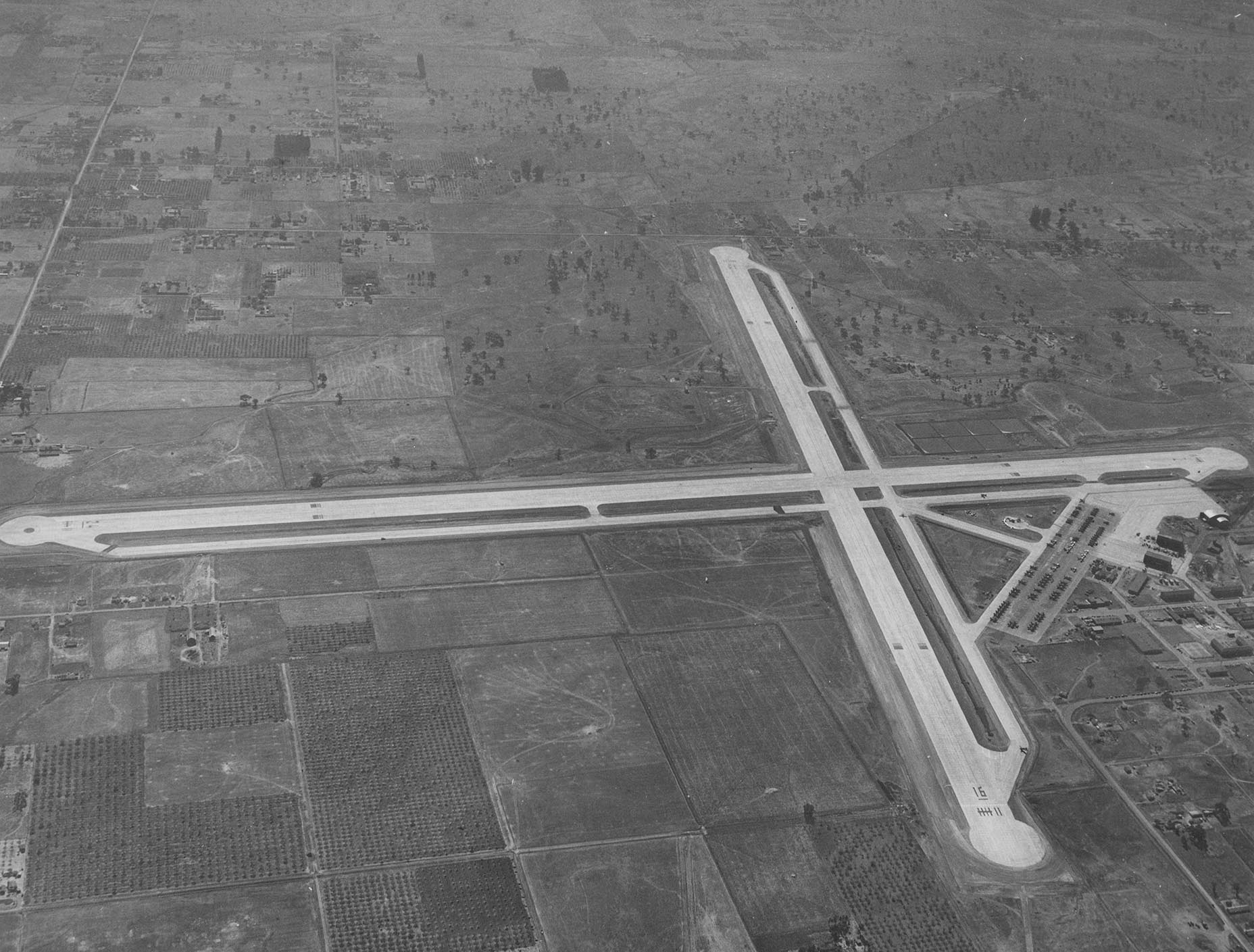
The Navy commissioned the airfield in 1943, designating it a Naval Auxiliary Landing Field under the command of Naval Air Station Alameda, the major fleet air station on San Francisco Bay. Sonoma County's flat terrain and reliable flying weather made it an ideal site for training squadrons bound for the Pacific Theater. The two concrete runways were laid out in a crossing pattern -- one oriented at 160-340 degrees, the other at 060-240 -- each with its own parallel taxiway and a concrete apron at the northwest quadrant where the runways intersected. The configuration allowed operations in nearly any wind condition, a critical feature for training pilots who would need to land on carrier decks in unpredictable Pacific weather. NALF Santa Rosa did not operate alone. Two smaller outlying fields, Naval Outlying Landing Field Cotati and Naval Outlying Landing Field Little River, supported the Santa Rosa operation, creating a training network that stretched across Sonoma County's agricultural landscape.
Twenty-One Squadrons
The numbers tell the story of the airfield's wartime intensity. Twenty-one squadrons cycled through Santa Rosa during World War II, training in fighters, dive bombers, and torpedo planes -- the three aircraft types that formed the striking arm of carrier aviation. Pilots practiced formation flying over the vineyards and dairy farms of Sonoma County, their aircraft visible and audible to the rural communities below. The training was urgent. By 1943, the Pacific war had shifted from desperate defense to island-hopping offense, and the Navy needed trained aviators faster than its existing facilities could produce them. Auxiliary fields like Santa Rosa absorbed the overflow, turning farmland into runways and quiet towns into temporary military communities. When the war ended, the urgency evaporated. The Navy relinquished the Santa Rosa airfield between 1946 and 1948, and the runways fell silent.
Recalled to Service
Silence did not last. When the Korean War broke out in 1950, the Navy reactivated the Santa Rosa field in 1951, dusting off the infrastructure that had sat idle for only a few years. But the reactivation was brief. By 1952, the field was being wound down again, and the Navy abandoned it for the final time between 1952 and 1954. The Korean War reactivation was a pattern repeated at dozens of auxiliary airfields across the country -- a reminder that military infrastructure, once built, tends to linger in a state of potential usefulness, ready to be recalled when the next conflict demands it. For Santa Rosa, the recall lasted barely a year. The concrete remained, the taxiways remained, but the military mission was finished. What would become of two 7,000-foot runways in the middle of wine country was now a civilian question.
Lights, Camera, Runway
The answer came in the mid-1960s, when the former military field was reopened as a civilian airport called the Santa Rosa Air Center. It operated for about 25 years, never becoming a major commercial facility but providing general aviation access to the region. Its real claim to fame came from Hollywood. In 1990, the production crew for "Die Hard 2: Die Harder" used the Santa Rosa Air Center to film runway and airport scenes. The long concrete runways and the facility's airport infrastructure provided a believable setting for the film's dramatic sequences. Two years later, the same location hosted filming for "Stop! Or My Mom Will Shoot," Sylvester Stallone's action comedy, which shot there over a four-week period. By 1991, the Santa Rosa Air Center closed permanently. The runways that had trained torpedo bomber pilots and hosted Hollywood action sequences fell quiet for the last time. Today, the land where 21 squadrons once practiced carrier tactics has been absorbed back into the suburban and agricultural fabric of Santa Rosa, another piece of wartime infrastructure that served its purpose and moved on.
From the Air
NALF Santa Rosa was located at approximately 38.42N, 122.76W in Santa Rosa, Sonoma County. The field had two 7,000-foot concrete runways in a crossing pattern (160-340 and 060-240 orientations). The site is now largely redeveloped, but traces of the runway alignments may be visible from altitude. The nearest active airport is Sonoma County Airport (KSTS), approximately 4 nautical miles to the northwest. At 2,000-3,000 feet AGL, the Santa Rosa urban area and the Highway 101 corridor provide orientation. The former airfield site lies in the southwestern part of the city.