Naval Communication Station Harold E. Holt
It was named for Harold Holt three months after he disappeared. Australia's Prime Minister had attended the station's commissioning ceremony on September 16, 1967 — a formal occasion at the remote tip of North West Cape, where the United States and Australia were jointly opening a naval communications facility. On December 17, 1967, Holt went swimming at Cheviot Beach in Victoria and was never seen again. He was declared dead, presumed drowned. The base was renamed in his memory the following September. There is something fitting about a communications station built to whisper through seawater bearing the name of a man lost to it.
How to Talk to a Submarine
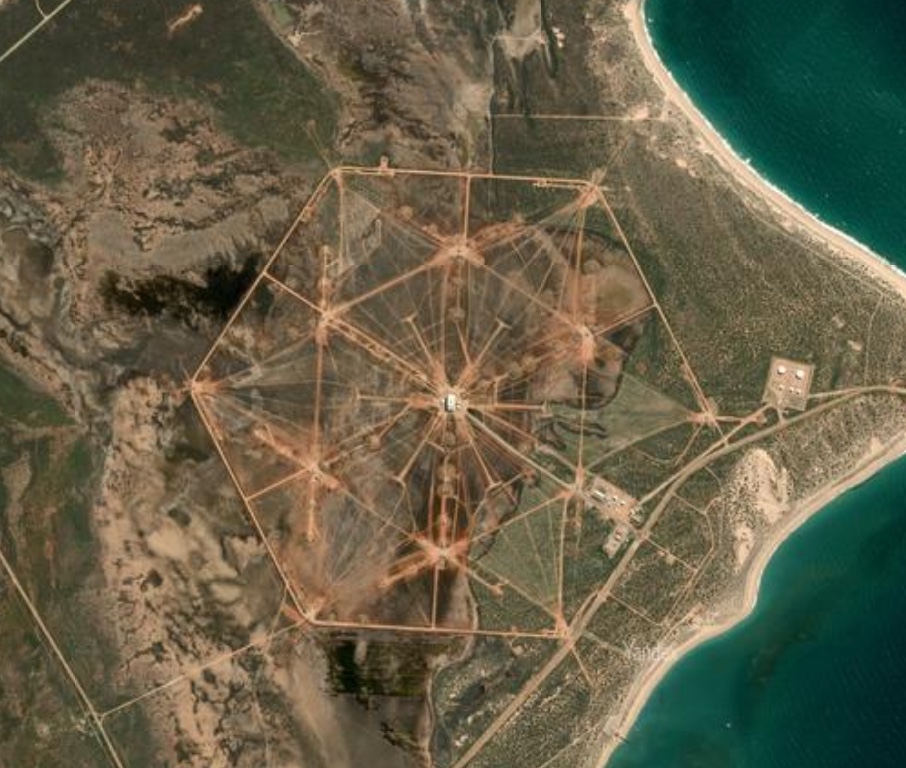
The physics of radio communication impose a hard constraint: most frequencies cannot penetrate seawater. Very low frequency signals — VLF, below 30 kilohertz — can. At 19.8 kilohertz, a transmitter powerful enough can send messages to submarines at depth, anywhere in the western Pacific and eastern Indian Ocean. That is what Naval Communication Station Harold E. Holt does, broadcasting at one megawatt — which makes it, by its own account, the most powerful transmission station in the Southern Hemisphere. The catch is that a standard antenna would need to be nearly four kilometers tall to work at that wavelength. The solution is Tower Zero, 387 meters high, surrounded by twelve additional towers between 303 and 358 meters tall, arranged in concentric hexagons. To the radio waves, this array looks like a single antenna two kilometers across.
A Base Born of Cold War Geometry
Australia's Minister for External Affairs Garfield Barwick negotiated the original lease for the base in 1963. The location was strategic: North West Cape sits at the edge of the Indian Ocean, within range of Soviet submarine activity in both oceanic basins. The United States needed a Southern Hemisphere VLF anchor to complete global coverage. Australia provided the territory; the US provided the technology and, initially, the personnel. What Australia did not receive was access to the cipher room, where communications with nuclear-armed submarines were encoded. The joint statement that formalized Australian co-operation in 1974 explicitly noted that the US gave no undertaking to relay fire orders to submarines bearing nuclear missiles. The partnership had limits.
Protests, Politics, and Transfer
The base became a focus of Australian sovereignty debates through the 1970s and beyond. In May 1974, several hundred people traveled to North West Cape from around the country to protest and symbolically occupy the facility. Political pressure gradually shifted the balance of control: a Royal Australian Navy officer took command in 1992, US Naval personnel withdrew in 1993, and by 1999 the station had formally become an Australian facility. In 2002, the Royal Australian Navy handed operation to the Defence Materiel Organisation. The 'US' prefix had been dropped from the name decades earlier. The station's strategic purpose, however, remained unchanged.
Space, Satellites, and a Flight Scare
The station's mission expanded in the 21st century. In 2013, it was announced that the Space Surveillance Telescope — part of the United States Space Surveillance Network — would relocate from White Sands Missile Range in New Mexico to Harold E. Holt. The telescope became operational at North West Cape in October 2022. A C-Band Space Surveillance Radar followed in the same year, operated remotely by No. 1 Space Surveillance Unit from RAAF Base Edinburgh in South Australia. The facility that began as a Cold War communication relay now watches space. Meanwhile, the towers generated their own controversy in 2008, when two Qantas flights experienced unusual malfunctions near Learmonth Airport. Investigators concluded the VLF transmissions were an extremely unlikely cause — but the speculation spread anyway, as it does when something this large and this secretive sits at the edge of the ordinary.
From the Air
Naval Communication Station Harold E. Holt is located at 21.82°S, 114.17°E, 6 km north of Exmouth on North West Cape, Western Australia. Tower Zero and the surrounding antenna array are among the most distinctive structures visible from the air in this part of Australia — thirteen towers between 300 and 387 meters tall, arrayed in hexagonal pattern. From cruising altitude they appear as a cluster of thin spires at the cape's northern tip. RAAF Learmonth Airport (YPLM) is approximately 40 km south.