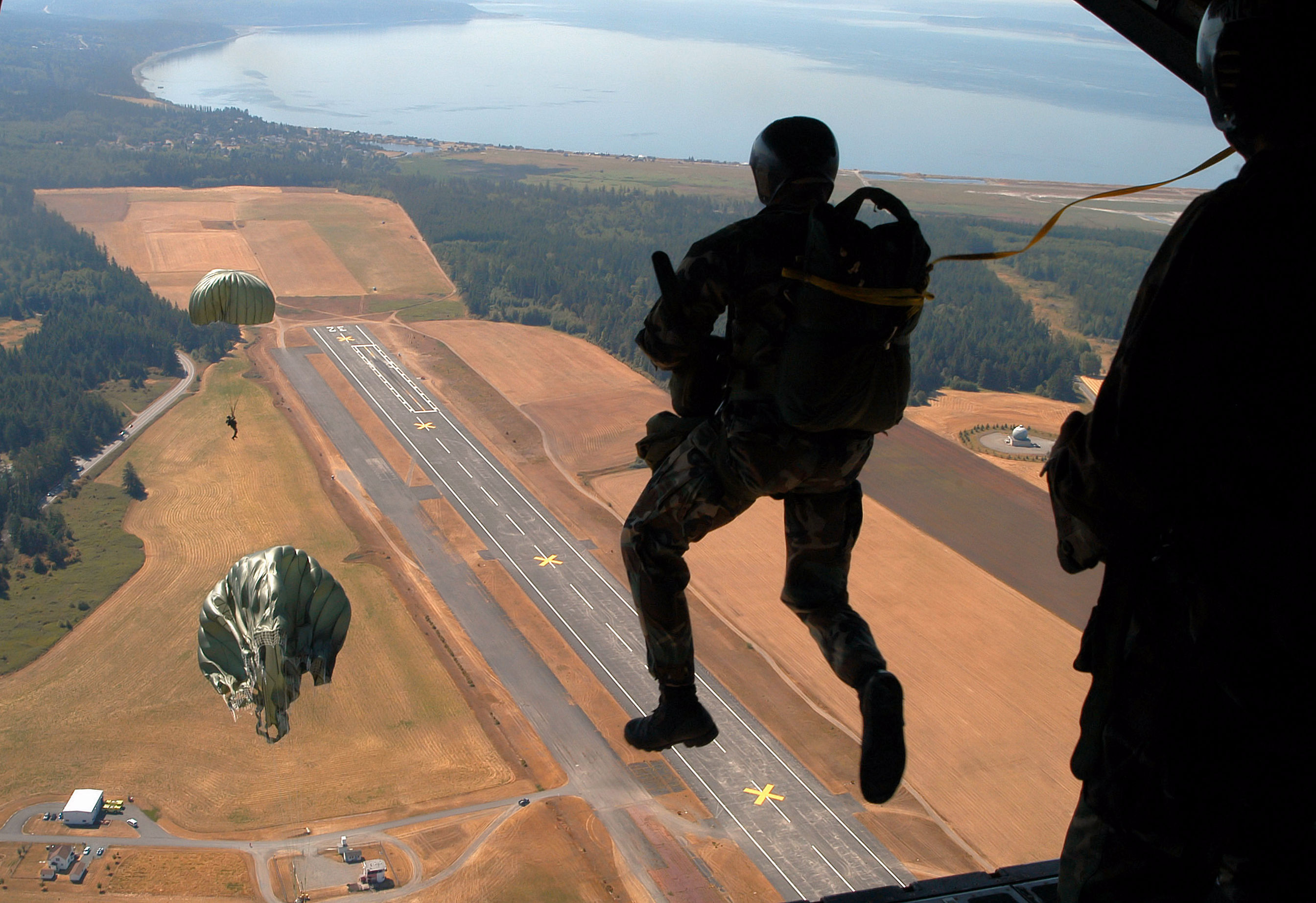
Naval Outlying Landing Field Coupeville
You hear NOLF Coupeville before you see it. The sound of an EA-18G Growler on final approach is not the distant hum of commercial aviation -- it is a physical force, a wall of noise that rattles windows and sends dogs under beds miles from the runway. The Navy commissioned this outlying landing field in 1943, a grass strip carved into the prairie two miles southeast of Coupeville on Whidbey Island. Eight decades later, it remains one of the most contentious pieces of military real estate in the Pacific Northwest, a place where national defense collides with historic preservation, endangered species, and the patience of everyone who lives within earshot.
Practicing for the Deck
The purpose of NOLF Coupeville is singular and specific: Field Carrier Landing Practice. Naval aviators and their crews fly patterns over the field, descend to the runway, touch down on a painted line that simulates an arrestor wire, then immediately throttle up and climb away to loop around for another pass. Each aircraft makes multiple touch-and-go landings per session. The technique replicates the experience of landing on an aircraft carrier -- the tight approach, the controlled crash onto the deck, the instant acceleration back to flying speed. The Navy considers OLF Coupeville ideal for this training because of its remote location and low ambient lighting, which approximate conditions at sea. Before the EA-18G Growler became the sole tailhook aircraft stationed at nearby NAS Whidbey Island, the field served the EA-6B Prowler, the A-6 Intruder, and the A-3 Skywarrior.
The Sound and the Fury
Jet noise has been an intermittent controversy since the field transitioned to higher-performance aircraft, but the arrival of the EA-18G Growler escalated the conflict dramatically. In July 2013, a local citizens' group filed a lawsuit demanding an Environmental Impact Study examining Growler operations at both NOLF Coupeville and NAS Whidbey Island. The Navy initiated the study in 2014, and the citizens' group paused its litigation to wait for the results. When the study was completed in March 2019, the findings pleased the Navy and alarmed the community: the EIS approved an increase from roughly 3,000 to 12,000 touch-and-go landings per year at OLF Coupeville, and a jump from 90 to 360 hours of annual aircraft activity. The decision quadrupled the field's authorized use.
Reserve Versus Runway
What makes the NOLF Coupeville dispute unusual is not the noise itself -- military communities across the country deal with jet noise -- but the location. The field sits within the boundaries of Ebey's Landing National Historical Reserve, the first such designation in the United States, a landscape of 19th-century farmsteads, pioneer cemeteries, and Victorian-era buildings that Congress chose to protect in 1978. The Citizens of Ebey's Reserve, one of the opposition groups, took its name directly from the reserve and filed suit in federal district court. The Washington State Attorney General's Office filed a separate action, arguing that the Navy's expanded operations violated the National Historic Preservation Act, the National Environmental Policy Act, and the Endangered Species Act. The legal battles placed the field at the intersection of military readiness, historic preservation, and ecological protection -- three federal priorities that rarely conflict so directly in such a small geographic area.
Eighty Years on the Prairie
NOLF Coupeville nearly touches State Route 20, the main road across Whidbey Island, and sits about ten miles south of NAS Whidbey Island, the Navy's primary installation in the area. Driving past on SR-20, the field is easy to miss when it is quiet -- a flat expanse of grass and asphalt on the edge of Ebey's Prairie. When the Growlers are flying, it is impossible to miss. The sound carries across Penn Cove, over the Victorian rooftops of Coupeville, and out into the farmland that has been cultivated continuously since the 1850s. The field has outlasted the Skywarrior, the Intruder, the Prowler, and multiple rounds of community opposition. Whether it will outlast the current wave of litigation remains an open question, but the Navy's commitment to carrier landing practice -- and its limited options for training sites with the right combination of isolation and proximity -- suggests that the thunder above Ebey's Prairie is not going away soon.
From the Air
Located at 48.18N, 122.63W, two miles southeast of Coupeville on Whidbey Island. The field is identifiable as a single runway oriented roughly north-south, adjacent to SR-20. CAUTION: Active military airfield -- check NOTAMs and local advisories. NOLF Coupeville is restricted to military use. NAS Whidbey Island (KNUW) is approximately 10 nm north. Growler operations may be in progress with intense jet traffic in the pattern. Recommended viewing from 3,000+ ft AGL and outside the published traffic pattern.