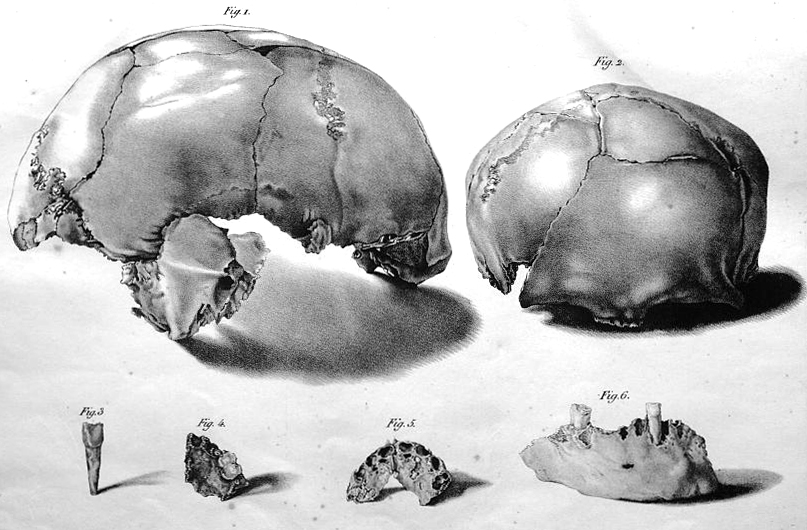
Neanderthal 1
He broke his left arm sometime in middle age, and it never healed right. The fracture sat near the elbow, badly aligned, and the muscle eventually wasted around it. He took a blow to the forehead, too - hard enough to leave a scar on the bone. His sinuses ached chronically. In old age, something deep in his skeleton began to eat him alive: a metastatic disease no one would name for forty thousand years. Then he died, and the limestone above the Dussel river closed over him, and the world he knew vanished, and his species vanished, and his bones waited.
August 1856
The quarrymen at the Kleine Feldhofer Grotte were not looking for him. They were looking for limestone - the Industrial Revolution wanted lime, and the Neander Valley had plenty. So they blasted the cave open, and inside the mud-clay floor they found what looked like animal bones. Most were tossed aside without ceremony. Only sixteen pieces survived the rubble: a skullcap with that low, sloping brow, both upper arm bones, ribs, a clavicle, half a pelvis, both thigh bones. Word reached Johann Carl Fuhlrott, a schoolteacher in Elberfeld who collected fossils on the side. He took one look and understood that something extraordinary had survived the workmen. A newspaper notice the following month speculated wildly: maybe a flat-headed American Indian, maybe one of Attila's Huns. Fuhlrott carried the bones to Bonn that winter in a satchel.
The Cossack Theory
What followed was a decade of magnificent wrong answers. The anatomist August Mayer, who would not actually see the bones until illness had passed, decided in absentia that the skeleton belonged to a Russian Cossack who had wandered into the cave during the wars against Napoleon. The bowed thigh bones came from a life on horseback. The brow ridges? Worry lines from chronic pain. Rudolf Virchow - the towering medical authority of the era, who opposed evolution for political reasons - largely backed him. Even Thomas Huxley, Darwin's bulldog, thought the skull fell within the normal range of modern humans. Only in 1864 did the Irish geologist William King quietly propose, in a footnote, that this was something else entirely: Homo neanderthalensis, a different kind of human. The British paleontologist George Busk, holding a near-identical skull from Gibraltar, observed dryly that even Mayer would struggle to argue "that a rickety Cossack of 1814 would have holed up in the clefts of the rock of Gibraltar."
The Person Inside
Modern pathology has read the bones the way a physician reads a chart. The Gottingen researcher Michael Schultz catalogued the injuries early this century. Neanderthal 1 was a man whose body kept a record of hardship. He had survived a fractured arm that left him partly disabled. He had survived a head wound and an internal bleed in a brain vessel. He had lived long enough to develop a metastatic bone disease that nothing in 40,000 BCE could treat. And here is the part that matters most: someone, almost certainly, helped him through it. Neanderthals across Europe cared for their injured. They buried their dead. They made tools, controlled fire, and ranged from Gibraltar to Siberia. He was not a brute. He was a person, and his species would be gone within a thousand years of his burial.
What Got Left Behind
In 1997, German researchers extracted mitochondrial DNA from his right humerus - the first Neanderthal genome fragment ever recovered. The Cell journal headline that year read "Neanderthals were not our ancestors," which turned out to be premature. The full genome, decoded in 2010, told a more intimate story: somewhere between 50,000 and 60,000 years ago, Neanderthals and the newly arrived Homo sapiens met, and met often enough that today most non-Africans carry a few percent of Neanderthal DNA. He is not your ancestor in the direct sense. But somewhere in your immune system, your hair, the architecture of your skin, there are letters of code that crossed forty millennia to find you.
Returning to the Cave
The Kleine Feldhofer Grotte itself was destroyed by the limestone quarrying that exposed it. For more than a century its exact location was lost. Then in 1997, archaeologists triangulated their way back through the blast rubble and found the original cave floor - and beneath it, more than twenty additional Neanderthal bone fragments, stone tools, and forty teeth. A piece of cheekbone fit precisely into Neanderthal 1's skull. A third humerus, more delicately built, belonged to a second individual - Neanderthal 2, dated to exactly the same period. They were not alone in that cave. The site is now an archaeological garden. The man whose bones started everything has, in a sense, finally been put back together.
From the Air
Located at 51.227 N, 6.944 E in the Neander Valley, 13 km east of Dusseldorf. Cruise altitude reveals the wooded ravine of the Dussel river cutting through limestone country between Mettmann and Erkrath. Nearest airport: Dusseldorf International (EDDL), 18 km northwest. Visibility is typically moderate in the Rhine-Ruhr industrial corridor; clear winter mornings give the best views of the valley's geography.