Neanderthal Museum
The building looks, from the outside, like a curled fingerprint pressed into the woods. Inside, the architects gave you no stairs and no elevators between the major exhibits - only a single spiral ramp that climbs through four floors of the building, and through three million years of human becoming. You start in the African savanna and walk uphill until you arrive in the modern city. The route is one continuous line, because evolution is one continuous line, and the museum trusts you to feel that in your legs.
A Competition in 1993
When the Land of North Rhine-Westphalia decided to build a museum at the site where the type specimen of Homo neanderthalensis had been found, they ran an open architectural competition. One hundred and thirty entries arrived, from Germany and abroad. The winning design came from three architects working together: Gunter Zamp Kelp, Julius Krauss, and Arno Brandlhuber. Their concept rejected the usual museum logic of discrete rooms and instead proposed a single helical pathway, an unbroken story told in concrete. The building opened on 10 October 1996. Within a year it had collected the Architekturpreis Beton and the BDA-Award Dusseldorf. In 1998 the European Museums Forum gave it a Special Commendation for European Museum of the Year. Roughly 170,000 visitors walk that spiral every year.
The Cast Collection
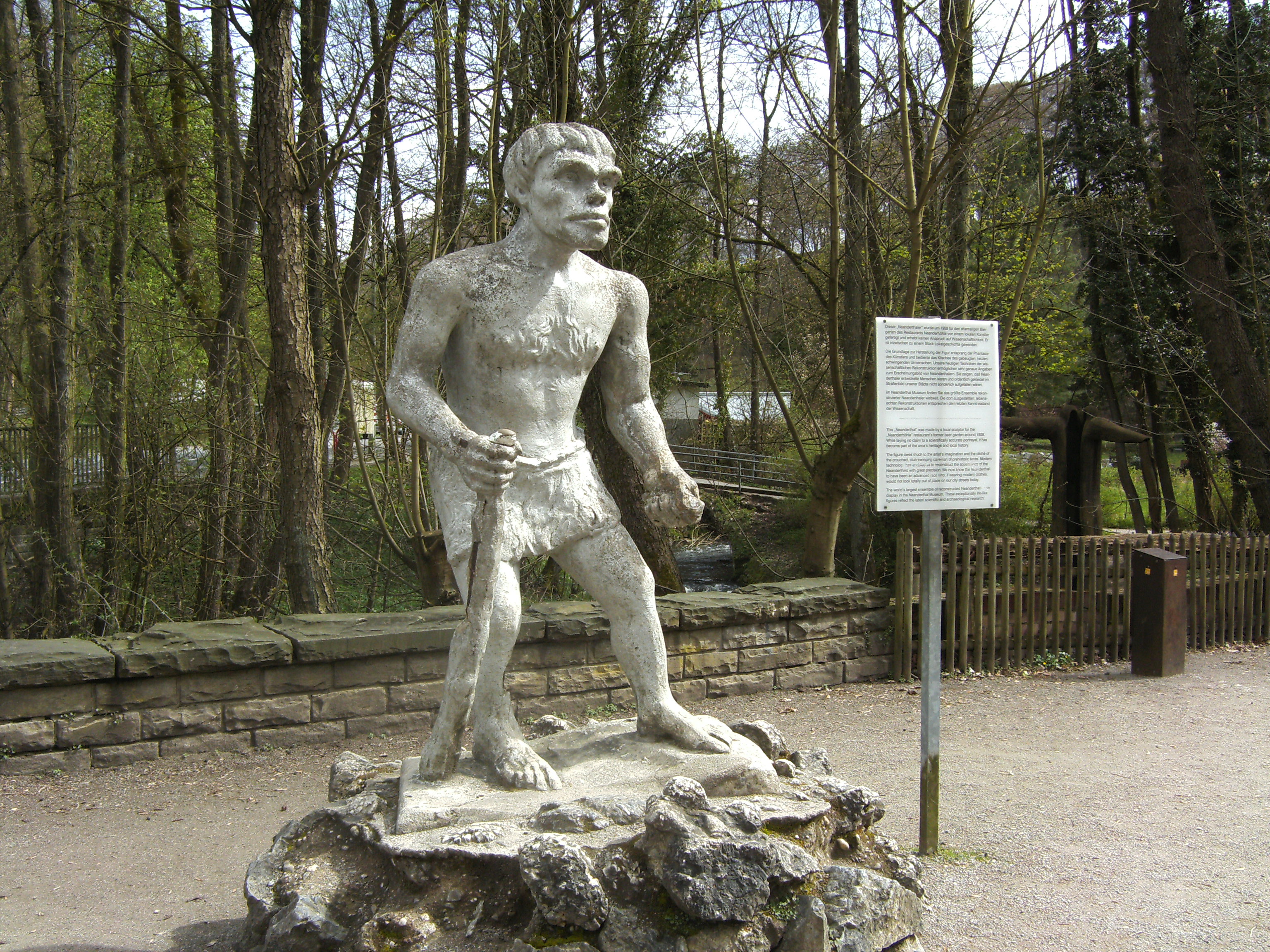
The museum cannot, of course, hold the actual fossils of Lucy or the Taung Child or Peking Man - those originals are held jealously by national museums in Ethiopia, South Africa, Beijing. What it can hold are casts, taken directly from the originals, and over the decades the Neanderthal Museum has built one of the most complete hominid cast collections in the world. The Krupp Foundation underwrote much of it. You can stand in front of a 3.2-million-year-old skull from Hadar, then turn around and meet a Cro-Magnon, then walk a few meters further and find yourself face to face with a life-size reconstruction of the local man himself, fleshed out and clothed and looking right at you. He looks, the museum's own materials note, less like a monster than a slightly more rugged version of the family next door.
Outside the Walls
The exhibits do not stop at the door. Walk out the back and you enter an archaeological garden where the original Kleine Feldhofer Grotte once was. The cave itself was destroyed by 19th-century limestone quarrying, but markers and reconstructions trace its outline. An art trail called Menschenspuren - Human Traces - winds through the trees, mixing sculpture with the Pleistocene landscape. In a fenced Ice Age game reserve nearby, you can see aurochs (the wild cattle of Caesar's Gallic wars) and Przewalski's wild horses - both species that would have been entirely familiar to a Neanderthal foraging this same valley. The museum also runs a Stone Age workshop where children knap flint, work leather, and lace sinew, learning the technologies that kept their species alive for two hundred millennia.
The Research Engine
Behind the visitor experience runs a serious research operation. The museum hosts the NESPOS Society - Pleistocene People and Places - which maintains the world's largest open database of Neanderthal scans and surface measurements, drawn from sites across Belgium, Croatia, France, and Germany. Hundreds of high-resolution 3D fossil scans are distributed free to researchers who could never afford to fly to every original. The foundation also funds excavations and hosts international conferences. A milk tooth from a Neanderthal child aged 11 to 14, recovered during the 1997-2000 re-excavations of the Feldhofer site, was stolen from the museum in 2004 - and then quietly returned shortly thereafter. No charges, no story. Whoever took it apparently could not live with what they had done.
Why Build It Here
There are larger natural history museums in Europe. There are museums with deeper budgets and flashier multimedia. But the Neanderthal Museum has something none of them can replicate: it stands within walking distance of the cave where the name was born. In 1856, no one alive understood what the bones from this valley meant. Schaaffhausen and Fuhlrott guessed, and were laughed at. King named the species in a footnote. Mayer thought it was a Cossack. The whole field of paleoanthropology had to invent itself to make sense of what the quarrymen had stumbled across. The museum sits at the exact point where modern humanity learned it had cousins.
From the Air
Located at 51.227 N, 6.951 E in Mettmann, North Rhine-Westphalia. The museum nestles in the wooded Neander Valley between Mettmann and Erkrath, with the archaeological garden marking the original cave site about 200 meters to the southwest. Nearest airport: Dusseldorf International (EDDL), 15 km northwest. From cruise altitude in clear weather, look for the dense forest belt along the Dussel river breaking up the suburban grid.