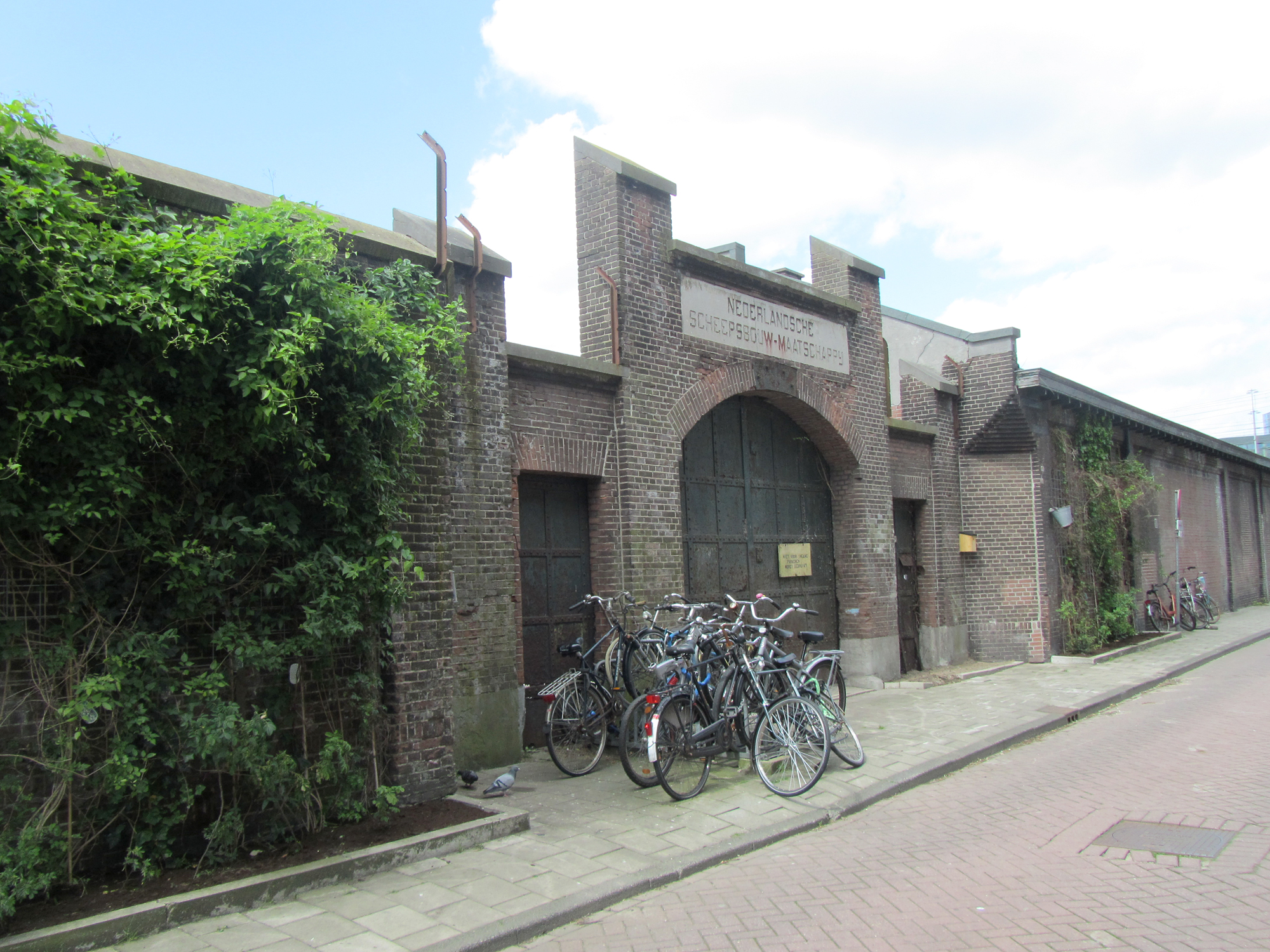
Nederlandsche Scheepsbouw Maatschappij
On 20 May 1915 the Nederlandsche Scheepsbouw Maatschappij sent a brand-new passenger liner down the slipway toward the river IJ, and the liner immediately got stuck. The Jan Pieterszoon Coen was 522 feet long and 60 feet wide. The exit from the Oosterdok, the small inner harbour where the NSM shipyard had been wedged for two decades, was not. To get the ship out, the shipyard had negotiated with the city to temporarily dismantle part of the Mariniersbrug. The ship still scraped through, damaging the bridge, and spent ninety minutes jammed in it. By the time the Coen finally cleared the railway bridge that night, the board of NSM had already made up its mind: this could not happen again. The shipyard had outgrown its own city.
Founded on a Closed Door
NSM came into being because Amsterdam had just lost its largest shipbuilder. In 1891 the Koninklijke Fabriek, which had built ships and locomotives in tandem for half a century, was restructured as Werkspoor and abandoned its shipbuilding business entirely. The men who had spent their working lives building ships there were suddenly without trade. In 1893 they approached Jacob Theodoor Cremer, a politician and businessman with stakes in colonial trade and the Stoomvaart Maatschappij Nederland, and persuaded him to bankroll a new yard. The contract was signed on 25 August 1894. Daniël Goedkoop Jr. became the first CEO, the supervisory board read like a roster of Amsterdam shipping money, and the first 500 shares of 1,000 guilders each were spread across an unusually large number of small investors, which the official histories take as a polite hint that nobody was certain the venture would survive.
A Different Theory of Shipbuilding
The founding plan was radical in a Dutch context. It rested on five principles drawn up by outside consultants. The shipyard would only build new ships, never repair them, because repair work disrupted the rhythm of continuous production. Workers would be paid by piece rate, not hour, because the old wooden-ship craftsmen who still dominated Amsterdam shipyards were too slow for steel production and largely too old to retrain. Younger men would be brought in and educated from scratch. The yard would chase foreign orders alongside Dutch ones rather than wait for domestic shipping lines. And critically, NSM would not build its own engines: it would buy them from Werkspoor next door, which freed it from the immense capital cost of a machine shop. None of these decisions matched the strategy of the Rotterdam yards Fijenoord and RDM, where ship repair and engine-building were core revenue streams. Either NSM had found a better way, or it was making a series of expensive mistakes.
The Workers, Counted
By 1908 NSM was the third-largest shipyard in the Netherlands. By 1909 it was the largest, measured in launched tonnage, and would stay there. In 1913 it launched five ships totalling 31,000 brt, tied with RDM in Rotterdam. The board's own explanation, given by Mr Goedkoop years later in 1933, was the scientific organisation of work, knowing how long each task should take so that the piece-rate system could function. There was a more disturbing detail buried in the same remark. In some categories, the skilled-labour share of the Dutch workforce was only 20 percent against 80 percent in some British yards. The Dutch were faster partly because they had broken complex tasks into smaller, simpler ones that could be done by less-skilled workers paid less per piece. This was Taylorism at sea, decades before the term was widely used in Europe. The men who built the ships were getting more productive and, by skill measure, less specialised at the same time.
Across the IJ
After the bridge-damaging exit of the Jan Pieterszoon Coen, NSM acquired a 50-year lease on 170,000 square metres on the north bank of the IJ, west of Zijkanaal I, with an option for another 25 years. The new shipyard opened on 6 October 1922. Its main workshop building stretched 140 metres under overhead cranes; one drill press could punch 32 holes at once with the steel sheet stepping automatically between cycles. Three concrete slipways 190 metres long ran in parallel, their lower ends below the waterline behind doors so a ship could be launched by simply flooding the slipway. It was easily the most modern shipyard in the Netherlands. It also opened straight into the worst Dutch shipbuilding crisis since the founding of the company. Freight rates had collapsed after the First World War; new orders had vanished. By January 1922 NSM had already laid off 400 men. The grand new yard sat largely idle for years, requiring 5 percent annual depreciation against profits that were not coming in.
Depression, War, and the Merger
NSM survived the Great Depression better than its rivals because, having no repair branch to fall back on, it had been forced to keep chasing foreign orders. It pivoted toward tankers, motor ships, and refrigerated cargo carriers. Three reefers built for the Norwegian line Westfal-Larsen in 1932 included MS Moldanger, which suffered a disastrous fire on the slipway and needed expensive partial rebuilding. The Netherlands stayed on the gold standard long after its competitors devalued, leaving NSM bidding for international orders at structural cost disadvantage; it kept losing money through 1935 and 1936. The Netherlands finally left the gold standard on 27 September 1936, and within months NSM went from 250 employees back to 1,500. The Second World War began for NSM with the cruiser Jacob van Heemskerck still in primer paint; she was hastily painted grey and sailed for England without a single trial run of her engines. In September 1944 the German occupiers tried to destroy the shipyard, and the workers tried to stop them. The damage was estimated after the war at 3.8 million guilders. By February 1946 NSM merged with the Nederlandsche Dok Maatschappij to form NDSM, the giant North-Holland shipbuilder whose name still echoes through Amsterdam today, attached to a wharf that hosts art studios and music festivals on what used to be the largest shipyard in the country.
From the Air
The old NSM site sits at 52.3987°N, 4.8952°E, on the north bank of the IJ across from central Amsterdam, in the area now generally referred to as the NDSM-werf in Amsterdam-Noord. From the air the location is easy to identify: the wide industrial frontage on the north side of the IJ, with the modern Eye Filmmuseum to the east on the south bank approximately where the Wilhelmina Drydock once was launched. Schiphol (EHAM) lies 12 km south-west. Useful navigation cues: the IJ itself running west-east, the cruise terminal on the south bank, and the cluster of preserved industrial cranes still standing on the former NDSM site. Best viewed at low altitude in daylight; the contrast between the old industrial north bank and the dense historic centre to the south is striking.