Negoro-ji: The Temple That Armed Its Monks with Muskets
The bullet holes are still there. Look closely at the massive wooden walls of the Daito pagoda at Negoro-ji, and you can see where matchlock rounds tore into the timber in 1585, when Toyotomi Hideyoshi's army swept through these mountains to destroy one of the most powerful religious institutions in Japan. The pagoda survived. Almost nothing else did. At its peak, Negoro-ji was not simply a temple -- it was a fortified city of warrior monks commanding an army of 10,000 soldiers armed with some of the first firearms ever used in Japanese warfare. That a Buddhist temple could rival the great Sengoku warlords in military and economic power speaks to a feudal Japan far stranger than its popular image of serene gardens and silent meditation.
A Reformer's Exile
Negoro-ji's origins lie in a religious dispute. In 1131, the Shingon Buddhist priest Kakuban rose to lead the sect's headquarters on Mount Koya and immediately began making enemies. He tried to reunite the Ono and Hirosawa branches of Shingon Buddhism. He attempted to assert Mount Koya's authority over the sect's powerful metropolitan base at To-ji in Kyoto. Most controversially, he introduced elements of Pure Land Buddhism into Shingon practice. The establishment pushed back hard. Kakuban resigned his posts in 1135 and retreated to the chapel of Mitsugon-in, but his opponents followed -- armed followers burned his residence to the ground in 1140. He fled south into the mountains of Kii Province, to an estate granted to him by ex-Emperor Toba in 1132. He called it Ichijo-zan Daidenpon Negoro-ji. Kakuban died there in 1143, but his legacy was only beginning. In 1288, his disciple Raiyu moved key chapels from Mount Koya to Negoro-ji and declared the independence of a new school: the Shingi Shingon.
A City of Warrior Monks
By the late Muromachi period, Negoro-ji had grown into something unprecedented: a religious city sprawling across the mountainside, with 450 temples and chapels -- some accounts claim 2,700. The temple controlled estates with a kokudaka of 720,000 koku, a measure of rice-producing wealth that placed it on par with the mightiest feudal lords of the era. More striking still was its army. The Negoro-shu, as its warrior monks were known, numbered approximately 10,000 soldiers, many armed with matchlock rifles recently introduced to Japan via Portuguese traders. These were among the first organized military units in the country to adopt firearms on a large scale. The temple allied strategically with the era's most powerful figures, assisting Oda Nobunaga during the Ishiyama Hongan-ji War from 1570 to 1580 and supporting Tokugawa Ieyasu at the Battle of Komaki and Nagakute in 1584.
Hideyoshi's Fire
The alliance that saved Negoro-ji could not last. The temple's military power made it a threat to anyone seeking to unify Japan, and when Toyotomi Hideyoshi launched his invasion of Kii Province in 1585, Negoro-ji was a primary target. The Siege of Negoro-ji ended in catastrophe -- nearly the entire temple complex was burned to the ground. The circumstances remain disputed centuries later: whether the fire came on Hideyoshi's direct orders, was set by desperate defenders, or spread through the chaos of battle has never been definitively settled. The temple surrendered without resistance, which makes its total destruction all the more troubling. The main surviving hall, the Daidenho-do, was dismantled and carted off to Kyoto, intended for Tensho-ji, a memorial temple Hideyoshi planned as a mausoleum for Oda Nobunaga. Tensho-ji was never built, and the hall simply vanished from history.
What the Fire Could Not Touch
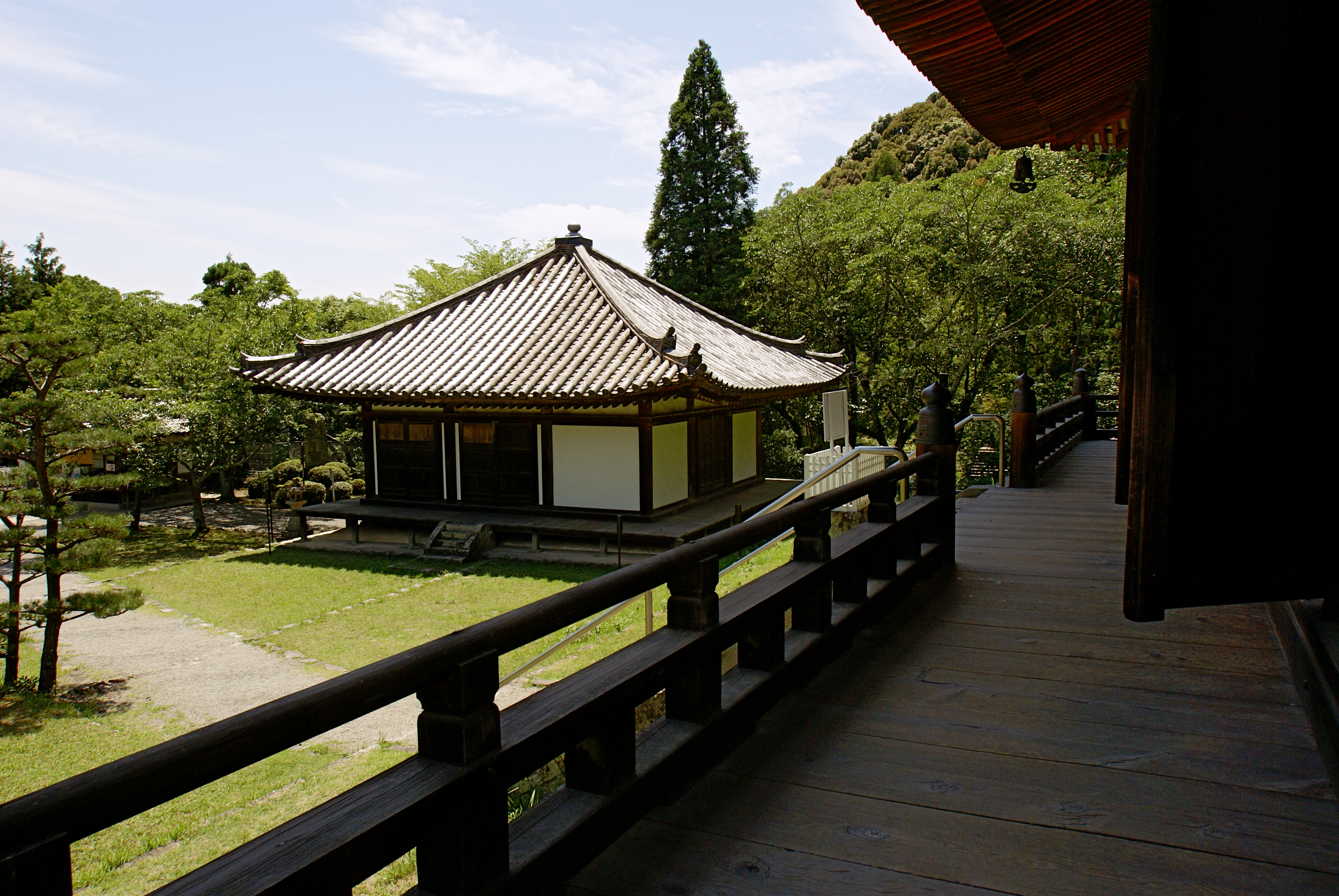
The Daito pagoda endured. Standing 40 meters tall and 15 meters wide, it is the largest Tahoto-style pagoda in Japan -- a National Treasure since 1899. Construction began around 1480 and was completed around 1547, just decades before Hideyoshi's assault. Inside, a statue of Vairocana Buddha sits within a circle of twelve pillars. The Daishi-do, a three-by-three bay hall built around 1391, also survived. Its principal image, a statue of Kobo Daishi -- the founder of Shingon Buddhism -- bears an inscription that dates its creation. Both structures were designated Important Cultural Properties. The Daidenho-do visitors see today was rebuilt in 1824 by local carpenters with assistance from Osaka and Echigo craftsmen. Inside stand three towering statues completed between 1387 and 1405: a 3.5-meter seated Dainichi Nyorai flanked by a 3.43-meter Kongosatta and a 3.3-meter Sonsho Butcho -- a grouping so unusual, and statues of Sonsho Butcho so rare in Japan, that the ensemble was designated an Important Cultural Property in 1994.
Iron Rounds and Irony
After the destruction of the Toyotomi clan following the Siege of Osaka in 1615, Tokugawa Ieyasu -- who had once been Negoro-ji's ally -- donated the buildings of Shoun-ji to help the temple rebuild. Shoun-ji had been built by Hideyoshi himself to mourn his infant son Tsurumatsu. The irony is thick: a temple destroyed by Hideyoshi was reconstructed using a temple that Hideyoshi built for his dead child. During the Edo period, the Kishu Tokugawa clan patronized Negoro-ji, and rebuilding continued for centuries. Archaeological excavations beginning in 1976 have unearthed pottery, lacquerware, Buddhist implements, and weapons across the grounds. The temple was designated a National Historic Site and a National Place of Scenic Beauty in 2007. Today Negoro-ji sits quietly in the Katsuragi Mountains outside Iwade, surrounded by encroaching suburban development -- a temple that once fielded an army of 10,000, now guarding its bullet-scarred pagoda against the slow advance of apartment blocks.
From the Air
Located at 34.29N, 135.32E in the Katsuragi Mountains near Iwade, Wakayama Prefecture. The temple complex sits in a forested mountain valley, with the 40-meter Daito pagoda visible as a landmark among the trees. Nearest major airport is RJBB (Kansai International Airport) approximately 20 km southwest. RJOO (Osaka/Itami) lies about 55 km to the north. Best viewed at 2,000-3,000 feet AGL from the west, where the pagoda and temple rooflines contrast with the surrounding mountain forest. The Katsuragi mountain range runs along the border of Osaka and Wakayama prefectures.