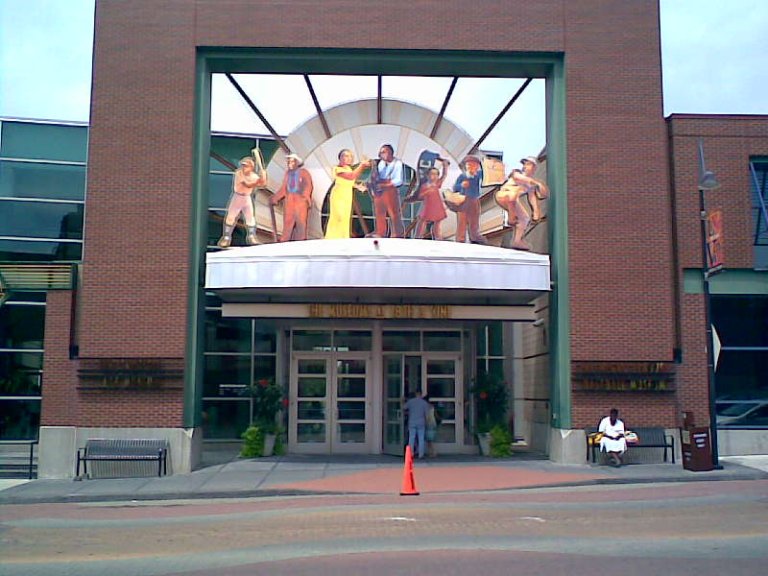
Negro Leagues Baseball Museum
Walk onto the Field of Legends and Satchel Paige is still on the mound. Josh Gibson crouches behind the plate. Cool Papa Bell ranges center field. They are bronze now, twelve nearly life-sized statues frozen in position on a baseball diamond at the heart of the Negro Leagues Baseball Museum in Kansas City, Missouri. The field is separated from visitors by chicken wire at the museum's entrance and accessible only after completing the full chronological tour -- a deliberate design choice that makes you earn your way to the legends. Founded in 1990 in the historic 18th & Vine District, the hub of African-American cultural activity in Kansas City during the first half of the twentieth century, the NLBM shares its building with the American Jazz Museum. The pairing is apt. Both institutions preserve art forms that thrived in this neighborhood when mainstream America was not paying attention.
Born from Memory
The museum was founded by a group that included former Kansas City Monarchs outfielder Alfred 'Slick' Surratt, legendary first baseman and manager Buck O'Neil, researcher Larry Lester, historian Phil S. Dixon, and community leader Horace Peterson. It started in a single-room office inside the Lincoln Building at 18th and Vine, the intersection that once anchored Kansas City's black entertainment district. By 1994, the museum had expanded into a larger dedicated space. The early years were lean. By 2008, the NLBM was on the verge of financial collapse. Bob Kendrick took over as president in 2011 and led a turnaround rooted in community engagement. By 2012, the museum posted a profit of $300,000 -- its strongest year since 2007. In 2019, the American Business Awards recognized it as Nonprofit Organization of the Year.
The Field of Legends
The museum's centerpiece is an indoor baseball diamond adorned with bronze statues of twelve giants of the Negro leagues. Gibson, 'the Black Babe Ruth,' who allegedly hit over 80 home runs in a single season, crouches behind the plate. Buck Leonard, his teammate on the Homestead Grays, stands at first. John Henry Lloyd takes second, Judy Johnson mans shortstop, and Ray Dandridge holds third. The outfield belongs to Cool Papa Bell, Oscar Charleston, and Leon Day. At the plate is Martin Dihigo, the only player inducted into the Halls of Fame of three countries: Mexico, Cuba, and the United States. The statues also honor Rube Foster, who founded the first Negro National League in 1920, and Buck O'Neil, the former Kansas City Monarch who served on the museum's board until his death on October 6, 2006. O'Neil's Presidential Medal of Freedom, awarded posthumously by President George W. Bush, is now displayed in a special area dedicated to his memory.
From the Monarchs to Jackie Robinson
The museum chronologically traces the Negro leagues from the founding of the Negro National League in 1920 through the Negro American League's final season in 1962. The walls are lined with photographs of players, owners, and officials. Game-worn uniforms, cleats, and gloves sit in lockers dedicated to the sport's greatest figures. The Kansas City Monarchs loom large in the story -- not only as one of the most successful franchises but as the team where Jackie Robinson played before breaking Major League Baseball's color barrier in 1947 with the Brooklyn Dodgers. In 2013, an advance screening of the film 42, the Robinson biographical movie, was held in Kansas City as a benefit for the museum. Harrison Ford, who portrayed Monarchs scout and Dodgers general manager Branch Rickey in the film, participated in the fundraiser.
Geddy Lee's Baseballs and the Living Legacy
On June 5, 2008, Rush bassist and vocalist Geddy Lee donated nearly 200 autographed baseballs to the museum -- one of the largest single donations the NLBM had ever received. The signatures include Hank Aaron, Cool Papa Bell, and Lionel Hampton. The gift was a reflection of the museum's reach beyond traditional baseball circles. Each year, the NLBM presents legacy awards named for Negro league greats: the Oscar Charleston Legacy Award for most valuable players, the Satchel Paige and Bullet Rogan Legacy Awards for pitchers, the Larry Doby Legacy Award for rookies, and the Jackie Robinson Lifetime Achievement Award for career excellence in the face of adversity. These awards tie the museum's mission directly to the present, honoring current Major League players while keeping alive the names and stories of those who played in baseball's shadow for four decades. The 18th & Vine District buzzes with that same spirit today -- jazz clubs, barbecue joints, and a museum that insists you remember the men who played the game when nobody was watching.
From the Air
Located at 39.0914°N, 94.5627°W in the 18th & Vine District of Kansas City, Missouri. The museum is in the urban core east of downtown, near the junction of 18th Street and Vine Street. Kansas City International (KMCI) is approximately 20 miles northwest. Charles B. Wheeler Downtown Airport (KMKC) is about 5 miles north along the Missouri River. The 18th & Vine District is recognizable from lower altitudes by its position relative to downtown Kansas City's skyline and the distinctive street grid. Best viewed from 3,000-5,000 feet in combination with nearby landmarks like Union Station and the Liberty Memorial to the west.