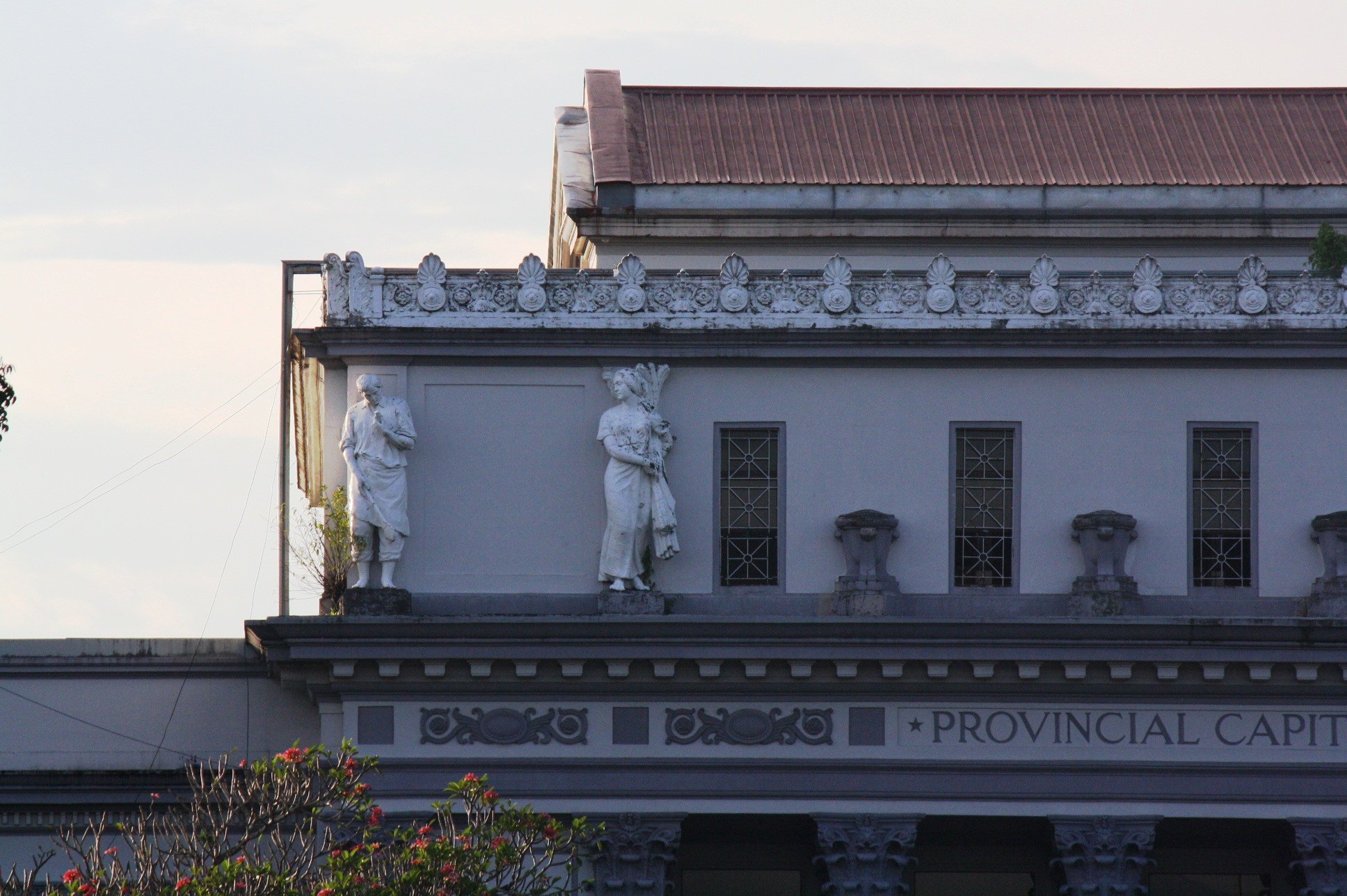
Negros Occidental Provincial Capitol
The Gonzaga family refused to sell. The land that Governor Jose Locsin wanted for his new provincial capitol in 1926 was partly swamp, its grass used to feed the horses that pulled the calesas through Bacolod's streets. When the province offered 1,200 pesos per hectare, the Gonzaga heirs -- Jose, Gertrudes, Adela, Aurelia, Mamerta, Juan, Francisco, and Vilardo -- held firm, represented by lawyer Manuel Fernandez Yanson. The province filed for expropriation. The courts intervened. Eventually, the heirs gave in, and the Bureau of Public Works began construction before the end of 1927 on a building that would become the architectural centerpiece of the Philippines' wealthiest province.
Burnham's Shadow, Arellano's Hand
The capitol's architectural lineage runs through the most influential names in Philippine civic design. When William Cameron Forbes served as governor general in 1904, he invited American urban planner Daniel Burnham to the Philippines. Burnham recommended William E. Parsons as consulting architect to the government. Parsons arrived in 1905 and established the architectural office of the Bureau of Public Works, staffing it with both American and Filipino architects, including Juan Nakpil, Tomas Mapua, and Juan de Guzman Arellano. It was Arellano who executed the Negros Occidental Provincial Capitol using Burnham's Beaux-Arts principles: an E-shaped floor plan with a grand central entrance flanked by symmetrical wings, wide ceremonial steps ascending to three-story-high colonnades topped with Corinthian capitals. The building was designed to project authority and permanence, a statement that the wealthiest sugar province in the Philippines deserved a seat of government to match.
A Troubled Construction
Building the capitol proved as contentious as acquiring its land. The Bureau of Public Works authorized construction on June 2, 1927, with the Provincial Board setting aside a budget of 255,000 pesos. But the contractor, Manuel Concepcion, failed to satisfy the government with his pace of work. Officials confiscated his bond and took over the project themselves. The structure was finally completed on October 23, 1933, but was not formally accepted until January 11, 1935, during the term of Governor Emilio Gaston. That same year, the courts ordered the government to compensate three additional Gonzaga heirs -- Magdalena, Carmen, and Vicente -- whose lands had been covered by the construction but who had been left out of the original expropriation proceedings. They received 1,552.40 pesos plus six percent interest, a belated acknowledgment that the province had built on ground it had not fully paid for.
Occupation in Name Only
During World War II, the capitol's formal governance continued through two governors who operated largely in name only. Governor Antonio Lizares maintained his office in Talisay, his hometown, before health problems forced him to step down. Governor Vicente Gustilo, based in Cadiz, succeeded him and served until the war's end. But real power over Negros Occidental lay with the Japanese military, who administered the province from seized mansions on Burgos Street. The capitol building survived the war intact, its Beaux-Arts colonnades enduring a conflict that destroyed much of the surrounding infrastructure. On July 19, 2004, the National Historical Commission of the Philippines declared the building a National Historical Landmark under Resolution No. 9.
Tolentino's Sculptures and the Lagoon
The capitol is not merely an administrative building. Its grounds form a civic complex that includes the Capitol Park and Lagoon, a public green space where carabao sculptures by National Artist Guillermo Tolentino anchor the northern and southern ends of the water. Tolentino, best known for creating the Bonifacio Monument in Manila, contributed works that are displayed both inside the capitol building and around the lagoon. The complex also houses the Negros Museum, situated in the former Provincial Agriculture Building, and the broader Capitol Central commercial and civic district that has grown around it. Walking through the wide steps and beneath the Corinthian colonnades of Arellano's design, you are walking through a vision of what Philippine civic architecture could be when a province had the wealth and the will to build something that would outlast the sugar boom that paid for it.
From the Air
Located at 10.676°N, 122.951°E in central Bacolod, Negros Island. The E-shaped Beaux-Arts capitol building is a prominent landmark visible from the air, fronted by the Capitol Park and Lagoon. The civic complex is surrounded by the urban core of Bacolod. Nearest airport is Bacolod-Silay International Airport (RPVB), approximately 15 km northeast. Best viewed at 2,000-3,000 ft AGL. The Guimaras Strait is visible to the west, with sugarcane fields extending east toward the Negros highlands.