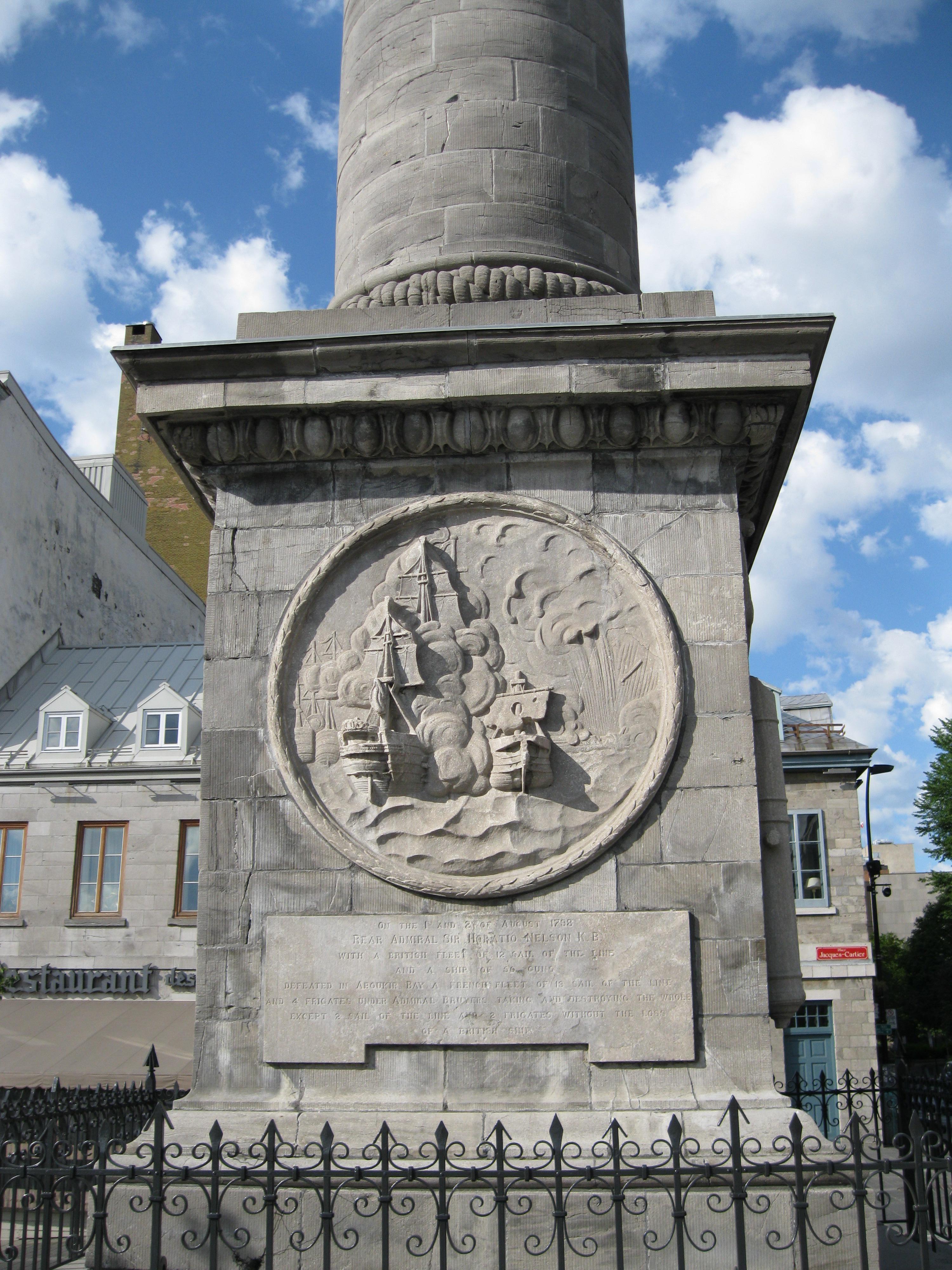
Nelson's Column (Montreal)
The news arrived on a snowy New Year's Eve. It was December 31, 1805, and since the Saint Lawrence River was frozen shut, the dispatch had traveled overland from New York City. Samuel Gerrard was hosting a ball when a messenger interrupted with word that Admiral Horatio Nelson had been killed at the Battle of Trafalgar. Gerrard abandoned his guests, hurried to the Exchange Coffee House, and publicly proposed that Montreal raise a monument to the fallen hero. Subscribers pledged funds on the spot. A list was left open at the Old Court House, and within weeks the names of both British and French Montrealers filled its pages. Four years later, in August 1809, a grey limestone column topped with a statue carved from Coade stone rose in what was then called New Market Place. It predates London's famous Nelson's Column by more than 30 years. It is the oldest monument in Montreal and the oldest war monument in Canada.
A Triumph of Virtue
The fundraising committee that formed in January 1806 bridged Montreal's two founding cultures. John Richardson, Louis Chaboillez, John Forsyth, Sir James Monk, and Sir John Johnson coordinated with allies in London, including Sir Alexander Mackenzie. The subscription list reads like a directory of early Montreal power: fur trader William McGillivray, university founder James McGill, military figure Jacques-Philippe Saveuse de Beaujeu, and members of the Panet and Beaubien families. Most striking were the Sulpicians -- the Catholic religious order that had shaped the city since its founding -- who contributed alongside their Protestant neighbors. Like many French Canadians of the era, the Sulpicians viewed Napoleon with deep suspicion. They regarded the destruction of his navy at Trafalgar not as a British triumph but as, in their words, "a triumph of virtue." The monument's funding was, from the beginning, a shared civic act rather than a colonial imposition.
Coade Stone and Cannon Chain
The committee contracted the London firm of Coade and Sealy to design and fabricate a monument built to survive any weather. The column itself was cut from grey compact limestone. The statue of Nelson and the ornamental reliefs were made from Coade stone -- a ceramic material invented by the firm that could be molded into fine detail yet resist frost, rain, and salt air for centuries. The pieces were shipped to Montreal in April 1808. William Gilmore, a local stonemason who had personally contributed seven pounds to the project, was hired to assemble the seventeen parts. The foundation base was laid on August 17, 1809. General Sir Gordon Drummond supplied eight pieces of cannon to anchor the iron chain that originally encircled the base. The total cost came to just under 1,300 pounds: 523 for masonry, 468 for ornaments, 58 for design and plans, and 66 for iron railings. The column was erected on land that had once belonged to the formal gardens of the Chateau Vaudreuil, built in 1723 for the governor of New France and destroyed by fire in 1803. The square was renamed Place Jacques-Cartier in 1847.
The Column That Would Not Move
Not everyone celebrated. For some French Canadians, the monument became a symbol of British dominance over Quebec. In 1890, a group of Quebec nationalists plotted to blow up the column. The plot failed. In 1930, French-Canadian Montrealers responded with a different tactic: they erected a statue of Jean Vauquelin, a French Navy officer, in a nearby square that was subsequently named after him. The two monuments have stood within sight of each other ever since, a silent conversation between competing national memories. In 1997, the Montreal City Council proposed relocating the column to a district inhabited predominantly by English-speaking Quebecers. Local opposition stopped the move. The original Horatio Nelson statue was removed from the column that same year -- not for political reasons, but for preservation. It now resides in the Montreal History Museum, replaced by a replica atop the pillar.
Duty Performed
In October 1900, a rededication ceremony after the column's restoration brought together speakers from several of Montreal's communities. Louis Francois Georges Baby, descended from an old French-Canadian family, reminded the audience that both British and French citizens had raised the monument together. Henri Cesaire Saint-Pierre went further, claiming that the original idea had actually been French-Canadian -- a creative reinterpretation of Samuel Gerrard's Anglo-Irish origins. Saint-Pierre declared that the monument stood as a lesson for "duty performed," irrespective of nationality. Judge Curran spoke for the Irish community; Lord Strathcona represented the Scots. The rededication captured something essential about the column's survival: it endures not because one group claimed it, but because no single group ever fully could. Today the column stands in Place Jacques-Cartier, surrounded by the cobblestones and tourist cafes of Old Montreal. It has outlasted the Dublin pillar it once raced to completion -- Dublin's Nelson's Pillar, also funded by public subscription, was destroyed by Irish republican extremists in 1966. Montreal's column, contested and celebrated in equal measure, still stands.
From the Air
Nelson's Column stands at 45.51N, 73.55W in Place Jacques-Cartier in Old Montreal, near the waterfront. The column itself is too small to spot from high altitude, but Place Jacques-Cartier is identifiable as a wide, sloping cobblestone square running from Notre-Dame Street down to the Old Port. The distinctive dome of Bonsecours Market is immediately east. Montreal/Pierre Elliott Trudeau International Airport (CYUL) is 11 nm west. Montreal/Saint-Hubert Airport (CYHU) is 9 nm southeast. Best viewed at low altitude (1,500-2,000 feet AGL) when circling Old Montreal, with the Jacques Cartier Bridge and Habitat 67 as reference points.