NEMO Science Museum
Coming into Amsterdam Centraal by train, look out the right window as you cross the IJ harbor and you will see what looks like a ship surfacing. The hull is green copper, the prow tilts upward at a defiant angle, and the whole vessel appears to be climbing out of the water and stopping just short of taking off. This is NEMO, the Netherlands' largest science center, and what you see is not a metaphor — it is literally sitting on top of the IJ-tunnel that carries the highway under the harbor. Renzo Piano designed the building to follow the curve of the tunnel beneath it, which is why the prow rises. He could have made it disappear into the waterfront. Instead he made it the most photographed building in eastern Amsterdam.
The Ship on the Tunnel
Piano's brief was unusual. The IJ-tunnel was already there, a road tube descending into the harbor floor between Oosterdok and Kattenburg. The building had to sit on top of it without adding weight that could compromise the tunnel's structure. Piano's solution was to use the tunnel's own curve as the building's footprint, then ramp the roof upward over the highest part of the tunnel arch to make the rising-ship form. The patinated copper cladding gives the building a deep oxide green that ties it visually to the water around it. NEMO opened in 1997 under a different name — newMetropolis — and became Science Center NEMO in 2000 before being rebranded as NEMO Science Museum in 2016. Each renaming pulled the institution closer to what visitors had been calling it the whole time.
A Quiet 1923 Origin
The museum is younger than its building suggests, and older than its name suggests. The collection traces back to 1923, when the artist Herman Heijenbrock opened the Museum van den Arbeid — Museum of Labor — on the Rozengracht. Heijenbrock had spent his career painting industrial workers, smoke-blackened factories, glowing forges. He believed labor and industry deserved museum treatment. The institution went through several reinventions in the twentieth century — renamed NINT (Nederlands Instituut voor Nijverheid en Techniek) in 1954, then newMetropolis when it moved into Piano's building in 1997 — but the through-line is unmistakable: a museum that has spent a century trying to explain how things are made and how they work.
Inside the Hull
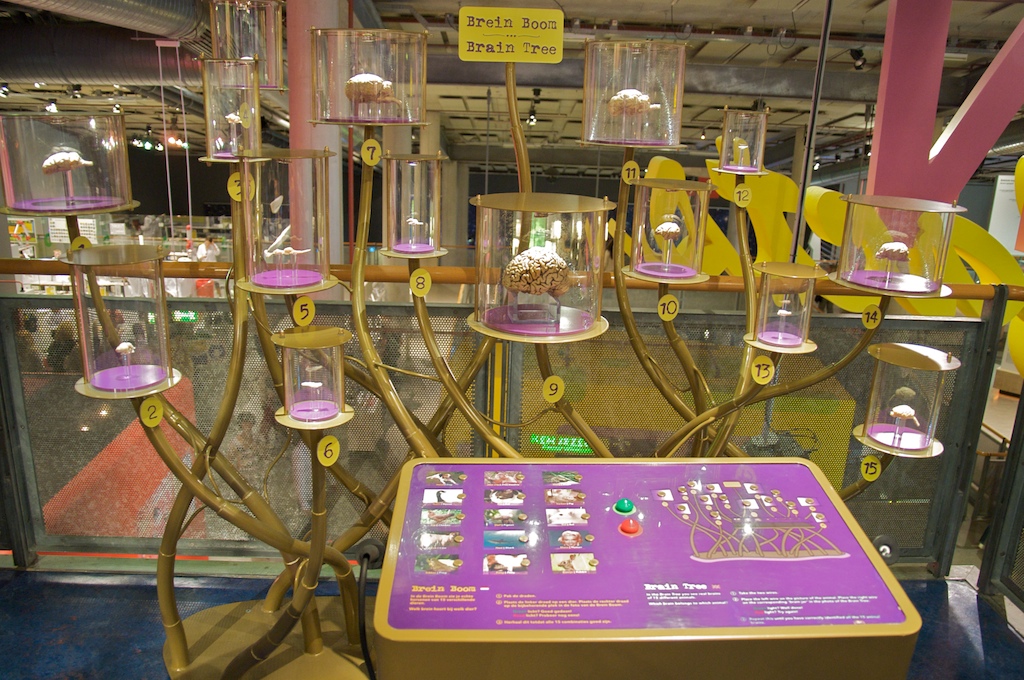
The interior gives you five floors, each loose enough that children can run between exhibits without breaking anything. The first floor is built around DNA and chain reactions: a room of giant dominoes wired into contraptions, including a giant bell and a flying car, and a half-hourly show that fires off the largest Rube Goldberg circuit in the museum. The second floor is the ball factory — small plastic balls travel along conveyor belts where visitors sort them by weight, size, and color, then barcode them and send them back. There are also displays on the water cycle, on electricity, on metals and buildings. The third floor is a laboratory where visitors can do real experiments: testing vitamin C, looking at DNA under microscopes. The fourth floor turns dark and quieter, devoted to the human mind, with memory tests, illusions, and sense-trickery.
The Roof
Take the steps that climb the building's tilted spine and you reach the upper deck. The view is the prize. The terrace looks out across Amsterdam Centraal Station, the canal ring, the bell towers of the Westerkerk and Zuiderkerk, the Rijksmuseum to the south, and the modern apartment towers along the IJ to the north. There is a cafeteria and a children's play area, but most visitors are there for the panorama. Crucially, you do not have to buy a museum ticket to climb to the roof — the terrace is free in summer and counts as one of the highest publicly accessible viewpoints in central Amsterdam. Locals use it as a sunset spot, sometimes treating it more like a city park than a museum extension. From up there, the building's shape makes sense: you are standing on the deck of a green copper ship moored to a tunnel.
Numbers and Neighbors
NEMO draws around 728,000 visitors a year, making it the seventh-most-visited museum in the Netherlands and the most-visited science museum in the country. The neighborhood around it has changed completely in the years since the building opened: the Oosterdokseiland, once a working dock, is now lined with the new Public Library Amsterdam, the Conservatorium van Amsterdam music school, and a cluster of glass-fronted offices. NEMO arrived first. Renzo Piano's prow looking out over the IJ helped establish that this stretch of harbor was somewhere people were willing to come — and now they come for the library, the conservatory, the ferry across to Amsterdam Noord, and the view from the science museum's roof.
From the Air
Located at 52.3741 N, 4.9124 E on the Oosterdokseiland, immediately east of Amsterdam Centraal Station. Nearest airport: Amsterdam Schiphol (EHAM/AMS), 15 km southwest. NEMO's distinctive tilted green copper roof is one of the easiest visual landmarks in central Amsterdam from any approach altitude; it sits directly above the IJ-tunnel entrance and points its prow toward Centraal Station's central platforms.