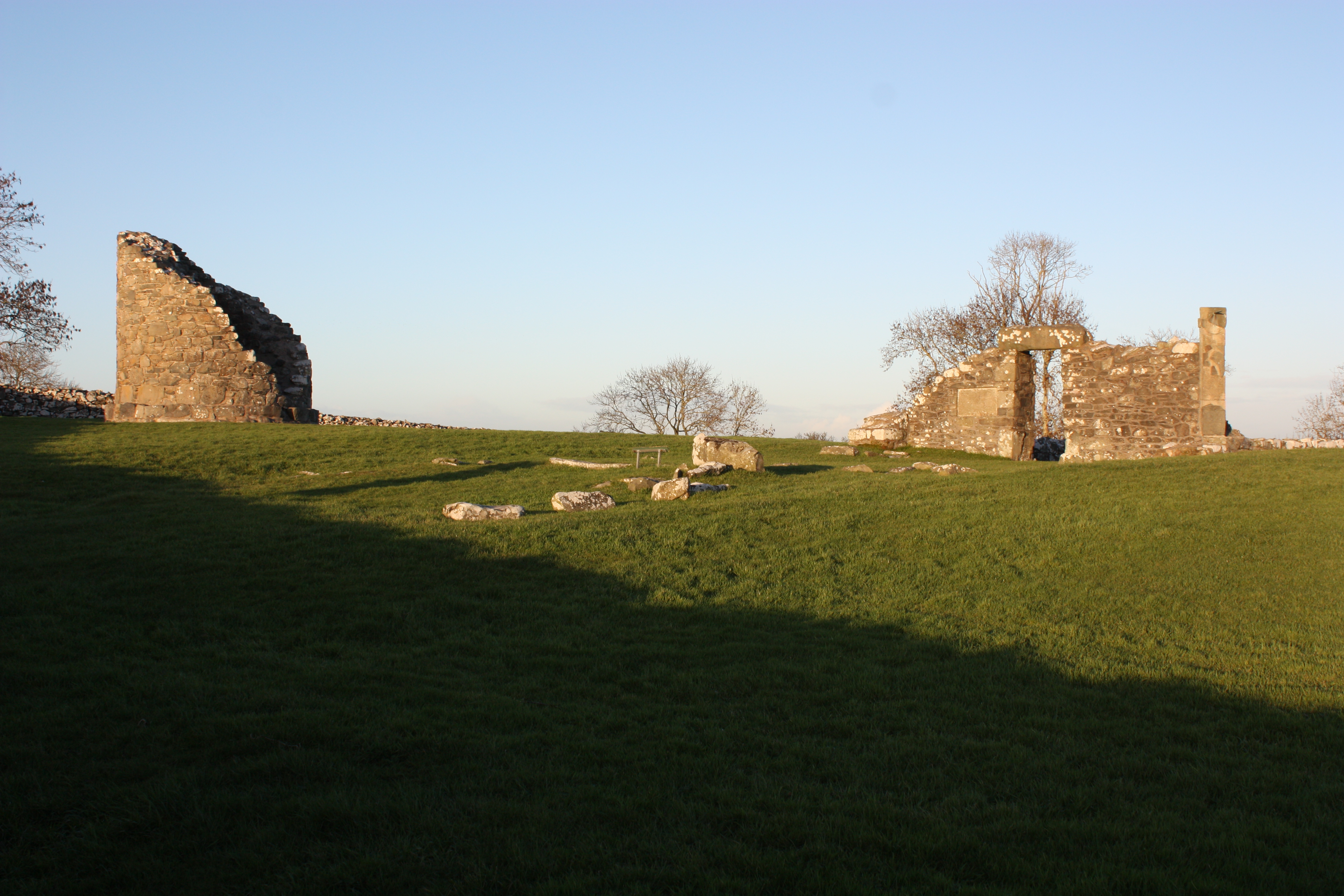
Nendrum Monastery
The tide mill's oak timbers have been dated to the year 619 AD, making it the oldest excavated tide mill anywhere in the world. That a community of monks on a small island in Strangford Lough could engineer something so sophisticated fourteen centuries ago says everything about Nendrum. This was not a remote hermitage clinging to survival. It was a thriving centre of learning, industry, and faith, with orchards, gardens, pastures, arable fields, and a guest house for travellers. The monastery's Irish name, Naondroim, belongs to a place that once mattered enormously and then, over the course of a single violent night, fell silent.
Mochaoi's Island
Tradition says the monastery was founded in the fifth century by Mochaoi, a saint whose proper name was Caolan -- Mo Chaoi being an affectionate pet name, as was common with Irish saints. According to tradition, Saint Patrick himself appointed Mochaoi. Several annals record his death between 490 and 497. The island that bears his name, Mahee Island, sits within Strangford Lough, a body of water designated an Area of Outstanding Natural Beauty. Narrow roads and causeways lead from the A22 south of Comber to reach the monastery site, a journey that feels like entering a different century. Nendrum was early chosen as the seat of a bishop; both the Annals of Tigernach and the Annals of Ulster describe Cronan, who died around 640, as "bishop of Nendrum."
Harnessing the Tides
The monks of Nendrum did not merely pray and copy manuscripts. They built. Dendrochronology -- the science of dating by tree rings -- placed the earlier tide mill at 619 AD and a later one at 787 AD. The later mill's horizontal waterwheel drove millstones 830 millimetres in diameter. The principle was elegant: a millpond filled at high tide, then the stored water was released through a channel to turn the wheel as the tide dropped. It required precise engineering of sluice gates and channels, and an intimate understanding of tidal rhythms. These were not simple farmers. They were engineers who had figured out how to put the sea to work, centuries before such technology became common elsewhere in Europe.
Consumed in His Own House
References to Nendrum appear in the Annals of the Four Masters and other sources between the seventh century and the year 974, when the chronicle records a stark entry: "Sedna Ua Demain, Abbot of Nendrum, was consumed in his own house." Scholars read this as meaning Sedna was burned to death, likely during a Viking raid. It is the last mention of Nendrum in the annals. The monastery may have limped on in some diminished form -- its church served a parish until the fifteenth century -- but the community that had built tide mills and hosted bishops was finished. The site gradually disappeared under soil and grass. It was not until the 1920s that H. C. Lawlor excavated the ruins, substantially rebuilding the three concentric stone enclosures that remain the most visible feature today.
Stones and Solstice
What survives at Nendrum requires imagination to appreciate. The central enclosure holds a round tower stump, a ruined church, and a sundial -- one of only a handful of early medieval sundials known to exist. The second enclosure contains what has been called a monastic school or workshop, along with further burials. The dry stone walls, though substantially rebuilt by Lawlor, trace the original layout of a self-contained world. A small cottage from the early twentieth century now serves as a visitor centre. Each year on the Sunday after the summer solstice, the United Parish of Killinchy, Kilmood and Tullynakill holds an open-air service within the walls of the old church. In June 2017, the first christening since the monastery's dissolution took place at the site. Fourteen centuries after Mochaoi, the stones still gather the faithful.
From the Air
Located at 54.50°N, 5.65°W on Mahee Island within Strangford Lough, County Down. The island is connected to the mainland by causeways and appears as a small wooded landmass amid the lough's distinctive island-dotted waters. Belfast City Airport (EGAC) is approximately 20 km to the northwest. From the air, Strangford Lough's sheltered waters and scattered islands are a distinctive navigational landmark.