Nenets Autonomous Okrug
Ninety-nine percent. That is the share of industrial activity in the Nenets Autonomous Okrug devoted to oil and gas. In 2021, crude petroleum accounted for 99.9% of all exports from this vast Arctic territory, with the remaining fraction -- fresh fish. Yet across the same 177,000 square kilometers of tundra, the Nenets people continue to herd reindeer as they have for centuries, moving across a landscape that appeared in Russian chronicles as early as the 11th century. This is the paradox of Nenetsia: an ancient indigenous homeland layered beneath one of the most concentrated petroleum economies on Earth, home to a genetically distinct population of polar bears and fewer than 45,000 people.
Chronicles and Conquest
The Nenets people first appear in the written record in the Primary Chronicle, compiled around 1113 by the monk Nestor in Kiev. At the time, the northern territories fell under the influence of Novgorod, and the indigenous peoples of the Arctic fringe were known mainly as subjects of tribute. The word "Zapolyarny" -- the name of the okrug's single administrative district -- translates as "beyond the polar circle," and the vast majority of the territory indeed lies north of the Arctic Circle. Russian settlement pushed into the region over the following centuries, with Pustozersk, founded in 1499, serving as the first permanent outpost. But the Nenets themselves had been here far longer, their culture shaped by reindeer, tundra, and the rhythms of Arctic seasons.
One District, One Capital
The Nenets Autonomous Okrug holds an unusual distinction: it is the only federal subject of Russia divided into just one district. Its administrative capital, Naryan-Mar, sits on the Pechora River and is home to roughly half the okrug's entire population. The territory is technically part of Arkhangelsk Oblast, though it operates as a separate federal subject -- a status that residents fiercely protected in 2020, when a proposed merger with Arkhangelsk Oblast was met with such local opposition that the plan was scrapped entirely. The okrug's political identity, small as its population may be, matters deeply to the people who live here.
Petroleum and Reindeer
The economy tells two stories simultaneously. The dominant narrative is petroleum: oil and gas revenues surged from 6.7 million euros in 1997 to 190 million euros by 2007, transforming the okrug's finances while leaving its infrastructure struggling to keep pace. Severe Arctic conditions and the absence of roads hamper development at many extraction sites. The second story is reindeer. Three categories exist in the district -- collective, personal, and private herds. Most reindeer belong to collective farms, with Nenets herders employed to manage them. Those herders are then permitted to keep personal reindeer without registration or grazing permits. The meat feeds the district and reaches markets in the neighboring Komi Republic and Arkhangelsk Oblast.
Polar Bears at the Edge
The Arctic ecology of the okrug has features found nowhere else. The polar bears that roam this territory belong to a genetically distinct sub-population associated with the Barents Sea -- a separate taxon from the bears found elsewhere in the Arctic. The landscape is tundra and permafrost, dotted with innumerable lakes and threaded by the Pechora River system. Winters are long and savage; summers are brief explosions of light and life. The territory borders the Komi Republic to the south and Yamalia to the east, and lies adjacent to the Arctic archipelago of Novaya Zemlya -- the site of the most powerful nuclear detonation in history.
Holding the Line
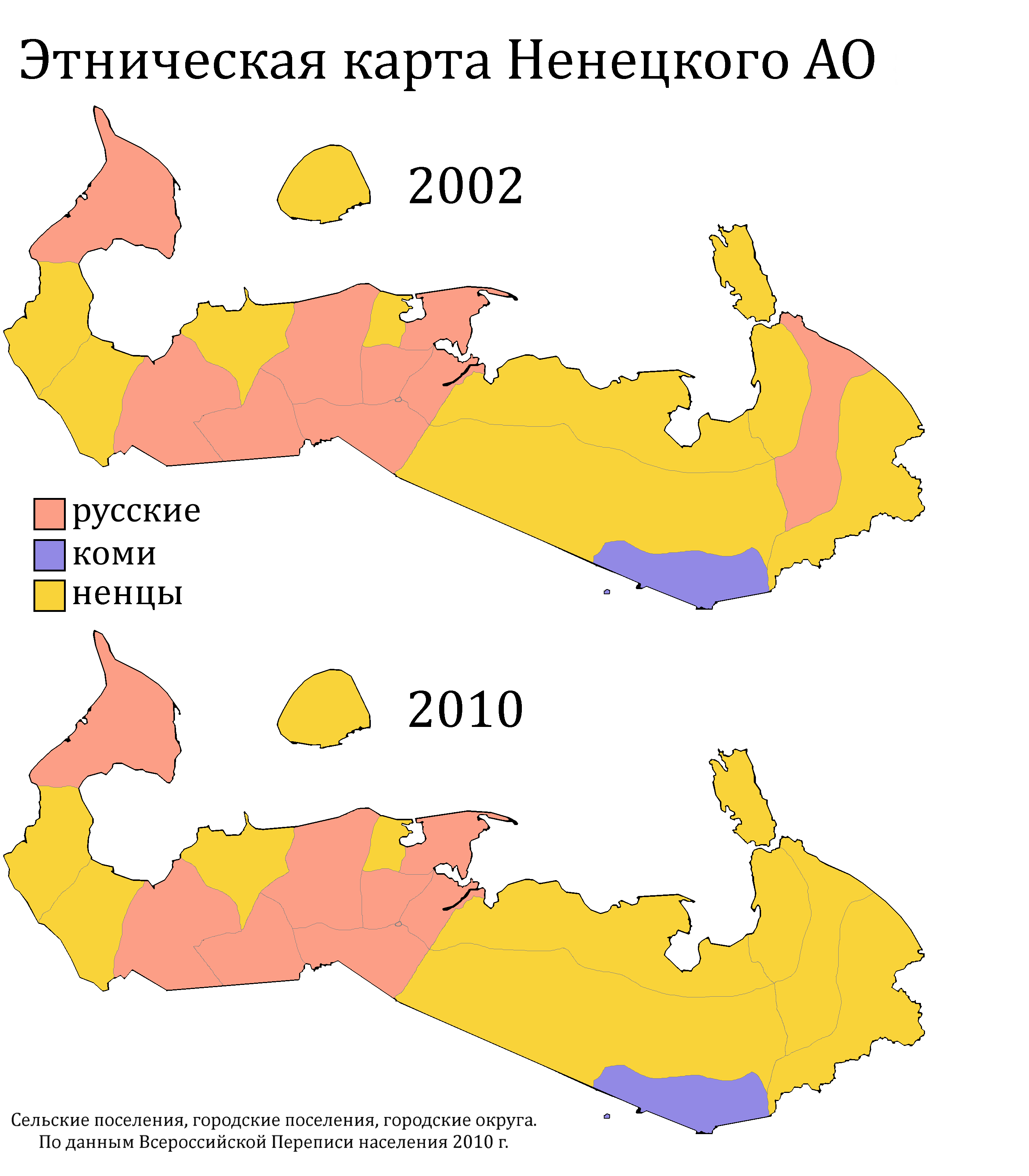
The 2020 merger fight revealed something essential about the Nenets Autonomous Okrug. Despite being Russia's least populous federal subject -- its 42,090 residents as of the 2010 census would barely fill a mid-sized sports arena -- the territory possesses a sense of identity disproportionate to its population. That identity is rooted in the Nenets people's millennia-long presence, in the okrug's unique administrative structure, and in the hard reality that living beyond the Arctic Circle forges a particular kind of community. The petroleum will eventually run out. The reindeer, if the tundra holds, will not.
From the Air
The Nenets Autonomous Okrug covers approximately 177,000 km2 of Arctic tundra centered around 68.83°N, 54.83°E. Naryan-Mar Airport (ULAM) is the primary access point. From the air, the landscape is flat, treeless tundra punctuated by thousands of lakes and the meandering channels of the Pechora River system. The coastline along the Barents Sea is low and marshy. Novaya Zemlya is visible to the north in clear conditions. Oil and gas infrastructure -- pipelines, platforms, and access roads -- are visible in several sectors.