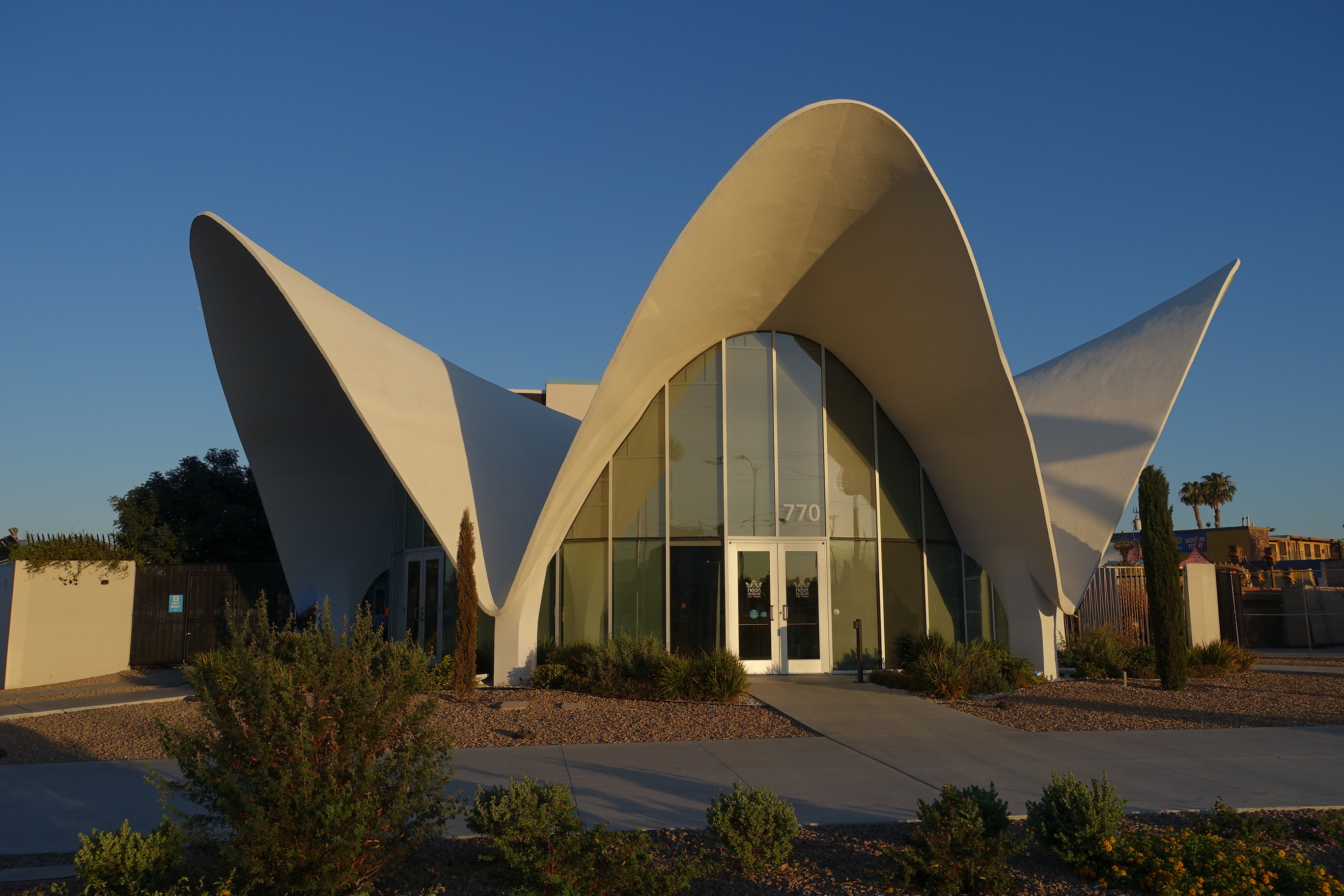
The Neon Museum
The first donation was a hand pouring whiskey into a glass. In 1989, the 5th Street Liquor Store gave away its late-1940s neon sign, a familiar beacon to generations of Las Vegas locals, and unwittingly sparked a movement to rescue the city's disappearing visual identity. Today that sign rests among more than 200 others at the Neon Museum, a two-acre sanctuary where the ghosts of demolished casinos and forgotten motels glow once more under the desert sky.
The Slow Fade
Las Vegas embraced neon in the 1920s, and by the 1930s, hotel-casinos competed for attention with ever-more elaborate signs manufactured by Young Electric Sign Company. But progress in Las Vegas means demolition. When the Sands Hotel fell in 1996, preservationists scrambled, but the Allied Arts Council lacked equipment and storage. Signs vanished into dumpsters. The locally famous—a cowboy on horseback, a spinning roulette wheel—simply disappeared. Patrick Gaffey of Allied Arts spent years storing rescued signs in the Nevada desert, waiting for a museum that seemed perpetually out of reach. In 1995, he admitted, "Our problem was we never had the manpower to really get it off the ground."
A Mayor's Mission
Las Vegas Mayor Jan Jones changed everything. In 1995, she recruited city employee Barbara Molasky to make the museum real. On September 18, 1996, the Las Vegas City Council approved $150,000 in redevelopment funds. Rather than wait for a building, the Neon Museum focused on reinstalling vintage signs along North Las Vegas Boulevard, drawing visitors to downtown and the new Fremont Street Experience. The storage lot—the "Neon Boneyard"—became an accidental attraction. Hollywood discovered it: Tim Burton's Mars Attacks! and the Chevy Chase comedy Vegas Vacation both filmed among the rusting towers of light. Molasky became founding president, leading an 18-member volunteer board that fielded dozens of tour requests weekly they could not accommodate.
The Shell That Saved Everything
The breakthrough came from an unlikely source. In 2005, the Doumani family donated the shell-shaped lobby of the La Concha Motel, a Googie-architecture landmark from the Strip's golden age. The rest of the motel fell to developers, but that sculptural concrete shell—designed by architect Paul Revere Williams—would become the museum's visitor center. Moving it was an engineering feat: workers cut the structure into eight pieces and transported it along Las Vegas Boulevard to its new home. The nearly $3 million relocation and restoration proved the museum was serious. Grants and donations followed. On October 27, 2012, the Neon Museum officially opened to the public, ending the old appointment-only system. By year's end, 60,461 visitors had walked among the signs.
A City's Memory Lane
The Neon Boneyard is less museum than graveyard, and visitors experience it that way—wandering among tombstones of light. Signs lie where they landed, propped against each other or half-buried in gravel. The Stardust sign recalls Frank Sinatra and the Rat Pack. The Silver Slipper evokes an era when casinos could get away with a giant glittering shoe. Each sign tells a story of ambition, bankruptcy, reinvention. Approximately 80 percent of visitors come from outside Nevada, drawn not by gambling but by nostalgia for a Las Vegas they may never have known. By 2023, annual visitors reached 200,000, with 30,000 turned away due to sold-out tours. The museum staff, which outgrew the La Concha lobby by 2016, now operates from the former Las Vegas City Hall.
Still Glowing
Only 30 percent of the collection is on display. Hundreds of signs wait in off-site storage, victims of space constraints. The museum has explored expansion repeatedly—purchasing and demolishing the L.A. Street Market, considering moves to the Arts District, scouting downtown sites. Each plan has stalled, delayed by funding or pandemic. Yet the Boneyard persists, a stubborn monument to impermanence. Las Vegas tears down and rebuilds constantly; the Neon Museum exists to remember what was lost. Under the desert sun, these signs that once announced "vacancy" now proclaim something else: that even in a city built on forgetting, some things refuse to fade.
From the Air
The Neon Museum sits at 36.176N, 115.135W in downtown Las Vegas, approximately 2 miles north of the Strip. From the air, look for the distinctive shell-shaped La Concha visitor center on North Las Vegas Boulevard near Cashman Field. The Boneyard's collection of large signs may be visible at lower altitudes. Nearby airports: KLAS (Harry Reid International, 8nm south), KVGT (North Las Vegas Airport, 5nm north). Best viewed in morning light when shadows reveal the sculptural quality of the signs.