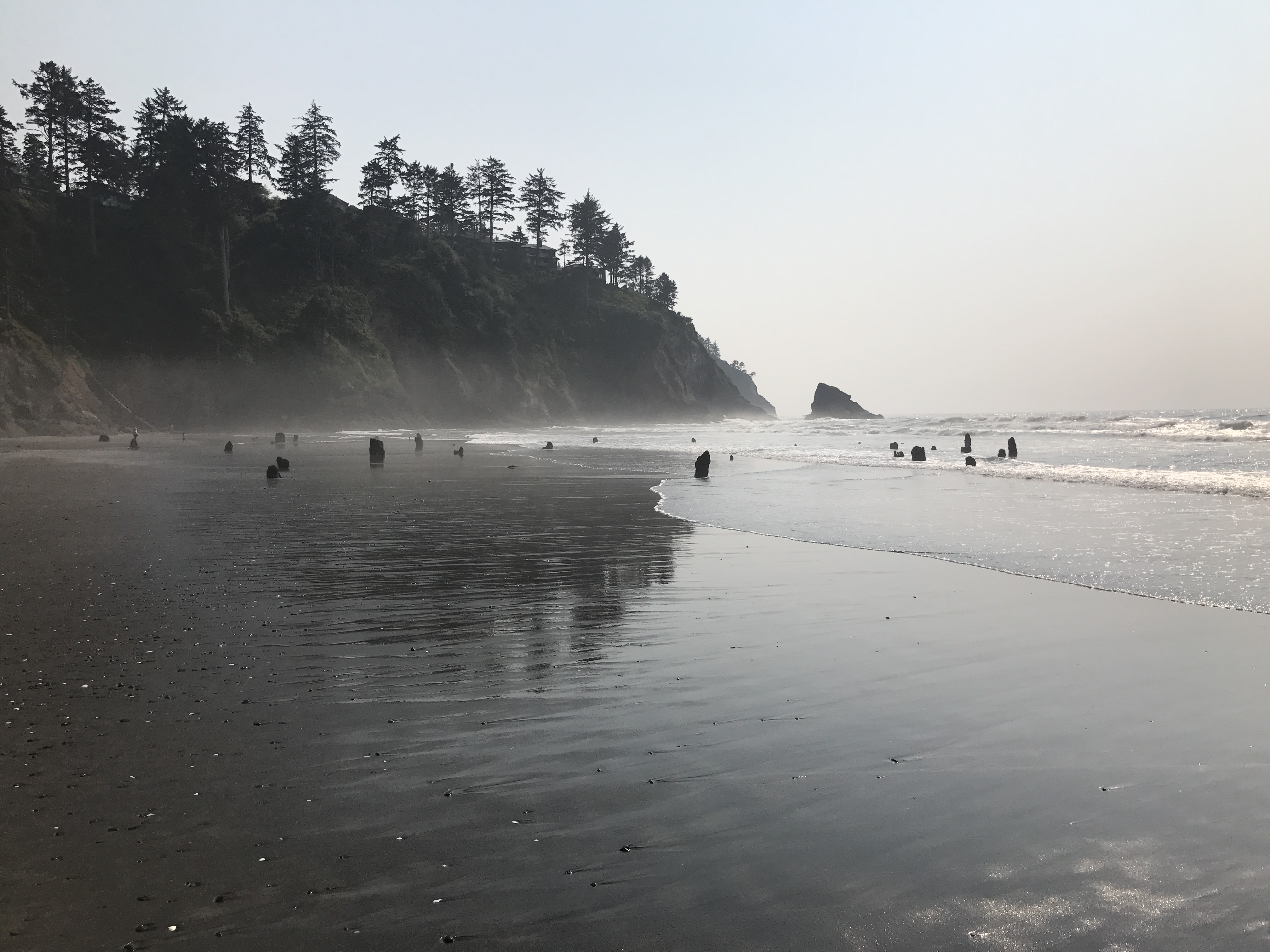
Neskowin Ghost Forest
For two thousand years, nobody knew they were there. Beneath the sand of a quiet Oregon beach, roughly a hundred Sitka spruce stumps lay entombed -- trees that once stood 150 to 200 feet tall, silenced by a seismic event so sudden that the soil still clings to their roots. Then the winter of 1997-98 arrived. El Nino-driven storms hammered the coast, stripping away centuries of accumulated sand, and the stumps emerged into daylight like something from a geological fever dream. Encrusted with barnacles and mussels, blackened by age but preserved by salt water that discourages the fungi that decompose wood on land, the Neskowin Ghost Forest announced itself to a world that had forgotten it existed.
What the Earth Remembers
Carbon dating places these trees at roughly 2,000 years old. When they were alive, they formed a coastal rainforest of Sitka spruce, the same species that still lines the Oregon shore today. How they died remains a matter of scientific debate. The prevailing theory held that an earthquake along the Cascadia subduction zone dropped the forest floor abruptly, and mud from landslides or tsunami debris then buried the trees where they fell. But several local geologists have challenged that narrative. Their research suggests gradual dune encroachment -- sand building up slowly around the trunks over years or decades, smothering the trees without any single catastrophic event. The truth likely varies from site to site. What is certain is that the stumps were buried quickly enough, and deeply enough, to survive intact for two millennia beneath the beach.
Clues Written in Driftwood and Soil
The Neskowin stumps are one of more than thirty ghost forests along the Oregon and Washington coasts. Most appear only as flat root systems pressed into the sand, barely recognizable. Neskowin is different: its stumps rise visibly from the beach, some of them substantial enough to sit on. The most famous of these ghost forests lies farther north in Washington, where a stand of red cedars helped scientists piece together the story of the Cascadia fault line itself. By examining when those trees died, researchers confirmed that the last great Cascadia earthquake struck on January 26, 1700 -- a date corroborated by Japanese tsunami records from the same day. The ghost forests are geological archives, each one a chapter in the seismic history of the Pacific Northwest.
A Beach Between Rock and Headland
The stumps scatter across the beach near Proposal Rock, a dome of 30-million-year-old basalt topped with a tiny forest of its own. The rock earned its name around 1900, when Captain Charley Gage proposed to Della Page beside it. To the north, the steep bluffs of Cascade Head frame the view. Between the rock and the headland, the stumps appear at low tide, some standing in clusters, others solitary, all of them dark against the pale sand. Reaching the northernmost stumps means wading across Neskowin Creek in cold, knee-high water -- a pilgrimage that winter visitors make when the lowest tides of the year expose the greatest number of stumps. January, February, and March offer the best viewing, though the forest is partially visible at any low tide throughout the year.
The Forest That Keeps Returning
Salt water is the paradox at the heart of this place. It killed the trees -- or at least hastened their burial -- but it also preserved them. Lignin-decomposing fungi, the organisms that break down wood on land, cannot thrive in saline environments. So the stumps endure, their wood darkened but structurally sound after twenty centuries of submersion. Each winter storm cycle reshapes the beach, sometimes covering stumps that were visible the previous season and revealing others that had been hidden for years. The ghost forest is not a fixed exhibit but a shifting one, dependent on the same ocean forces that created it. Geologists at Oregon State University continue to study the site, and the layers of sand and peat beneath the surrounding marshes may contain one of the best records of tsunami activity along the entire Cascadia subduction zone. The stumps are not merely relics. They are active evidence, still telling their story to anyone willing to read it.
From the Air
The Neskowin Ghost Forest sits at 45.098N, 123.989W on the Oregon Coast, just south of the village of Neskowin. The stumps are visible from low altitude on the beach near Proposal Rock. The nearest airport is Pacific City State Airport (KPFC), approximately 8 nautical miles to the north. Tillamook Airport (KTMK) lies about 20 nautical miles north. Cascade Head is a prominent visual landmark to the north, and the basalt dome of Proposal Rock marks the ghost forest location from the air. Coastal fog is common, especially in summer mornings; winter afternoons often provide clearer visibility.