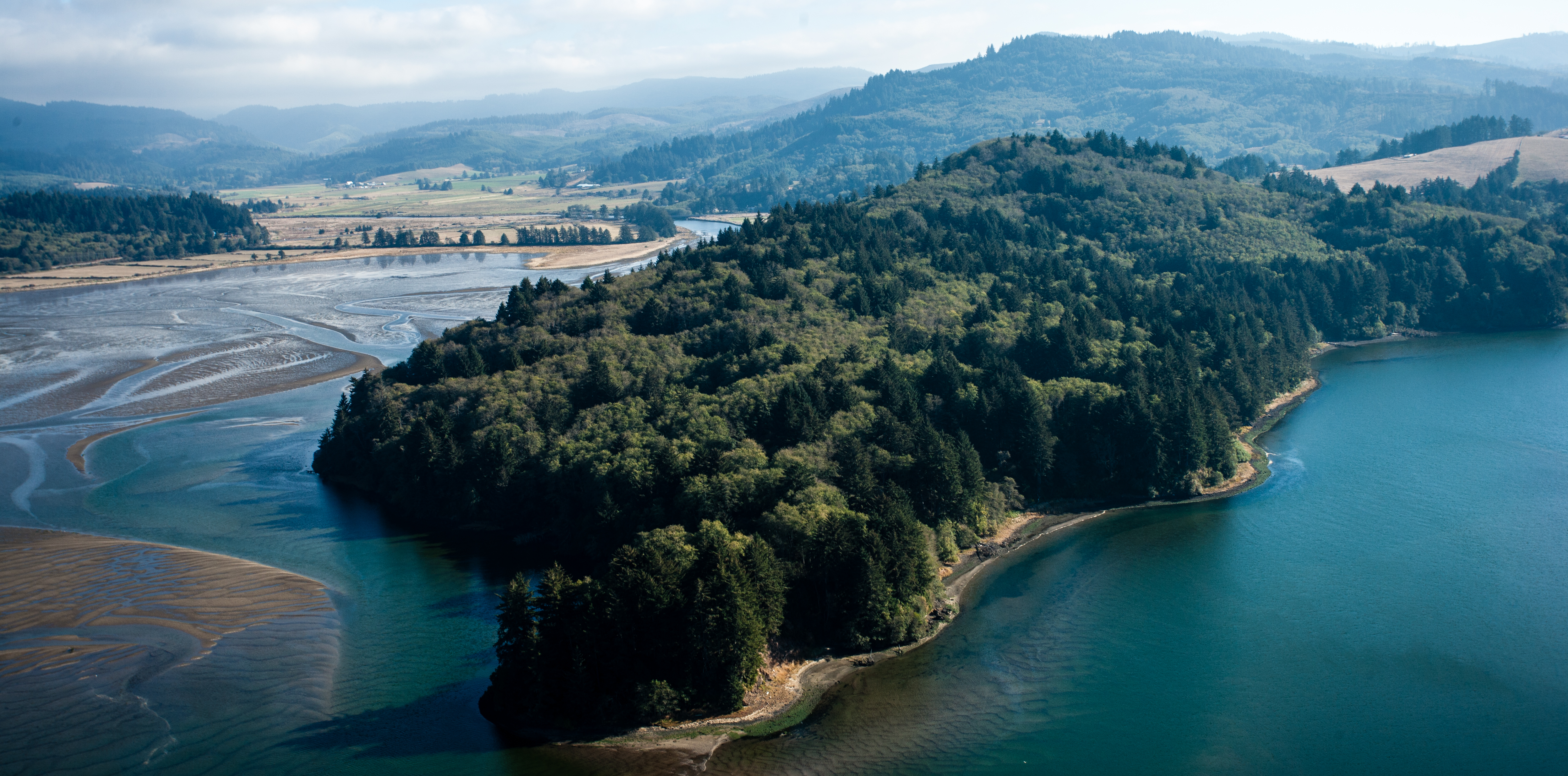
Nestucca Bay National Wildlife Refuge
One-tenth of every dusky Canada goose on Earth winters in a place that used to be a dairy farm. That statistic alone would make Nestucca Bay National Wildlife Refuge remarkable, but it only begins to describe what 600 acres of restored coastal habitat can hold. Established in 1991 where the Nestucca and Little Nestucca rivers meet the Pacific in southern Tillamook County, the refuge contains seven distinct habitat types compressed into a narrow coastal strip -- tidal marsh, mudflats, grassland, woodland, pasture, forested lagg, and freshwater bogs. Among them is the southernmost coastal Sphagnum bog on the entire Pacific Coast, a place where carnivorous sundew plants digest insects and bog cranberries grow in the acidic peat.
Where Geese Count on Short Grass
The dusky Canada goose is a subspecies found almost nowhere else. It breeds in Alaska's Copper River Delta and winters along the Oregon and Washington coasts, and its population has been a species of concern for decades. Nestucca Bay's short-grass pastures -- remnants of the old dairy operation -- provide exactly the winter foraging habitat these birds need from November through April. The Aleutian cackling goose, once classified as endangered, shares these fields. Peregrine falcons patrol the skies above, and bald eagles perch in the woodland edges overlooking the mudflats. Migrating shorebirds stop here during spring and fall, drawn by the same tidal flats that sustain Chinook and coho salmon, coastal cutthroat trout, and steelhead in the Nestucca River system below.
The Bog at the End of the Line
The Sphagnum bog is a biological outlier. Coastal Sphagnum bogs stretch along the Pacific from Alaska southward, but this is where the chain ends -- the southernmost example on the coast. In the bog, spongy moss builds up over centuries into a raised peat dome, creating conditions so acidic and nutrient-poor that only specialists survive. Sundew plants, their sticky leaves glistening with droplets that trap insects, supplement the meager soil nutrients with protein from their prey. Bog cranberries creep across the moss surface. The forested lagg -- a transitional zone between the raised peat and the surrounding mineral soil -- supports its own community of plants adapted to perpetually saturated ground. Beneath it all, scientists have discovered alternating layers of sand and peat in the adjacent Neskowin Marsh, a record of repeated tsunami events that may represent the most complete chronicle of Cascadia subduction zone activity yet found.
From Dairy Farm to Refuge
The land did not always look like this. Before 1991, much of the refuge was a working dairy farm, its pastures grazed, its wetlands drained by ditches. Establishing the refuge began the slow process of undoing that alteration -- removing drainage infrastructure, allowing tidal flows to reclaim the marsh, letting native vegetation reassert itself in the bogs and woodland edges. Oregon writer Matt Love documented this transformation firsthand. From 1998 to 2008, Love served as the refuge's caretaker, pouring his energy into the physical work of restoring scarred land. His book, "Gimme Refuge: The Education of a Caretaker," chronicles a decade of watching a dairy farm become a functioning ecosystem again. During those years, Love reinvented himself as a writer and historian, eventually founding Nestucca Spit Press and winning the 2009 Stewart H. Holbrook Literary Legacy Award from Oregon Literary Arts.
A Complex Within a Complex
Nestucca Bay is one of six refuges that form the Oregon Coast National Wildlife Refuge Complex, a chain of protected sites stretching along the state's shoreline. Each refuge addresses a different piece of the coastal ecosystem puzzle. Nestucca Bay's contribution is its diversity in miniature -- seven habitats packed into an area small enough to walk across in an afternoon, yet supporting species from carnivorous plants to salmon to raptors. The Cannery Hill headland, added to the refuge in 2013, offers an overlook where the full sweep of Nestucca Bay unfolds below. From that vantage, the mosaic becomes legible: the dark green of the woodland, the tawny expanse of the pasture, the silver channels of the tidal marsh, and beyond it all, the Pacific horizon where the rivers finally lose themselves in salt water.
From the Air
Nestucca Bay National Wildlife Refuge is located at 45.173N, 123.947W in southern Tillamook County, ranging 3 to 5 miles south of Pacific City. The bay and its surrounding wetlands are visible from the air as a broad tidal estuary where the Nestucca and Little Nestucca rivers converge. The nearest airport is Pacific City State Airport (KPFC), approximately 4 nautical miles north. Tillamook Airport (KTMK) is about 18 nautical miles to the north. Cannery Hill headland is a useful visual landmark on the bay's edge. Overflying at 1,500 to 2,500 feet AGL provides the best perspective on the habitat mosaic. Coastal fog is frequent in summer; clearer conditions are typical in fall and winter when the geese are present.