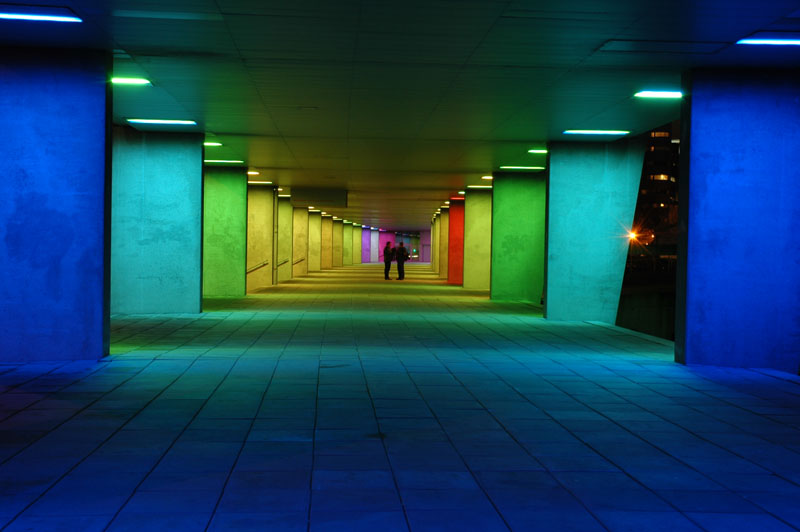
Netherlands Architecture Institute
The competition jury met in 1988 with six finalists on the table. Rem Koolhaas was the favorite. The architectural press loved his proposal. Riek Bakker, head of Rotterdam's urban development department, backed it. Then the jury picked Jo Coenen. The reasons given were diplomatic: Coenen's design blended better into its surroundings, made richer reference to the history of architecture. The reasons unspoken were that the institution being built was a national archive of Dutch architecture, and the building that would house it could not afford to be a one-architect monument. Coenen's pavilion opened in 1993 on the edge of the Museumpark, a low complex of glass and brick wrapped around a pond. Inside, behind sliding archive shelves, sits the documented memory of a country.
Eighteen Kilometers of Drawings
Place every architectural drawing and model in the institute's collection end to end and they would stretch 18 kilometers. The collection began with a complaint. In 1912 the Amsterdam architects' association Architectura et Amicitia ran out of room for its drawings and had to rent a spare room at the Hotel Parkzicht. Architect J.H.W. Leliman started agitating for a proper national museum that year, and the idea kept failing to materialize for the next 76 years. When the Netherlands Architecture Institute finally formed in 1988 by merging three smaller bodies, the question of where to put it triggered a brief but intense fight between Amsterdam and Rotterdam. Minister Brinkman chose Rotterdam. The institute moved temporarily to Westersingel while Coenen built the permanent home. The collection grew to encompass more than 500 architects' archives, a 60,000-volume library, drawings by figures whose names anchor Dutch architectural history: Cuypers, Berlage, Rietveld, Van Doesburg.
The House the Sonnevelds Built
A short walk from the institute stands a 1933 house that the NAI restored and opened to the public in 2001. Sonneveld House was designed by the firm Brinkman and Van der Vlugt in the Nieuwe Bouwen style, the Dutch arm of international modernism. Albertus Sonneveld, one of the directors of the Van Nelle factory in Rotterdam, commissioned it for his family. The house was furnished with pieces by W.H. Gispen, Bart van der Leck and other Dutch designers of the period. Today you can walk through bedrooms where modernist Dutch industrialists slept, see the Bruynzeel kitchen they cooked in, sit in the library beneath original Giso lamps. The Rotterdam Stichting Bevordering van Volkskracht had bought the house in 1977 and let it sit unrestored for over two decades. The restoration was a collaboration between the architectural firm Molenaar & Van Winden and the institute itself, which handled the refurnishing using period-correct pieces.
Urban Augmented Reality
In June 2010, the institute released a free application called UAR - Urban Augmented Reality - that did something genuinely novel for its time. Hold a smartphone up to a Rotterdam street corner and the app overlaid the buildings that had been demolished, the proposals that had never been built, and the future projects that were still under construction. The city that was, the city that might have been, the city that would become. The institute drew on its own archive and the collections of partner heritage organizations to populate the layers. Coverage expanded from Rotterdam to Amsterdam, Utrecht, The Hague, Breda, Haarlem and Gouda. Smartphones and tablets in 2010 were rudimentary by today's standards, but the project anticipated by a decade the way urban history would eventually be experienced - layered over the present, accessible in the palm of a hand, peeled back like translucent paper.
Becoming Het Nieuwe Instituut
On January 1, 2013, the institute ceased to exist as an independent body. State Secretary Halbe Zijlstra had designated it as one of three organizations that would merge to form a new body called Het Nieuwe Instituut, the New Institute, which would cover architecture, design and digital culture as a single sector institute for the creative industries. Premsela, which handled design and fashion, joined the merger. So did Virtueel Platform, the e-culture knowledge organization. The Coenen building stayed where it was. The collections stayed where they were. The bookshop, the cafe, the Sonneveld House, the exhibition galleries all kept operating. But the name on the door changed, and a slightly broader mission took over. The 18 kilometers of drawings now sit inside an institute that thinks about typefaces and software interfaces alongside facade details. The Dutch tendency to consolidate cultural infrastructure into bigger, more efficient containers caught up with its own architecture museum.
From the Air
The former Netherlands Architecture Institute building - now Het Nieuwe Instituut - sits at 51.9144 N, 4.4708 E in Rotterdam's Museumpark, the same cultural cluster that includes the Museum Boijmans Van Beuningen, the Kunsthal and the Natural History Museum. Nearest airport is Rotterdam The Hague (EHRD), 5 km northwest. From the air the Museumpark reads as a green rectangle between Westzeedijk and Westersingel, immediately south of the Centrum. The institute building's distinctive long horizontal mass alongside its reflective pond can be picked out at lower altitudes.