Netherlands Institute for Space Research
To detect a single X-ray photon arriving from a black hole eight billion light-years away, you cool a tiny strip of metal until it sits right at the temperature where it is about to become superconducting - then you wait. When the photon hits, the strip heats up by a few millionths of a kelvin, its superconductivity collapses, the readout current drops, and you have your measurement. That is what the Transition Edge Sensors built in the laboratories of SRON do, and they do it well enough that the European Space Agency is putting them aboard the Athena X-ray observatory. SRON has been doing this kind of work for sixty-five years.
From One Lab to Three
The institute began as the Laboratorium voor Ruimteonderzoek, founded in Utrecht in 1961 - early in the space age, when the Dutch government decided that a small country could not afford to build rockets but could afford to build instruments good enough to fly aboard everyone else's. In 1983, the Utrecht lab joined forces with the space laboratories in Leiden and Groningen under a new umbrella, the Stichting Ruimteonderzoek Nederland, and the acronym SRON was born. The full name has shifted twice since - to SRON Netherlands Institute for Space Research in 2005, and to Space Research Organisation Netherlands in 2025 - but the acronym has stuck. Today the institute is headquartered in Leiden after a 2021 move from Utrecht, with a second major facility in Groningen, and a permanent staff of more than 250 people distributed across four research programmes.
What They Build, What It Flies On
SRON's specialty is making instruments other people fly. The Reflection Grating Spectrometers on the European XMM-Newton observatory came from here. So did the Low Energy Transmission Grating Spectrometer on NASA's Chandra X-ray Observatory, the Short Wave Spectrometer on ESA's Infrared Space Observatory, and the HIFI heterodyne instrument on the Herschel Space Observatory. SRON contributed the Wide Field Camera to the Italian BeppoSAX mission that decoded gamma-ray bursts in 1997, and the Resolve spectrometer to the Japanese XRISM mission. The current portfolio runs deep: contributions to ESA's PLATO and ARIEL exoplanet observatories, the X-IFU calorimeter for Athena, parts of the LISA gravitational-wave observatory, the SPEXone polarimeter on NASA's PACE ocean-and-aerosol mission, and two band receivers on the ALMA millimetre-wave array in Chile.
Methane from Orbit
Some of SRON's most consequential work has been on Earth observation. The institute built TROPOMI, the imaging spectrometer aboard ESA's Sentinel-5p satellite. Since its 2017 launch, TROPOMI has mapped methane plumes from oil and gas operations, landfills, and coal mines with a resolution sharp enough to identify the polluter - turning a planet-warming pollutant that used to be effectively invisible from space into something governments can no longer plausibly deny. In 2025, SRON researcher Ilse Aben received the Stevin Prize - the Dutch counterpart to the Spinoza Prize, given for societal impact rather than pure science - in recognition of what she and her team had achieved with the instrument. Previous earth-observation work included SCIAMACHY on Envisat, GOME-2 on the MetOp satellites, and parts of ESA's gravity-mapping GOCE mission.
Physics at the Edge of Cold
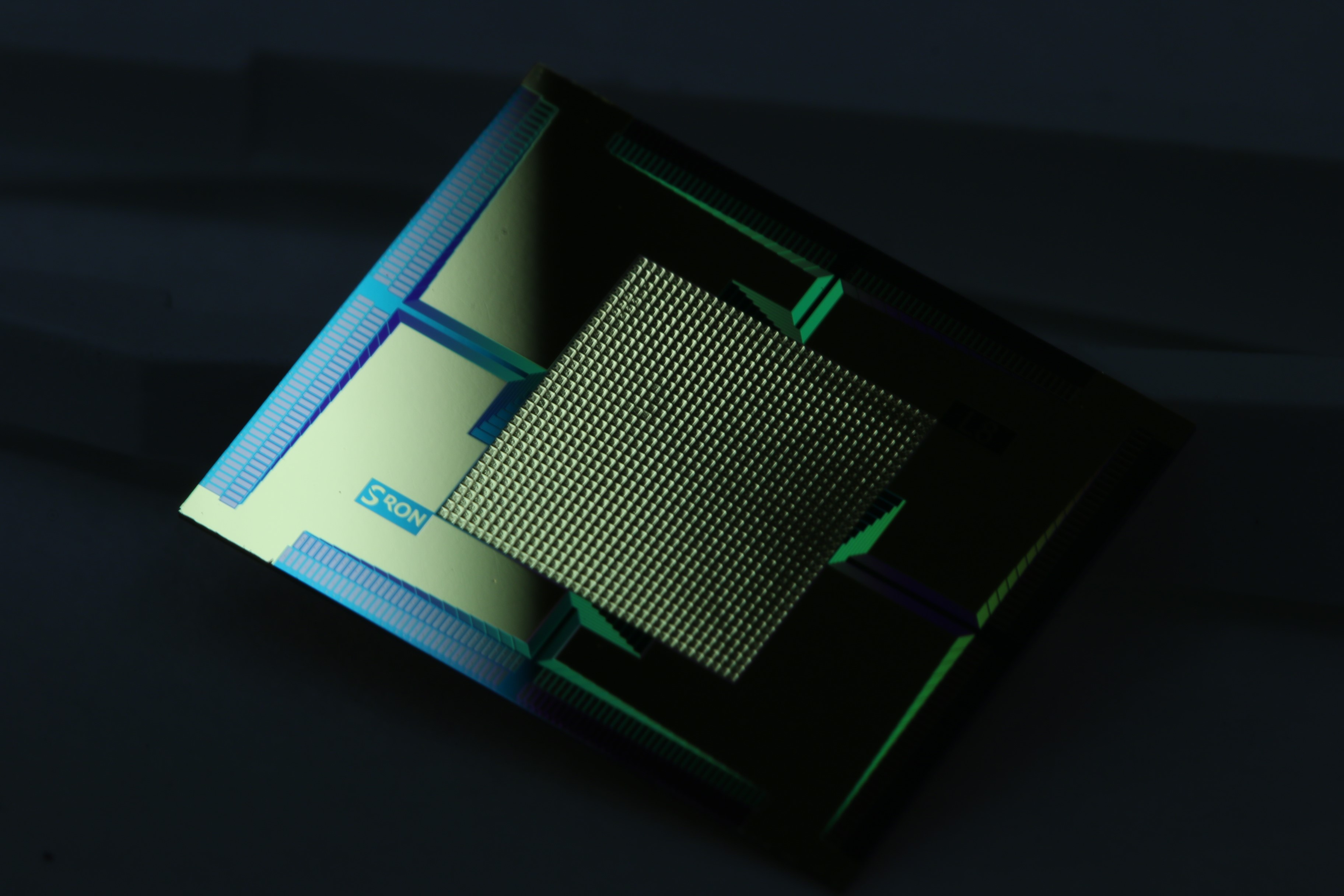
Two detector technologies dominate SRON's labs, and both rely on the strange behaviour of metals near absolute zero. The Transition Edge Sensor is the workhorse of high-resolution X-ray spectroscopy: at exactly the temperature where a thin film flips between normal and superconducting, the energy of an incoming photon nudges the material across the boundary, and the readout electronics record the size of the nudge. For infrared and exoplanet work, the institute develops Kinetic Inductance Detectors. These exploit the inertia of paired electrons in a superconductor - a photon arriving from space breaks a few pairs, hampers the superconducting flow, and increases the kinetic inductance enough to be measured. Both technologies must be cooled to a fraction of a kelvin above absolute zero. For GUSTO, the balloon-borne far-infrared telescope, SRON built an eight-pixel camera using Hot Electron Bolometers - another superconductor-based scheme - to map terahertz emissions from the interstellar medium of the Milky Way.
A Small Country, Visible from Space
Look down at the Netherlands from low orbit and you will see the SRON facilities only as ordinary buildings - one campus on the Zernike science park in Groningen, another in Leiden. What is harder to see is how much of what we know about the high-energy and infrared universe has flowed through these two addresses. A list of past missions that carried SRON hardware reads as a history of space-based astronomy: IRAS, ISO, BeppoSAX, Chandra, XMM-Newton, Compton, Herschel, Envisat, Hitomi. The current list points forward: Athena, LISA, PLATO, ARIEL. The director's chair has been held by Johan Bleeker (1985-2003), Roel Gathier as interim, Rens Waters (2010-2019), and since 2019 by Michael Wise. The Dutch contribution to space science has never been about rockets. It has been about what flies inside them.
From the Air
The Groningen SRON facility sits at 53.24 N, 6.53 E, on the Zernike science campus on the northern edge of the city. Groningen Airport Eelde (EHGG) is about 12 km south. From low altitude on a clear day, the Zernike campus is recognizable as a cluster of modern buildings northwest of the city centre, surrounded by green sports fields and the University of Groningen's main research complex. The institute's other headquarters is in Leiden, near the airport at Schiphol (EHAM).