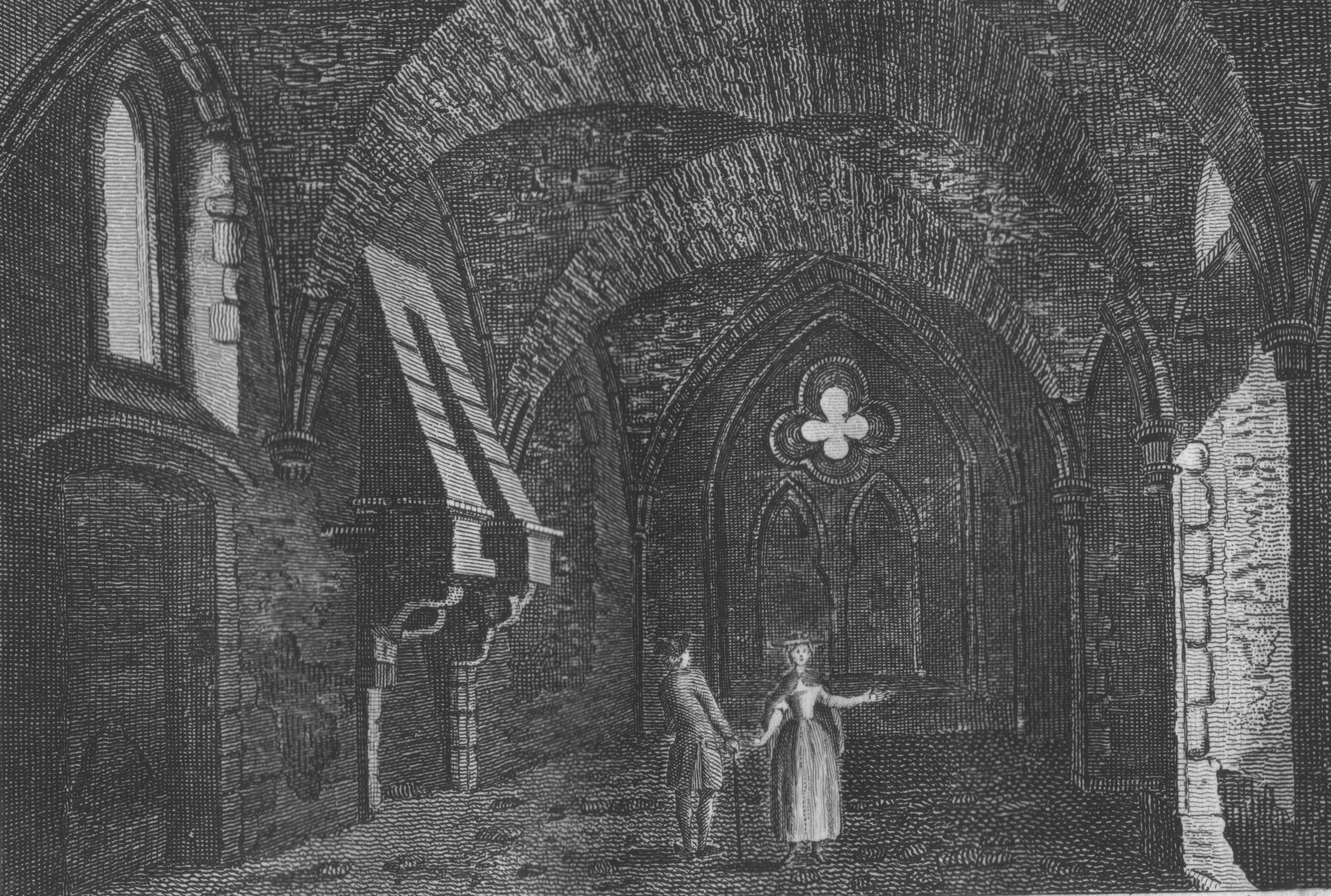
Netley Abbey
The monks of Netley Abbey were never famous. They produced no influential scholars, no powerful churchmen, and their nearly 300-year history passed without drama. What they were known for, their neighbors said, was hospitality -- generous welcome offered to travelers arriving by land and sea along Southampton Water. That generosity eventually helped bankrupt them, and their quiet monastery ended up as one of the best-preserved Cistercian ruins in southern England, admired by Romantic poets who probably would not have given the monks themselves a second thought.
A Bishop's Memorial
Netley was conceived by Peter des Roches, the influential Bishop of Winchester, as a memorial to himself. Des Roches intended a pair of monasteries -- Netley in Hampshire and La Clarte-Dieu in France -- to stand as lasting monuments to his legacy. He began purchasing land around 1236 but died in 1238 before the project was finished. His executors completed the foundation, and on 25 July 1239, the first monks arrived from neighboring Beaulieu Abbey to settle the site. Henry III added to the endowment with farmland, urban property in Southampton, and revenues from churches. The resulting abbey featured a large church, 72 meters long, built in the fashionable French-influenced Gothic style that Henry's own masons were pioneering at Westminster Abbey.
Genteel Poverty
Despite royal patronage, Netley never grew wealthy. By 1291, the abbey had a comfortable annual revenue of 81 pounds, but bad management soon pushed it toward bankruptcy. In 1328, the government appointed an administrator to address the crisis, forcing the abbot to sell estates to repay debts. A decade later, the monks were again appealing to the king, blaming their financial woes on the cost of hosting travelers and the king's own sailors who landed at the abbey. The crown provided small grants, but the property sales meant Netley's income never recovered. The abbey settled into what historians describe as genteel poverty -- maintaining its obligations and hospitality while its church's interior glowed with painted glass showing the Virgin Mary, the Crucifixion, monks, monsters, and humorous animals.
Dissolution and the Country House
In 1535, Henry VIII's commissioners found just seven monks living at Netley, all of them priests. The abbey's net income of 100 pounds placed it under the First Suppression Act, and in 1536 it was seized during the Dissolution of the Monasteries. The buildings were granted to William Paulet, a wealthy Tudor politician who converted the medieval monastery into a private mansion. The chapter house became a reception room, the monks' dormitory an upper gallery, and the cloisters a promenade. Paulet's family used Netley as a country house until the early 18th century, when it was abandoned and partially demolished for building materials -- stone from the north transept was carted away to build a folly on the Cranbury Park estate.
The Romantic Ruin
What the demolishers left behind became a magnet for poets and painters of the Romantic movement. The roofless church, with its Gothic arches open to the sky and ivy threading through Purbeck Marble columns, offered exactly the kind of picturesque decay that 18th- and 19th-century sensibilities craved. The ruins inspired elegies and watercolors, and Netley became a fashionable destination for day-trippers from nearby Southampton. In the early 20th century, the site was given to the nation, and English Heritage now cares for it as a Scheduled Ancient Monument. The extensive remains include the church walls, cloister buildings, the abbot's house with its two levels of vaulted apartments, and fragments of the post-Dissolution mansion. Traces of the monastery's original water supply -- two aqueducts that ran for several miles -- can still be seen in modern Southampton, where the eastern aqueduct survives as Tickleford Gully in Wentworth Gardens.
From the Air
Located at 50.88N, 1.36W near the village of Netley on the east bank of Southampton Water, Hampshire. The abbey ruins are in a wooded setting near the shoreline. Southampton Airport (EGHI) is approximately 3nm northwest. Best viewed at 1,500-2,500 ft AGL with the abbey visible amid trees along the waterfront.