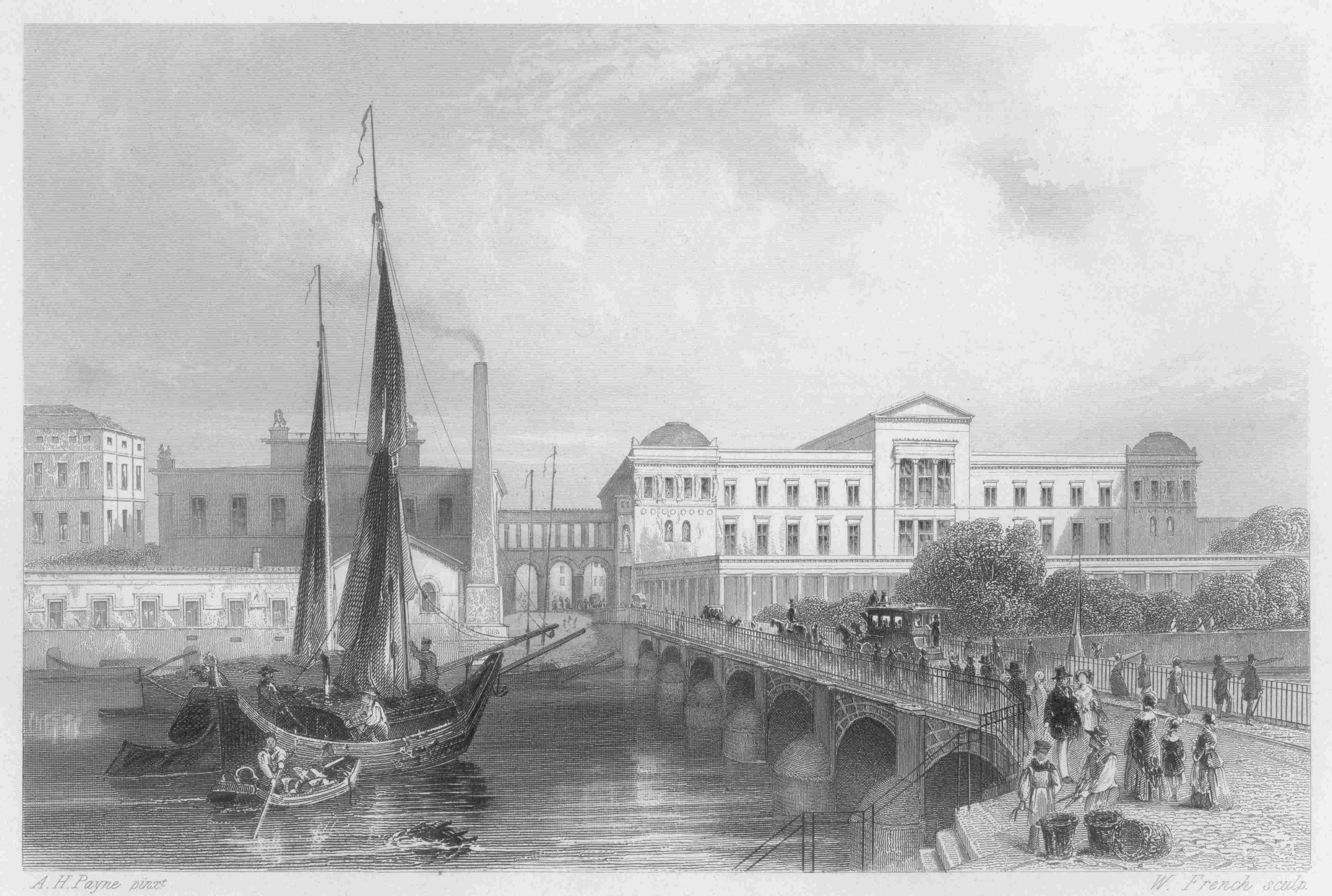
Neues Museum
Walk into the central staircase hall of the Neues Museum and look up. Friedrich August Stuler designed it in the 1840s as a triumphal Prussian space, walls covered in fresco cycles and gilded coffers, ceilings painted with the cosmologies of antiquity. What you see now is something different: bare brick where the murals burned, patches of original gold leaf among new plaster the colour of ash, raw concrete columns standing where shellfire took the originals. The Neues Museum was almost annihilated in 1945. It sat as a roofless ruin for the entire forty-year span of East Germany. When the British architect David Chipperfield reopened it in 2009, he did something almost no postwar German project had done — he refused to pretend the war had not happened.
Stuler's Engine
Construction began in 1843 on the orders of Frederick William IV of Prussia. The architect was Friedrich August Stuler, a student of Karl Friedrich Schinkel and the great organizer of Prussian state architecture. The Neues Museum sits on the soft alluvial mud of the Spree's central island, and the engineering was as ambitious as the decoration. Stuler used a steam engine — the first time one had been used in Berlin construction — to drive piles into the riverbed. The interior framing was iron, an industrial technique pulled into a building meant to look like a Renaissance palace. He completed it in 1855. It was the second building on what would become the Museum Island, designed to house the antiquities, the Egyptian collection, and the prints and drawings that would not fit in Schinkel's older Altes Museum next door.
The Bust That Came In
In 1912 a German archaeological team led by Ludwig Borchardt was digging at Tell el-Amarna, the abandoned capital of the heretic pharaoh Akhenaten. In a sculptor's studio under the sand they found a 50 cm limestone bust of his queen. Painted, almost completely intact, eyes still inset with rock crystal. Nefertiti. Borchardt brought her back to Berlin under arrangements Egypt has been disputing ever since. She arrived at the Neues Museum in 1924 and, with one wartime evacuation, has been the building's most famous resident ever since. She survived 1945 because she had been moved to a salt mine for safekeeping. The room she occupies today is austere and circular, lit from above. Visitors are not allowed to photograph her. They tend to walk in, fall silent, and stand.
Sixty Years as a Ruin
The Allied bombing of Berlin in 1943 and 1945 hit the Neues Museum repeatedly. The northwest wing collapsed entirely. The grand staircase was destroyed. Frescoes that had survived a century of Prussian winters were obliterated in seconds. The roof was gone. Then the country was partitioned, the Museum Island found itself in East Berlin, and the GDR — committed to reconstructing the more politically useful Pergamon next door — let the Neues Museum stand open to the rain. Trees grew inside it. By the 1980s the surviving frescoes had bleached and crumbled. After reunification the question was what to do. The cheap option was demolition. The expensive option was a full romantic reconstruction in the manner of the rebuilt Frauenkirche in Dresden. Chipperfield's team chose neither.
The Repair Made Visible
Chipperfield's principle, developed with the conservator Julian Harrap, was complementary repair. What had survived was kept exactly as it was, including the bullet holes, the soot stains, the gaps where shells had punched through walls. What had been lost was rebuilt in plain materials — recycled handmade brick, concrete tinted to read as new, plain plaster — that visibly distinguished new work from old. A surviving fresco of the Trojan War sits next to a wall of bare brick, with no attempt to bridge them. The result is unsettling at first. It looks unfinished. After a few minutes you understand the wager: every wall in this building tells you what was lost, and refuses to lie about how easy or how cheap recovery would be. The reconstruction took ten years. It opened in October 2009 and won the European Union Prize for Contemporary Architecture two years later.
From the Air
Museum Island sits in the central Spree at 52.520 degrees north, 13.398 degrees east, in the Mitte district of central Berlin. The Neues Museum is the central building in the row, between the Altes Museum to the south and the Pergamon to the north. From the air at 1,500 to 3,000 feet the island appears as a green-edged landmass with five large neoclassical buildings clustered tight together, the dome of the Berlin Cathedral immediately to the south. Nearest airport is Berlin-Brandenburg (EDDB), 18 km southeast.