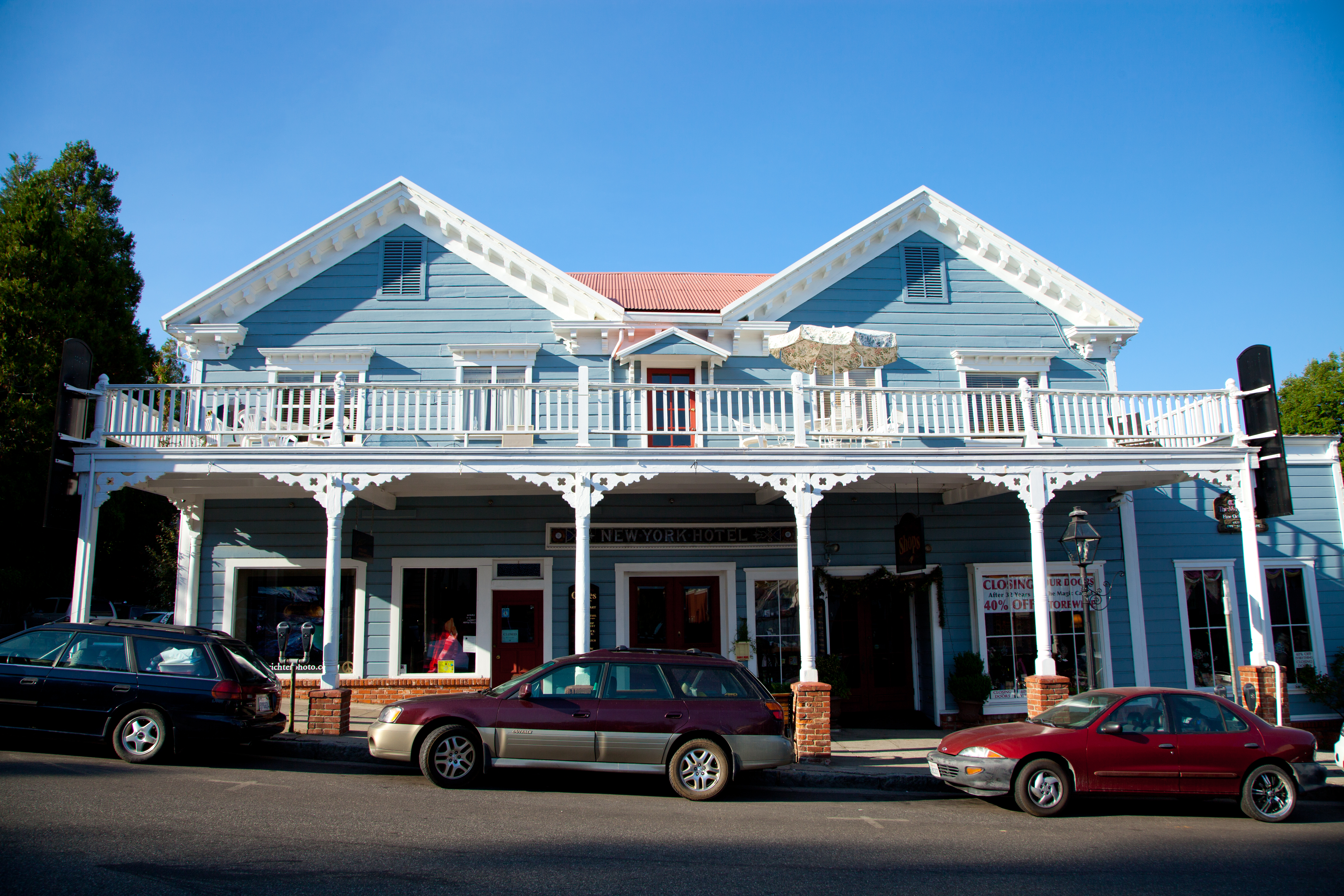
Nevada City Downtown Historic District
Five times the fire came, and five times Nevada City rebuilt. Between 1851 and 1859, flames leveled this Sierra foothill mining town again and again, yet each time the miners, merchants, and hoteliers hauled in more brick, more iron, more determination. The result is something remarkable: a 16-acre downtown where over 70 buildings stand as a continuous architectural record from the Gold Rush through the early twentieth century. Listed on the National Register of Historic Places in 1985, the Nevada City Downtown Historic District stretches across Broad, Main, and the connecting streets between them, its period of significance running from 1856 to 1917. Walk these blocks today and the storefronts tell a story that no single building could - the story of a town too stubborn to stay burned.
From Third-Largest City to Living Museum
It is hard to imagine now, but by March 1850, Nevada City was the third-largest city in California. Gold drew thousands to these foothills in Nevada County, and the town boomed with the energy of a place where fortunes could be made in an afternoon. Broad Street became the commercial spine, lined with hotels, assay offices, and saloons. The fires that swept through during the 1850s were devastating, but they also forced a transition from wood to brick and stone construction. The buildings that replaced the charred remains were more permanent, more ambitious. Italian Renaissance Revival facades appeared alongside vernacular storefronts. By the time the last great rebuilding was complete, Nevada City had traded its rough-hewn mining camp character for something approaching permanence - a downtown built to endure.
Broad Street's Architectural Parade
A walk along Broad Street reads like a catalog of nineteenth-century American architecture. At 301 Broad, a building first constructed by a Mr. Burlington in 1854 was rebuilt by C. E. Wilson in 1904, carrying the traces of both eras. The Hartung Building at 306 Broad dates to 1864, while the New York Hotel at 408 Broad, built in 1880 by contractor George M. Hughes, once offered travelers a place to sleep after the long stagecoach ride into the mountains. The Nevada Theatre at 401 Broad, completed in 1865 by builder George Pierce, is a California Historical Landmark - one of the oldest continuously operating theaters on the West Coast. Each building occupies its lot with a different personality, yet together they form a remarkably coherent streetscape, unified by scale, material, and the shared experience of surviving fire.
Bells, Belfries, and the Fight Against Flame
Two firehouses anchor the district's story of resilience. Firehouse No. 2 at 420 Broad Street, completed in January 1861, was the city's first purpose-built firehouse, its Classical Revival facade a statement of civic ambition for a town barely a decade old. Firehouse No. 1 at 214 Main Street followed just months later, finished in May 1861. Both buildings still carry their fire bells in belvederes above the roofline - a visual echo of the alarm that meant everything in a town that knew the cost of being slow to respond. The firehouses speak to a community that understood its greatest vulnerability and invested accordingly. Nevada City's fire companies were not just emergency services; they were civic institutions, their members among the most respected citizens in town.
Churches, Courts, and Quiet Streets
Beyond the commercial bustle of Broad and Main, the district unfolds into quieter blocks where churches and public buildings reflect a town settling into its identity. The First Baptist Church at 300 Main Street, built in Gothic style in 1857, is among the oldest surviving structures. St. Canice's Catholic Church at 317 Washington Street followed in 1864, its Gothic architecture serving the Irish miners who worked the surrounding claims. The Nevada County Courthouse, designed by George C. Sellon in 1937 in the Art Moderne style, is the district's most modern landmark - proof that Nevada City's architectural ambitions did not end with the Gold Rush. Residential buildings like the Aaron Baruh House, dating to 1852, and the Martin Luther Marsh House from 1873 show that people did not just work in this district. They made it home.
Preserved by Pride
Nevada City designated its own historic district in 1968, nearly two decades before the federal recognition came in 1985. That early action mattered. Where other Gold Rush towns watched their heritage crumble or get bulldozed for parking lots, Nevada City chose preservation. The city's 1968 ordinance included buildings the National Register later passed over, expanding the circle of protection to encompass residential homes and lesser-known commercial structures. Today, the Doris Foley Library for Historical Research occupies a Romanesque building on North Pine Street, Pioneer Cemetery marks the resting place of the town's earliest residents on West Broad Street, and the Ghidotti Gold Collection preserves specimens from the mines that made it all possible. The district lives not as a museum piece frozen in amber but as a functioning downtown - its buildings occupied, its streets walked, its story still being written.
From the Air
Nevada City Downtown Historic District sits at 39.263N, 121.019W in the Sierra Nevada foothills at approximately 2,500 feet elevation. Best viewed at 2,000-3,000 feet AGL. The compact downtown grid is visible from the air, with Broad Street and Main Street forming the main axes. Look for the distinctive belvederes of the two firehouses rising above the roofline. Nearest airport: Nevada County Air Park (GOO), approximately 3 nm north. Auburn Municipal Airport (AUN) is about 25 nm south. The forested hillsides surrounding the town make the urban grid stand out clearly in good visibility.