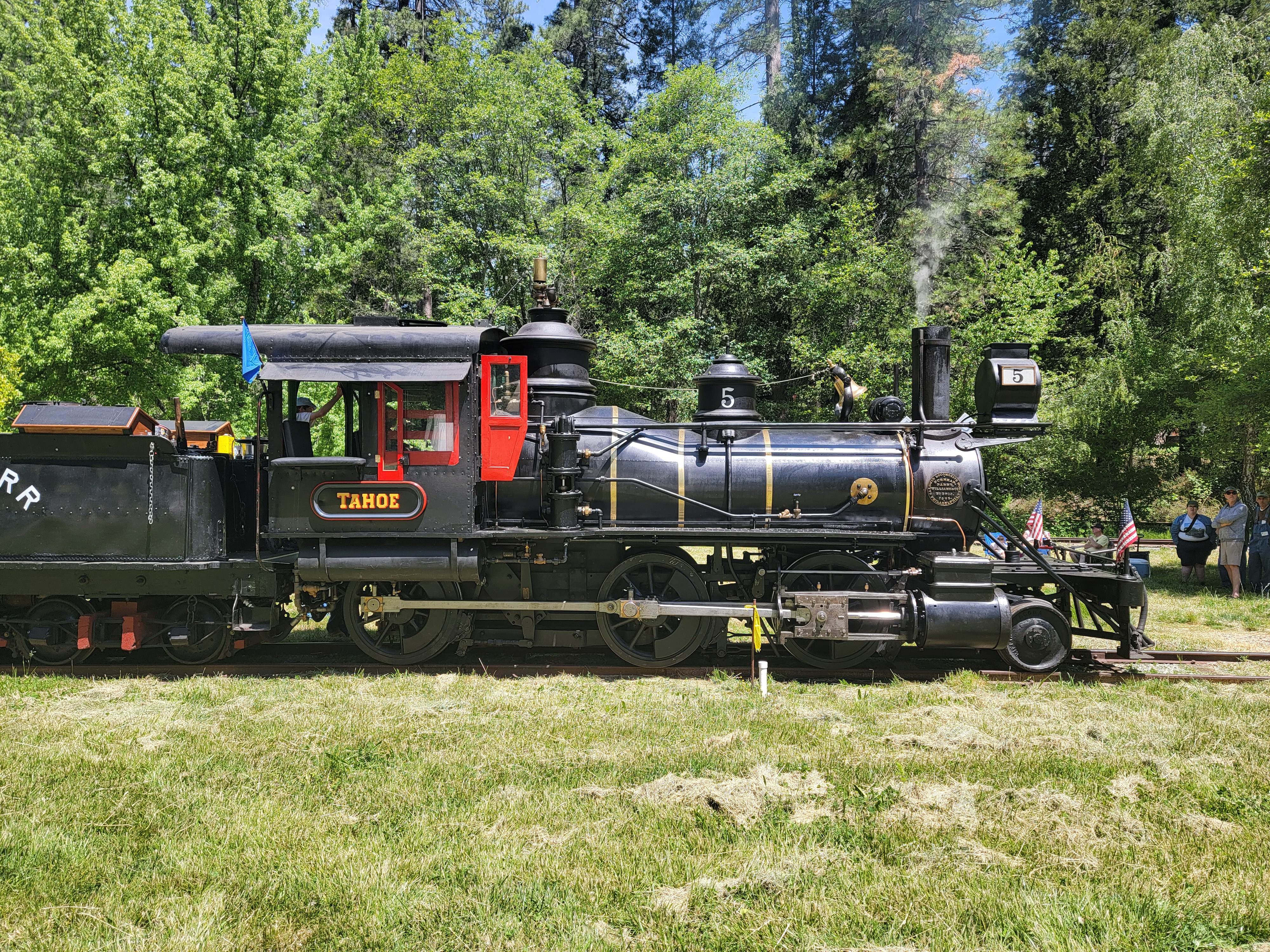
The Little Railroad That Went to Hollywood
Engine No. 5 has lived several lives. Built in Philadelphia in 1875 to haul timber around Lake Tahoe, sold to a narrow-gauge railroad winding through the Gold Country foothills, badly burned in a Grass Valley fire, shipped off to Hollywood to play bit parts in westerns, and finally returned to the Sierra Nevada town where it once worked. The Nevada County Narrow Gauge Railroad Museum in Nevada City, California, tells this kind of story - not the grand narrative of transcontinental rail, but the intimate, improbable tale of a small locomotive that refused to disappear. Founded in 1983 and operated by the Nevada County Historical Society, the museum preserves the rolling stock, photographs, and artifacts of a railroad that connected Nevada City and Grass Valley to the world for sixty-six years.
Three Feet Between the Rails
The Nevada County Narrow Gauge Railroad was never a sprawling enterprise. Its tracks, set at just three feet apart rather than the standard four feet eight and a half inches, ran through the rugged foothills of Nevada and Placer Counties from 1876 until 1942. Narrow gauge was a practical choice for mountain terrain - tighter curves, smaller tunnels, cheaper construction - but it also meant isolation. The railroad's equipment could not simply roll onto the tracks of the Southern Pacific or Central Pacific. Everything that moved on this line was built specifically for it, a closed ecosystem of specialized machinery threading through pine forests and around granite outcrops. For the mining towns of Grass Valley and Nevada City, this slender thread of steel was their lifeline to the broader economy, carrying ore, lumber, supplies, and passengers through country too rough for easy roads.
A Twin Born in Philadelphia
In 1875, the Baldwin Locomotive Works in Philadelphia built two identical 26-ton Mogul locomotives for the Carson and Tahoe Lumber and Fluming Company. These 2-6-0 engines were destined for the Lake Tahoe Railroad, where they would haul timber from the vast forests surrounding the lake. One of the twins, named The Glenbrook, survives today at the Nevada State Railroad Museum in Carson City, Nevada. The other - Engine No. 5, called The Tahoe - took a more winding path. Sold to the Nevada County Narrow Gauge Railroad in June 1899, it worked the mountain grades for sixteen years before fire swept through the Grass Valley rail yard on August 30, 1915. The blaze destroyed the locomotive's wooden cab and running boards, but the iron bones survived. Rebuilt and returned to service, Engine No. 5 kept hauling until the railroad itself gave out.
Second Act on the Silver Screen
When the Nevada County Narrow Gauge Railroad shut down in 1942, Engine No. 5 faced the scrapyard. Instead, Frank Lloyd Productions in Hollywood bought the locomotive and put it to work in front of cameras rather than behind a load of ore. The engine appeared in films including The Spoilers, a 1942 adventure starring Marlene Dietrich and John Wayne, and Rails Into Laramie in 1954. Universal Studios eventually took ownership, keeping the locomotive as part of its stable of period props. For decades, a machine built to haul Sierra lumber earned its keep pretending to be other trains in other places. It was a second career that no one in Nevada City could have predicted when the railroad closed - and one that, paradoxically, saved the engine from the cutting torch.
Homecoming
The museum brought Engine No. 5 back to Nevada County, where it was renovated and returned to operational condition. Today it steams through the museum's rail yard alongside another survivor: a small 0-4-0 tank locomotive built by H.K. Porter, Inc. in 1889 for the Sacramento Brick Company. The museum's collection extends beyond locomotives to include restored passenger cars undergoing painstaking renovation in its own workshop, a railbus that carries visitors on short excursions through the yard, and archives of photographs and documents spanning the railroad's entire history. The county's first steam automobile sits alongside displays of local aviation history, a reminder that the narrow gauge was only one chapter in the region's relationship with machines that move.
Keeping the Gauge Alive
Owned by the City of Nevada City, the museum occupies a quiet corner of a town that still feels shaped by the nineteenth century. Victorian storefronts line the streets above, and the forested Sierra foothills press close on every side. The Nevada County Historical Society operates the site, staffing the renovation shop where volunteers rebuild historic equipment with a blend of period techniques and modern precision. Short rail excursions let visitors ride behind equipment that once served real working lines, feeling the particular sway of narrow-gauge track beneath them. It is a modest museum by national standards - no massive roundhouses, no miles of mainline track. But modesty is the point. The Nevada County Narrow Gauge Railroad was a local line doing local work, and this museum preserves that human-scaled story with care and affection.
From the Air
The Nevada County Narrow Gauge Railroad Museum sits at 39.249N, 121.021W in Nevada City, California, in the western Sierra Nevada foothills at approximately 2,500 feet elevation. Best viewed at 2,000-3,000 feet AGL. The museum's rail yard and small collection of rolling stock are visible near downtown Nevada City. Nearest airport: Nevada County Air Park (GOO), approximately 3 nm south. Auburn Municipal Airport (AUN) is about 25 nm south-southwest. The town's Victorian-era downtown and surrounding pine forests are distinctive landmarks.