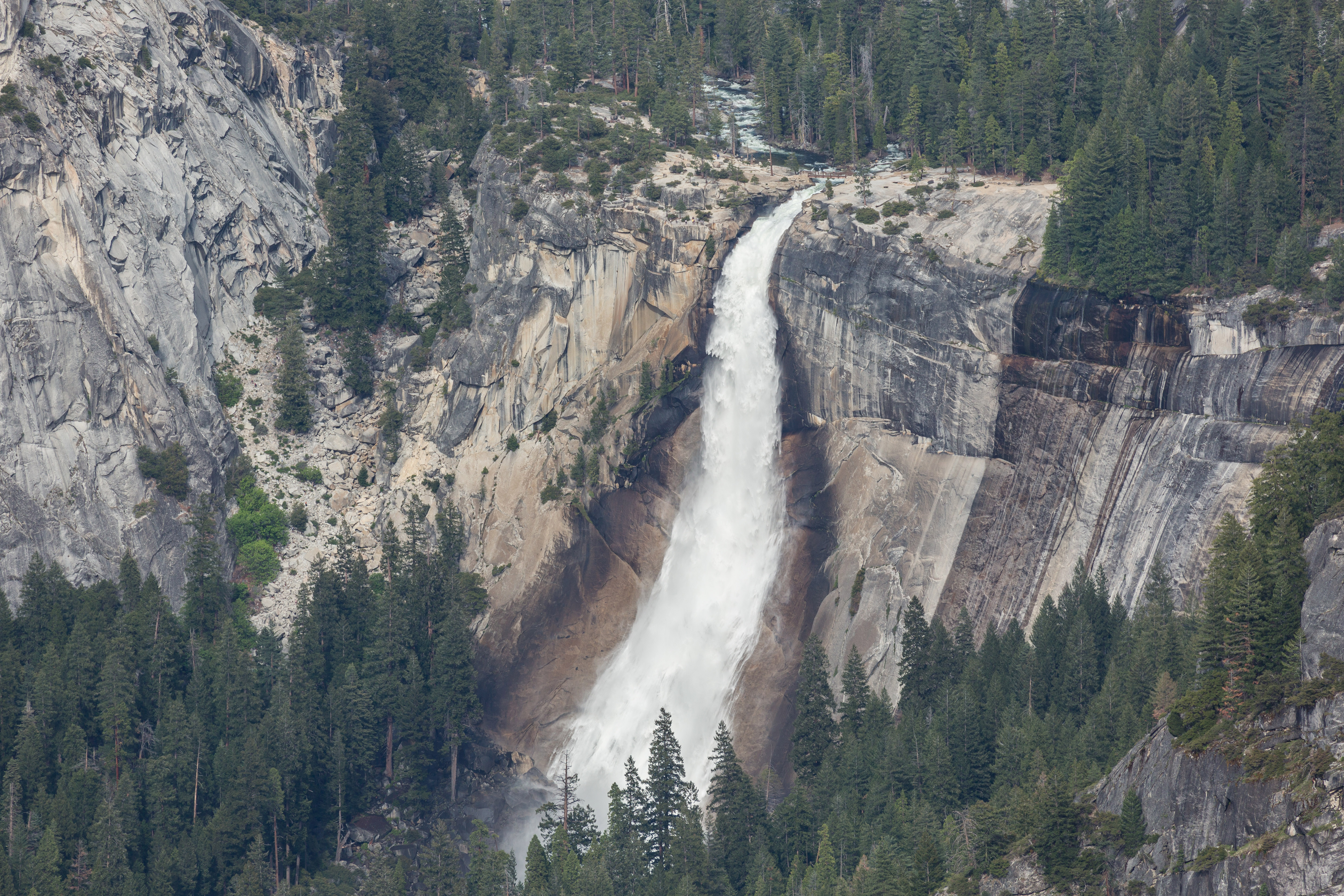
Nevada Fall
The word "Nevada" means snowy in Spanish, and Lafayette Bunnell chose it in the 1850s because the waterfall reminded him of an avalanche. The comparison is apt. Nevada Fall does not pour cleanly over its cliff like its downstream neighbor Vernal Fall. Instead, the water free-falls for roughly the first third of its 594-foot descent, then strikes a steep granite apron and explodes into a churning white mass that tumbles the remaining distance in a chaos of spray and foam. The impact at the midpoint is what gives Nevada Fall its signature bent shape - a kink in the curtain of water that makes it look, from Glacier Point, like a bolt of white fabric draped over a rocky knee. The Ahwahneechee people called it Yo-wy-we, a word describing the twist and squirm of falling water, which captures the motion more precisely than any English name could.
A Name for Every Season
Bunnell was a doctor with the Mariposa Battalion, the militia that forced the Ahwahneechee from Yosemite Valley in 1851. He was also the party's self-appointed poet, and he named landmarks with a romantic's eye. When he christened the lower waterfall Vernal Fall for its springtime associations, he wanted a wintry counterpart upstream. Nevada fit the bill - the white, foaming cascade evoked snowfields and cold peaks, and the name linked the waterfall to the Sierra Nevada range rising behind it. Bunnell wrote that the water "dashed down Yo-wy-we from the snowy mountains" and "represented to my mind a vast avalanche of snow." The naming was part of a deliberate program to replace indigenous place names with European ones, a pattern repeated across the American West. But Yo-wy-we persists in the historical record, and it remains a more accurate description of what the water actually does as it twists and bends against the cliff.
The Giant Staircase
Nevada Fall and Vernal Fall together form what geologists call the Giant Staircase, a series of granite steps down which the Merced River descends from the high country to the valley floor. Between the two waterfalls lies the Emerald Pool, a calm stretch of green water on a granite shelf where the river catches its breath before plunging over Vernal Fall's 317-foot drop. From Glacier Point, 3,000 feet above, the staircase structure is unmistakable - two white cascades stacked vertically with a green pool between them, like landings on a stairwell built for giants. The step-like topography was carved by glaciers that advanced and retreated through the valley over millions of years, scooping out rock at different rates depending on the hardness of the granite. The result is a landscape of ledges, and the Merced River has no choice but to fall from one to the next.
The Dangerous Edge
Above Nevada Fall, the Merced River widens into a pool so placid and inviting that swimmers have been using it for generations. There are no park restrictions against swimming here, despite the fact that the pool's downstream edge is the lip of a 594-foot waterfall. The consequences of misjudging the current have been fatal multiple times. In June 2011, three hikers were swept over the fall after entering the water above the brink. In June 2013, another death occurred at the same spot. In June 2018, an eighteen-year-old fell from the edge while attempting to take a selfie. The danger is deceptive because the pool itself is calm - the current strengthens gradually toward the lip, and by the time a swimmer feels the pull, there is often nothing to grab. The Park Service posts warning signs but has not closed the area, in part because the pool has been a swimming destination since the park's earliest days and in part because the sheer volume of visitors makes enforcement impractical.
The View from Below and Above
Most hikers encounter Nevada Fall from below, climbing the Mist Trail from Happy Isles through the spray of Vernal Fall and up the steep switchbacks that lead to the brink. The 2.7-mile climb gains 1,900 feet in elevation, and by the time hikers reach Nevada Fall they have already been drenched by Vernal Fall's mist. Nevada Fall itself produces less spray on the trail - the bent shape directs the mist sideways into the canyon rather than onto the path. Behind the waterfall rises Liberty Cap, a granite dome that looks from below like a clenched fist thrust skyward. The John Muir Trail passes the top of Nevada Fall on its way south toward Tuolumne Meadows and eventually Mount Whitney, 211 miles distant. For those who prefer an aerial perspective, Glacier Point offers perhaps the finest viewpoint in Yosemite - from there, the entire Giant Staircase unfolds like a diagram, with Nevada Fall at the top, the Emerald Pool in the middle, and Vernal Fall at the bottom, all connected by the silver thread of the Merced River.
From the Air
Located at 37.7253°N, 119.5328°W in the Merced River canyon east of Yosemite Valley. The 594-foot waterfall is visible from the air as a prominent white streak on the granite face, especially in spring. Liberty Cap, a distinctive granite dome, rises immediately behind the fall. The Giant Staircase formation (Nevada Fall + Vernal Fall) is best appreciated from above. Nearest airports: Fresno Yosemite International (KFAT), 65 miles south; Mariposa-Yosemite Airport (MPI), approximately 30 miles west. Best viewed at 3,000-5,000 ft AGL.