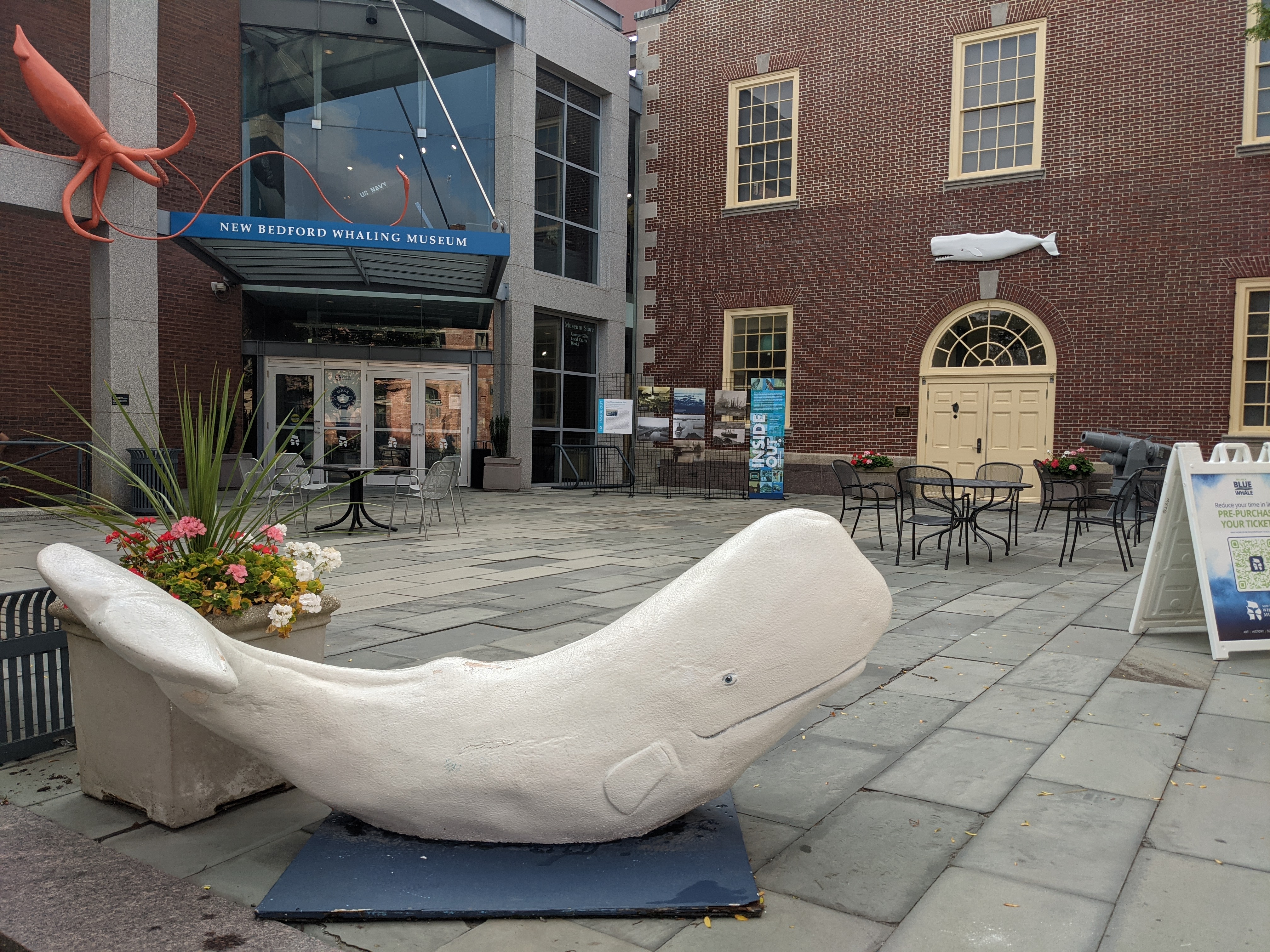
New Bedford Whaling Museum
"We are no longer a whaling museum without a whale, as some in the past have chosen to call us." Curator William Tripp spoke those words in 1936, the year a humpback skeleton named Quasimodo finally gave the New Bedford Whaling Museum the one thing it had been missing. Today, five complete whale skeletons hang in galleries that stretch across an entire city block on Johnny Cake Hill, and the museum holds over 750,000 artifacts documenting the era when whale oil lit the world and New Bedford sat at the center of it all.
A Crime Against History
The museum exists because a newspaper reporter shamed his city into action. On January 7, 1903, Ellis L. Howland of the Evening Standard stood before a gathering and delivered a blunt indictment: the logbooks that chronicled two centuries of whaling voyages were being ground up into wrapping paper and fiber wash tubs. The absence of a historical society, he declared, was "almost a crime." Six months later, one hundred founding members established the Old Dartmouth Historical Society and chose William W. Crapo, a local lawyer and congressman, as president. They rented rooms in the Masonic Lodge on the corner of Pleasant and Union Streets. Within a year, membership swelled to nearly 700, and the collection had already reached 560 artifacts. In 1906, industrialist Henry Huttleston Rogers donated the Bank of Commerce Building on Water Street, and a year later the New Bedford Whaling Museum opened its doors.
The Ship That Never Sailed
The museum's most dramatic artifact never touched water. In 1915, Emily Bourne donated the Bourne Building in memory of her father, Jonathan Bourne Jr., one of New Bedford's wealthiest whaling merchants. She then funded something extraordinary: a half-scale replica of her father's ship, the Lagoda, built inside the gallery. Completed in 1916, the model is the world's largest model whaling ship, fully rigged with sails and ropes and stocked with the supplies a crew would have needed for years at sea hunting sperm whales across the Pacific. The Lagoda sits permanently indoors, a landlocked vessel that captures the scale and ambition of an industry that sent New Bedford's fleet to every ocean on Earth. Nationwide interest in whaling history surged after the 1922 silent film Down to the Sea in Ships, filmed on location in New Bedford with local residents dressed in their grandparents' clothing as extras.
Bones That Tell Stories
Five whale skeletons now inhabit the museum's galleries, each one carrying its own history. Quasimodo, a three-year-old male humpback that died in 1932, was the first to arrive in 1936. A juvenile blue whale named KOBO -- King of the Blue Ocean -- joined the collection and now hangs in the Jacobs Family Gallery alongside Quasimodo. A 30-year-old male sperm whale skeleton arrived in 2002. The most poignant display came in 2008: the skeleton of Reyna, a 15-year-old North Atlantic right whale who was ten months pregnant at the time of her death, displayed with her fetus. None of the specimens came from whaling; all died from accidents or undetermined causes. In a museum built to document an industry of killing whales, the skeletons stand as monuments to the creatures themselves.
Scrimshaw, Logbooks, and the Melville Connection
The museum's collections include 3,000 pieces of scrimshaw and 2,500 logbooks from whaling ships -- both the largest such collections anywhere in the world. These logbooks are the primary documents of an industry that shaped global commerce for over a century, recording not just whale sightings and catches but weather, crew conflicts, and encounters with other ships. The collection doubled in size when the Kendall Whaling Museum of Sharon, Massachusetts, merged with New Bedford in 2001, adding some 70,000 artifacts. Fine art fills the galleries as well, including works by Albert Bierstadt, William Bradford, and Albert Pinkham Ryder, all of whom lived or worked in the New Bedford area. The museum partnered with the Melville Society in 2002 and now houses their extensive collection in the Research Library. Each year, visitors gather for the Moby-Dick Marathon Reading, an annual tradition that began in 1997, reading Melville's novel aloud from start to finish.
The City That Lit the World
The Azorean Whaleman Gallery, built in 1998 with the Azorean Maritime Heritage Society, tells the story of Portuguese sailors from the Azores who crossed the Atlantic on "a bridge of whale ships" and built a thriving community in New Bedford that endures today. An exhibit called Harbor Hope traces the region from Bartholomew Gosnold's 1602 landing through New Bedford's rise to surpass Nantucket as America's largest whaling center around 1827. The museum sits within the New Bedford Whaling National Historical Park, established in 1996, though it operates independently. Across the street stands the Seamen's Bethel, the chapel that inspired the pulpit scene in Moby-Dick. A twenty-minute film titled The City that Lit the World, produced by the National Park Service, plays for visitors -- a fitting name for a port whose whale oil illuminated streetlamps and parlors across America and Europe before petroleum changed everything.
From the Air
The New Bedford Whaling Museum sits at 41.6353N, 70.9232W on Johnny Cake Hill in downtown New Bedford, Massachusetts. From the air, look for the dense historic waterfront district along Buzzards Bay. The museum complex occupies an entire city block within the National Historical Park. Nearest airport is New Bedford Regional Airport (KEWB), roughly 3 nm to the north. Nantucket Memorial Airport (KACK) is about 30 nm to the southeast across Buzzards Bay. Best viewed at 2,000-3,000 feet AGL for context of the historic waterfront.