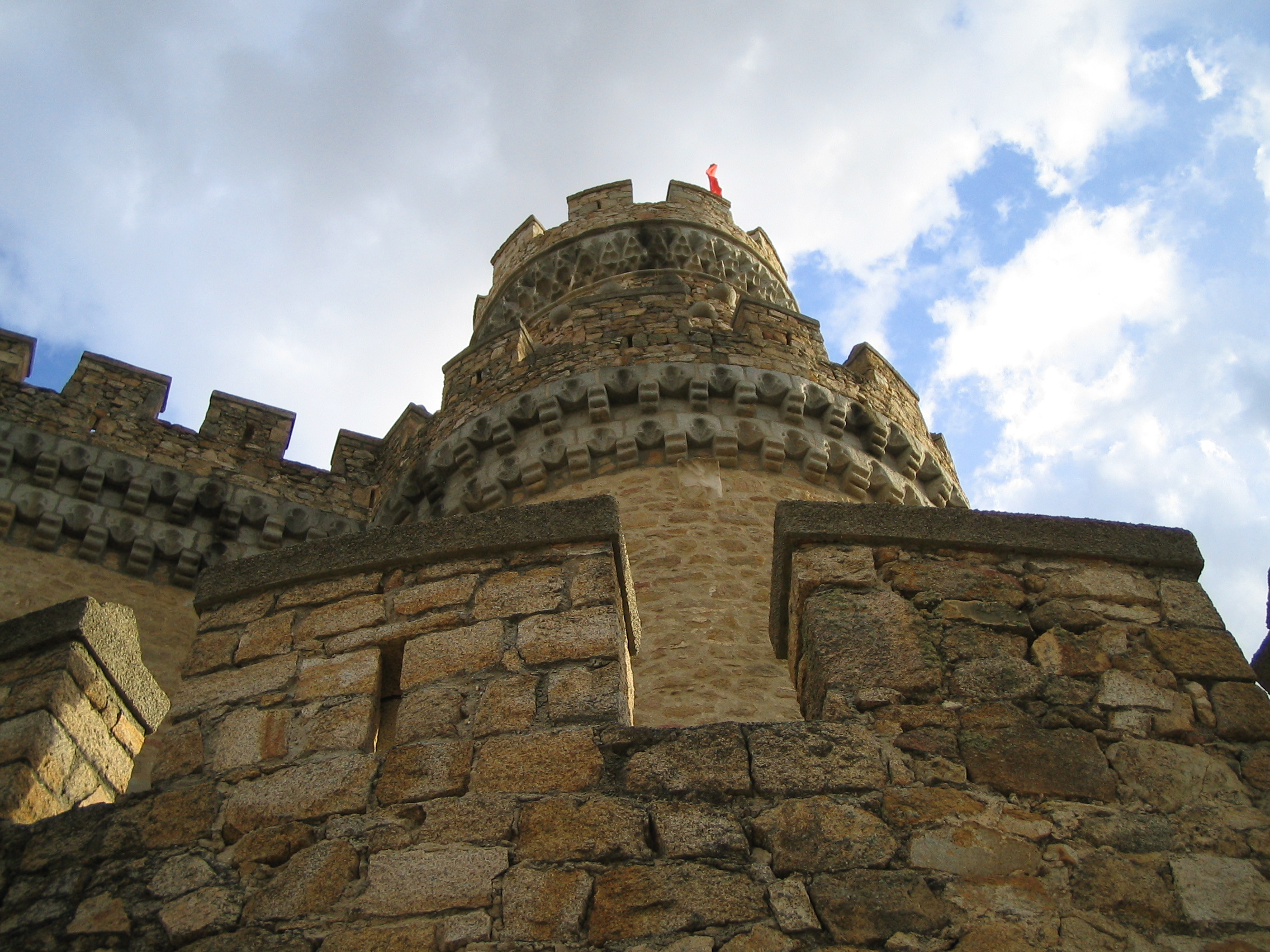
New Castle of Manzanares el Real
The man who started building it never saw it finished. Diego Hurtado de Mendoza, 1st Duke of the Infantado, broke ground on the New Castle of Manzanares el Real in 1475, raising a palace-fortress in granite beside the Santillana reservoir at the foot of the Sierra de Guadarrama. He died before the towers were complete. His son Inigo Lopez de Mendoza finished the job, hiring the architect Juan Guas -- the same man who designed the family's Palace of the Infantado in Guadalajara -- to give the castle the kind of Isabelline Gothic ornamentation that announced to everyone in central Castile exactly how wealthy and connected the Mendozas had become.
Contested Ground
Long before the Mendozas arrived, the upper reaches of the Manzanares River were fought over. Rich in pastures and forests, these lands were disputed for centuries by the rival communities of Segovia and Madrid after the Reconquista. In the fourteenth century, King John I of Castile settled the matter by donating the entire comarca to his steward, Pedro Gonzalez de Mendoza. The eldest Mendoza son, Diego Hurtado de Mendoza, Admiral of Castile, built the first fortress on the site -- now known as the Old Castle of Manzanares el Real -- though the structure likely had even earlier origins. When the family decided to build something grander in the 1470s, they simply left the old fortress to decay.
Stone, Towers, and Ambition
The castle is built entirely of granite, a quadrangular structure with four circular towers whose vertices are decorated with stone balls in the Isabelline Gothic style. The main hexagonal tower is the architectural highlight. A terrace ringed with machicolation and turrets crowns the building, while inside, a rectangular courtyard features porticos and two galleries supported by octagonal columns. The Gothic gallery on the first floor is considered the finest in all of Spanish military architecture. The southern chemin de ronde displays flaming tracery on parapets decorated with diamond shapes. Surrounding everything is a barbican carved with the cross of the Holy Sepulchre of Jerusalem -- a title held by Pedro Gonzalez de Mendoza, a reminder that this was a family that collected honors the way other families collected sheep.
A Century of Splendor, Then Silence
The castle served as a palatial residence for barely a hundred years. When Inigo Lopez de Mendoza y Pimentel, the 4th Duke of the Infantado, died in 1566, the castle ceased to be inhabited. Economic problems and inheritance disputes among the Mendoza heirs drained the family's resources and interest. The fortress that had been designed to project wealth and influence became just another abandoned castle on the Castilian landscape. It stood empty for centuries, its granite walls enduring where lesser materials would have crumbled.
From Film Set to Parliament
Neglect preserved the castle in a way that use might not have. Declared a Monumento Historico-Artistico in 1931, it is today one of the best-preserved castles in the Community of Madrid. In 1961, Charlton Heston rode through its gates when the castle served as a location for the film El Cid. More consequentially, in 1982 the castle hosted the establishment of the Parliamentary Assembly of Madrid, where the region's Statute of Autonomy was presented -- a moment of democratic rebirth inside walls built for aristocratic display. The castle now houses a museum of Spanish castles and a collection of tapestries. Still owned by the Duchy of the Infantado, it is managed by the Community of Madrid as a tourist attraction, a fate the ambitious Mendozas could never have imagined.
From the Air
Located at 40.727N, 3.862W at the foot of the Sierra de Guadarrama, approximately 50 km north of central Madrid. The castle is clearly visible from the air beside the Santillana reservoir, a large body of water that makes an excellent visual reference point. The granite fortress contrasts sharply with the surrounding terrain. Nearest airports: Madrid-Barajas (LEMD) approximately 55 km southeast, or Cuatro Vientos (LECU) approximately 45 km south. Best viewed at 3,000-5,000 ft AGL with the reservoir and mountains as backdrop.