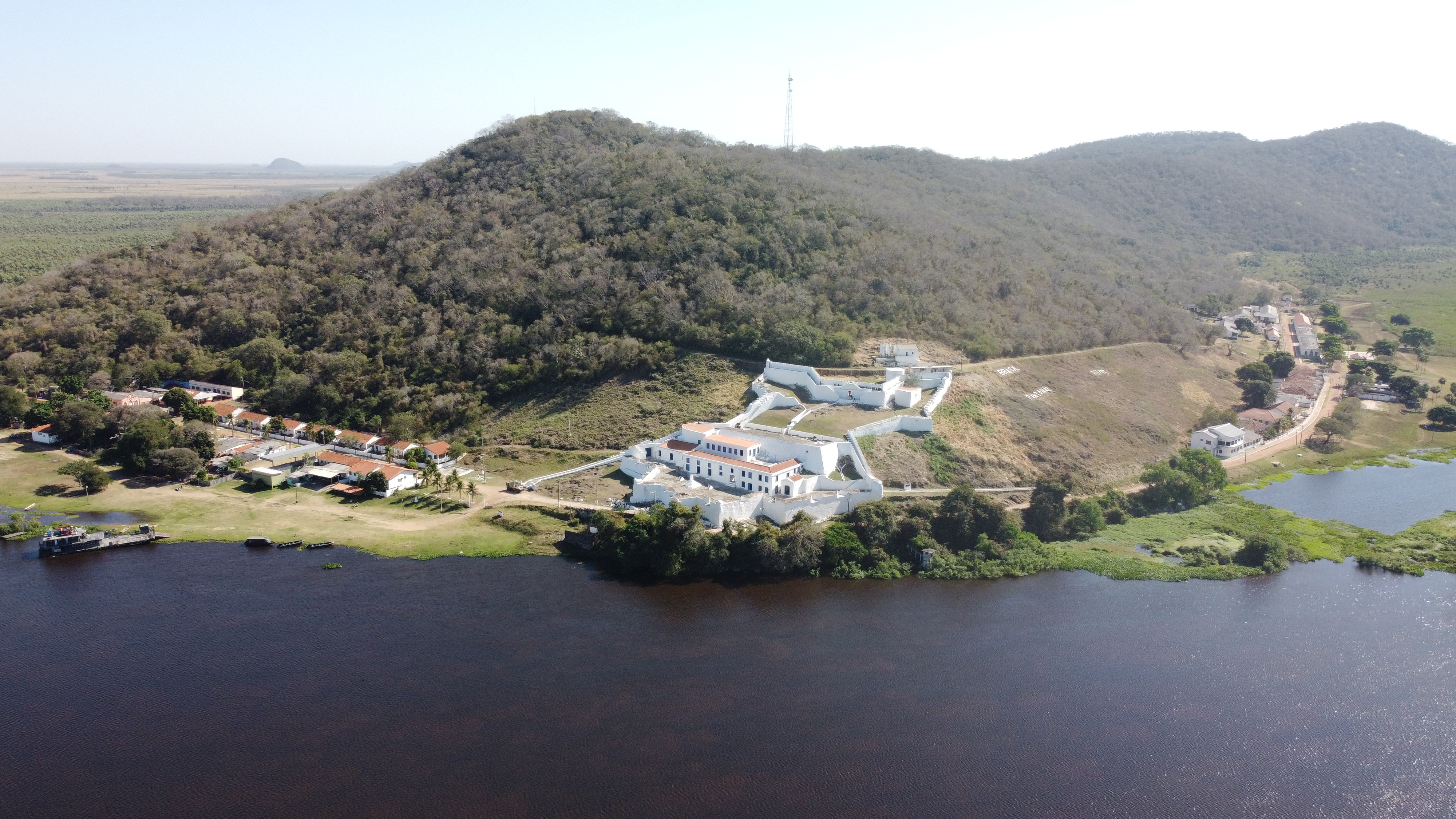
New Coimbra Fort
When one of its officers is promoted to general, no matter where in Brazil they serve, tradition requires them to send a gold star from their epaulettes back to the shrine of the Virgin of Carmel inside Fort Coimbra. It is a small gesture that speaks to something larger: this fortress on the Paraguay River, founded in 1775 and still garrisoned by the Brazilian Army, has accumulated nearly 250 years of loyalty, siege, abandonment, and reconstruction. Its walls have been shattered by Paraguayan artillery and rebuilt. Its guns have been captured and replaced. Its name has changed -- from Presidio de Coimbra to New Coimbra Fort to Fort Portocarrero -- but the place endures, perched on a hill where the river narrows and two long stretches of water meet at an obtuse angle.
A Frontier Drawn in Stone
The fort exists because of a line on a map. The Treaty of Madrid in 1750 attempted to settle the borders between Spanish and Portuguese territories in South America, and Portugal needed physical markers to enforce its claims in the remote interior of Mato Grosso. Bandeirantes from Sao Paulo and Jesuit missionaries from Paraguay had been pushing through the region since the early 18th century, but no permanent military presence anchored Portuguese authority along the Paraguay River. When the first colonial captain-general, Antonio Rolim de Moura Tavares, arrived in 1751, he began consolidating plans for defense. By 1772, the captaincy's fourth governor ordered construction to begin. An expedition departed from Cuiaba on July 22, 1775, and founded the fort on September 13 at a place previously called St. Francis's Narrows, where the river squeezed between its banks. The fort would also serve to inhibit raids by the Payagua and Kadiweu peoples, though the Kadiweu would later become crucial allies.
Forty-Two Against Six Hundred
The fort's most improbable defense came in September 1801, when it was still under construction. A Paraguayan expedition of four schooners and two canoes carrying 600 men arrived to assert Spanish territorial claims under the Treaty of Madrid. The fort encroached on what Spain considered its land, and news that the War of the Oranges had ended in peace had not yet reached this remote stretch of river. The garrison numbered just 42 men. But the Kadiweu people, now friendly with the Portuguese, had warned the defenders of the approaching force. The small garrison resisted the initial assault and then endured a ten-day siege. Storms damaged the Paraguayan ships, supplies ran short, and the attackers withdrew, having lost 20 men. It was the kind of stand that turns a military outpost into a symbol -- proof that geography and determination could substitute for numbers.
The Night the Fort Fell Silent
The fort's most dramatic chapter came on December 27, 1864, when the Paraguayan War opened with a massive assault on Coimbra. Colonel Vicente Barrios commanded 3,200 men -- five infantry battalions, two dismounted cavalry regiments, twelve rifled guns, a French-equipped rocket battery, and eleven warships. The fort's commander, Captain Benito de Faria, was outranked by Lieutenant Colonel Hermenegildo Portocarrero, who happened to be conducting a routine inspection. Portocarrero took command and replied to the surrender demand with defiance: "Only through luck and the honor of arms will we deliver the fort." The garrison of 125 regulars, 30 national guardsmen, some customs guards, 6 prisoners, and 24 indigenous allies fought for two days. Their families helped reload weapons and tend the wounded. On the siege's second day, a story persists that Portocarrero's wife ordered an army musician to raise an image of the Virgin of Carmel above the walls. The Paraguayans ceased fire and shouted "Long live Our Lady," giving the fort's women time to slip down to the river for water. Outgunned and with no relief possible, Portocarrero evacuated the garrison by night aboard the gunboat Anhambai. The Paraguayans suffered around 200 casualties; the Brazilians lost none. The fort remained in Paraguayan hands until April 1868.
Stone Walls and Living Memory
After the war ended in 1870, the fort was rebuilt from near-total destruction -- its walls had been almost completely shattered by artillery fire. Between 1907 and 1908, two 120mm Armstrong guns from the ironclad Barroso were mounted on its ramparts. New quarters rose beside the old walls in 1930. In 1974, Brazil's National Institute of Historic and Artistic Heritage declared it a heritage site. Today the fort houses the Portocarrero Company -- named in 2002 for the officer who defied the surrender demand -- though it was downsized to a platoon in 2016. Historical artillery pieces line the grounds, including guns that span centuries of Brazilian military history. The chapel where the Virgin of Carmel's shrine receives its offerings from newly promoted generals still stands within the star-shaped walls. The fort's position remains strategically relevant: from its hilltop, the river stretches in both directions toward the borders of Bolivia and Paraguay, a view that has justified military presence here since 1775.
From the Air
Located at 19.92S, 57.79W on the Paraguay River near Corumba, Mato Grosso do Sul, Brazil, close to the Bolivian and Paraguayan borders. The star-shaped fort is visible on a hilltop at a narrowing of the river. Best viewed at 2,000-4,000 feet AGL. Nearest airport: Corumba International Airport (SBCR). The river widens both upstream and downstream of the fort's position, making the narrows distinctive from the air.