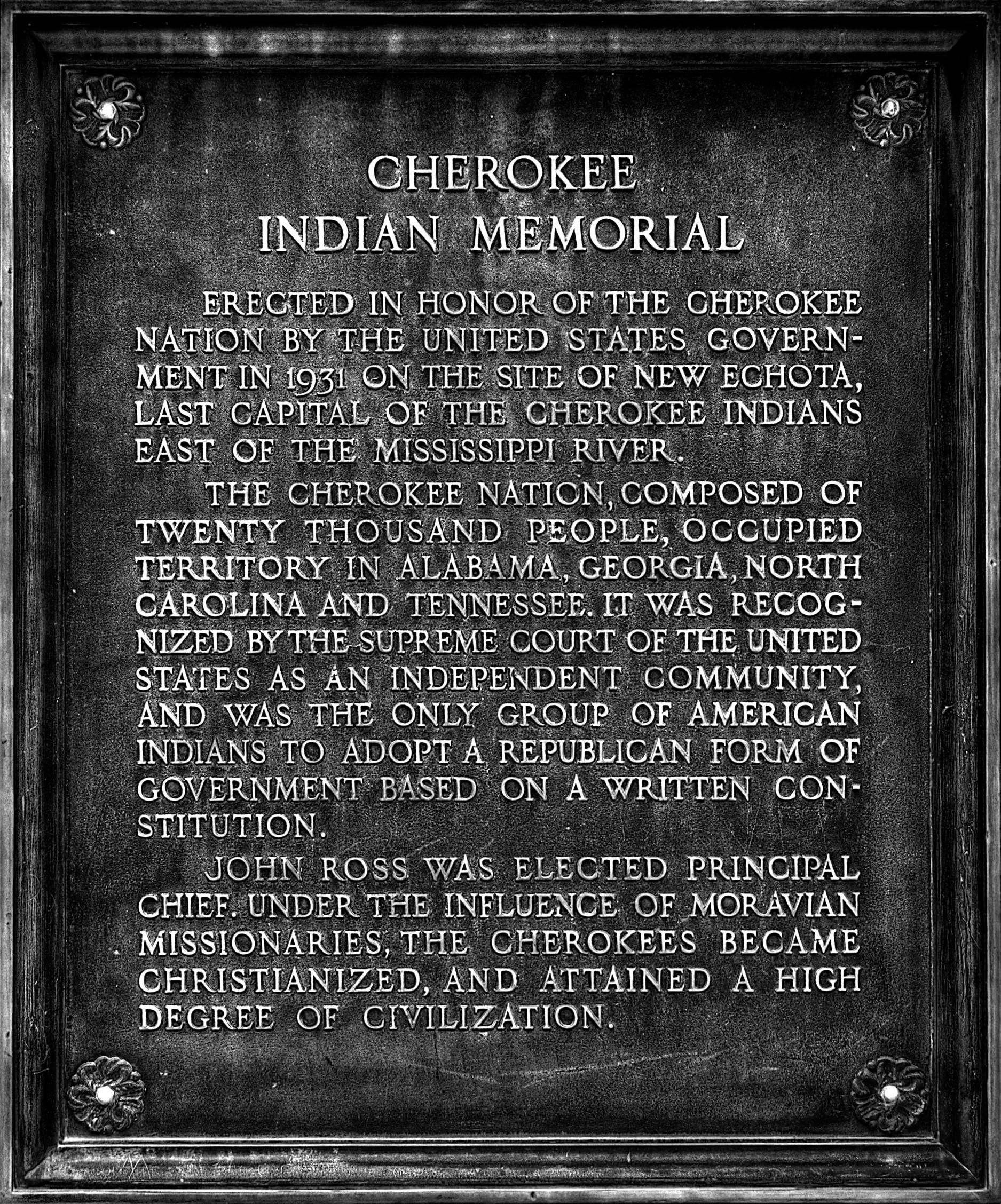
New Echota
On December 29, 1835, in a modest house in northwest Georgia, a small group of Cherokee signed away a nation. The Treaty of New Echota, agreed to by perhaps 500 of the 16,000 Cherokee then living in the Southeast, ceded all remaining tribal lands east of the Mississippi. Within three years, the U.S. Army would march thousands along the Trail of Tears. But the place where this happened was no backwater outpost. New Echota was a capital city -- the seat of a Cherokee government that operated a two-story council house, a supreme court, and the printing press of the first Native American newspaper.
A Capital Built at the Confluence
New Echota sits where the Coosawattee and Conasauga rivers meet to form the Oostanaula, a tributary of the Coosa. Archaeological evidence shows indigenous peoples inhabited this confluence for thousands of years before the Cherokee arrived. The Cherokee called the area Gansagiyi and used the nearby town of Ustanali as their seat of government beginning in 1788, after migrating south from eastern Tennessee under pressure from European-American settlement. By 1819, the Cherokee government was meeting at the site they would rename New Echota in 1825, honoring Chota, the former capital of the Overhill Cherokee along the Little Tennessee River. The English called the place simply "Newtown." The Cherokee called it the center of their world.
Syllabary in Lead Type
What made New Echota remarkable was not just governance but literacy. In 1820, Sequoyah completed his syllabary -- a writing system for the Cherokee language. Within a few years, Elias Boudinot and missionary printer Samuel Worcester were using it to publish the Cherokee Phoenix, the first Native American newspaper, printed in both English and Cherokee with type specially cast by Worcester. The council built a two-story Council House, a Supreme Court building, and the printer's shop. Private homes, stores, a ferry, and a mission station grew around them. Most of the year the town sat quiet, but when the council convened, hundreds of Cherokee arrived on foot, horseback, and in stylish carriages for gatherings that were as much social celebration as political assembly.
A Treaty Signed, a Nation Removed
After Congress passed the Indian Removal Act in 1830, Georgia began distributing Cherokee land to white settlers through its Sixth Land Lottery of 1832, despite the Cherokee never having ceded it. The U.S. Supreme Court upheld Cherokee rights, but Georgia pressed ahead. The Georgia Guard evicted Cherokee from their properties. By 1834, New Echota was becoming a ghost town, and council meetings shifted to Red Clay in present-day Tennessee. Then came the treaty. Major Ridge, John Ridge, and a minority faction known as the Treaty Party signed the Treaty of New Echota in Boudinot's home, believing negotiation might preserve some Cherokee sovereignty in western lands. Principal Chief John Ross, representing the majority, protested. The Senate ratified the treaty anyway. In 1838, under General Winfield Scott, the Army began forced removal. A concentration camp called Fort Wool held Cherokee at New Echota before their march westward.
A Century of Silence, Then Discovery
After the removal, New Echota stood abandoned for over a hundred years. Most structures vanished; a few houses lingered in use. In March 1954, archaeologist Lewis Larsen and a team from the Georgia Historical Commission began excavating the site. They uncovered 1,700 artifacts, including 600 items identified as Cherokee, a Spanish coin dated 1802, crockery, household wares, and -- most remarkably -- much of the lead type syllabary once used to print the Cherokee Phoenix. The discovery prompted Georgia to authorize reconstruction of the town as a state park in 1957. Today, visitors walk among rebuilt versions of the Council House, the Supreme Court, and the printer's shop. The Worcester House, home of the missionary called "the Messenger," was restored to its 19th-century condition. Vann's Tavern, originally owned by Chief James Vann who operated 14 taverns across Georgia, was relocated from Forsyth County.
What Remains
New Echota Historic Site opened to the public in 1962. Inside the reconstructed Cherokee Phoenix office, 600 pieces of original type went on display -- the physical alphabet of a people who refused to be illiterate in the language of their colonizers. In 1973, the U.S. Department of the Interior designated New Echota a National Historic Landmark, the nation's highest recognition. The Newtown Trail, a 1.2-mile interpreted path, leads visitors to Town Creek at the center of the old capital, where Cherokee once camped during council sessions. A monument on the grounds honors those who died on the Trail of Tears. The site stands as both museum and memorial -- proof that the Cherokee built a constitutional government, a free press, and a literate society, and that these achievements were deliberately destroyed by the nation that surrounded them.
From the Air
New Echota is located at 34.539N, 84.909W in Gordon County, northwest Georgia, at the confluence of the Coosawattee and Conasauga rivers forming the Oostanaula. Best viewed at 2,000-3,000 ft AGL. The river confluence is the primary visual landmark. Nearest airports include Richard B. Russell Airport (KRMG) in Rome, GA approximately 25 nm to the south. Calhoun, GA lies just to the south of the site. Look for the open-air museum grounds and reconstructed buildings along the river junction.