New London School Explosion
Walter Cronkite was twenty years old and working one of his first assignments for United Press when he arrived in New London, Texas, on March 18, 1937. Decades later, after covering World War II and the Nuremberg trials, he said: "I did nothing in my studies nor in my life to prepare me for a story of the magnitude of that New London tragedy, nor has any story since that awful day equaled it." What Cronkite found in that small East Texas oil town was the deadliest school disaster in American history -- 295 students and teachers killed in a single explosion caused by a gas leak that everyone should have noticed and no one did. The catastrophe remains the third-deadliest disaster in Texas history, behind only the 1900 Galveston hurricane and the 1947 Texas City disaster.
Oil Wealth and a Fatal Shortcut
In the mid-1930s, while much of America buckled under the Great Depression, the New London school district was one of the richest in the country. The 1930 discovery of oil in Rusk County had flooded the local economy with money, and the district's taxable value swelled to $20 million. Fifteen oil wells sat on school property alone. The London School, a substantial steel-and-concrete structure built in 1932 at a cost of $1 million, was a source of local pride. Its football team, the London Wildcats -- named after the wildcatters who drilled for oil -- played under some of the first electric stadium lights in Texas. But the school board made a fateful decision. Early in 1937, it canceled the natural gas contract and had plumbers tap into Parade Gasoline Company's residue gas line to save money. The practice was common in the oil fields: raw natural gas was considered a waste product, flared off at the wellheads, and oil companies turned a blind eye to the tapping. The problem was that untreated natural gas is both odorless and colorless. Invisible and undetectable, it began leaking into the crawlspace beneath the school.
3:17 in the Afternoon
Students had been complaining of headaches for weeks, but no one connected the symptoms to a gas leak. On March 18, the younger students -- grades one through four -- had been dismissed early for the next day's Interscholastic Meet in neighboring Henderson. A PTA meeting was underway in the gymnasium, a separate building. Approximately 500 students and 40 teachers remained in the main building. At 3:17 p.m., manual training instructor Lemmie R. Butler switched on an electric sander. The spark ignited the gas-air mixture that had accumulated in the crawlspace running the full length of the building's facade. The explosion obliterated the school. Survivors described a world gone suddenly, impossibly silent before sound rushed back all at once. The majority of the dead were students in grades five through eleven.
Seventeen Hours in the Rubble
Aid descended on New London from across Texas. Governor James V. Allred dispatched the Texas Rangers, the Highway Patrol, and the National Guard. Thirty doctors, 100 nurses, and 25 embalmers arrived from Dallas. Airmen from Barksdale Field, deputy sheriffs, and Boy Scouts joined the desperate search through the wreckage. Rescuers worked through the night and through rain, and in their urgency often pulled bodies free without checking whether they were alive or dead. Seventeen hours after the blast, the site was cleared. Buildings in Henderson, Overton, Kilgore, Tyler, and Longview were converted into makeshift morgues. One survivor recalled: "Daddy worked so long he almost had a nervous breakdown. As long as he was working he was fine, but as soon as he came home and sat down he'd start shaking." Reporters who arrived were pressed into service as rescuers. Felix McKnight, then a young Associated Press reporter, remembered being told that helpers were needed far more than journalists.
The Smell That Saves Lives
The investigation by the United States Bureau of Mines found that the connection to the residue gas line was faulty, allowing gas to seep undetected into the school. Because natural gas was invisible and odorless, the leak had gone entirely unnoticed. The Texas state legislature responded by granting the Texas Railroad Commission authority to require the odorization of natural gas. Within weeks of the explosion, thiol -- a sulfur compound also called mercaptan -- was added to natural gas supplies. That distinctive rotten-egg smell now instantly recognized in homes and businesses across the world exists because of what happened in a school in New London, Texas. The disaster also led Texas to restrict the professional title of "engineer" to those certified by the state, a regulation that remains in effect today.
What Remains in New London
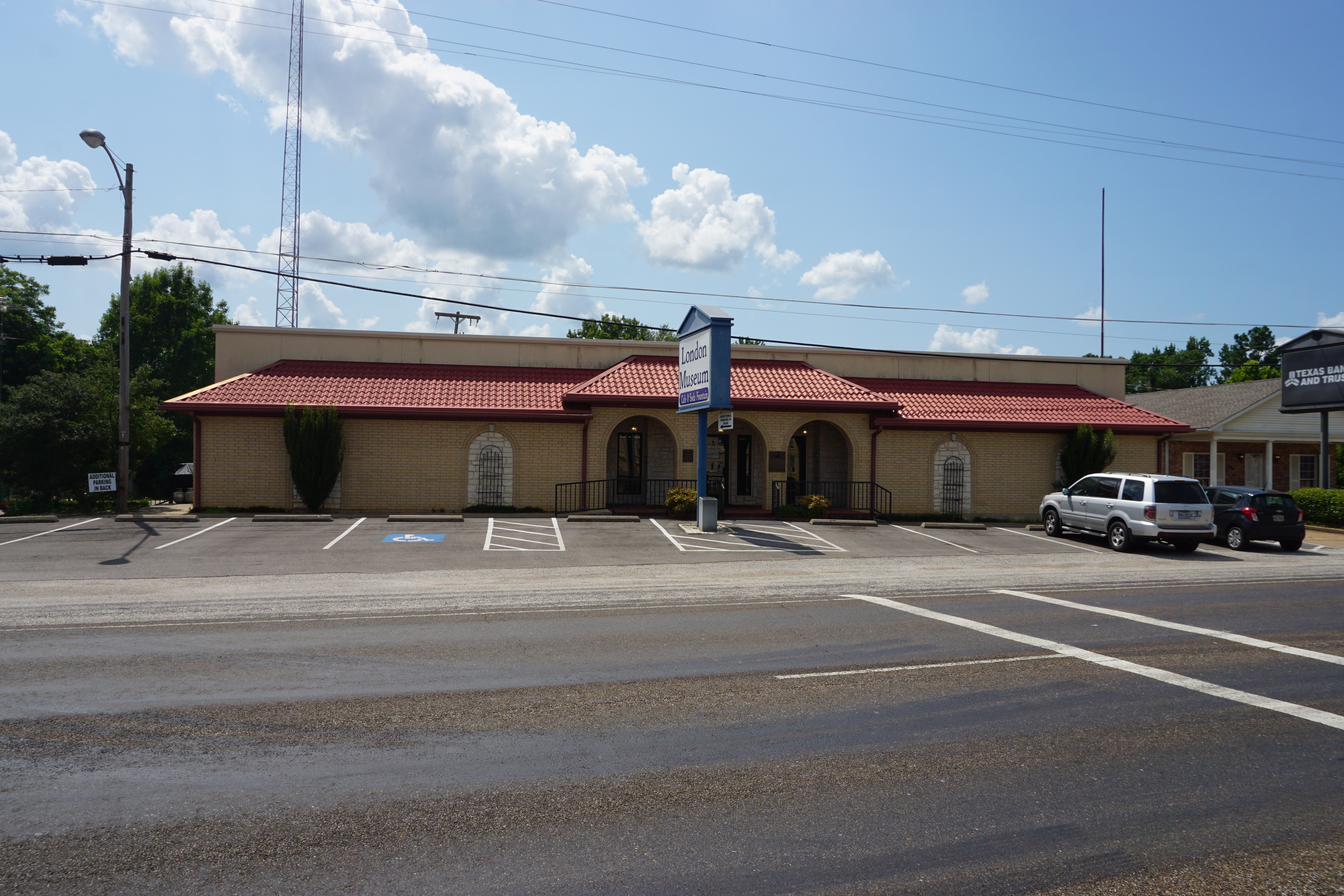
The surviving gymnasium was converted into classrooms, and classes resumed just ten days after the explosion, with thirty surviving seniors finishing the school year there. Eleanor Roosevelt sent a telegram of sympathy. Adolf Hitler, then leading Nazi Germany, sent one as well; a copy is displayed at the London Museum. In 1998, the London Museum and Tea Room opened across the highway from the school site. Its first curator, Mollie Ward, was herself an explosion survivor. She later served as mayor of New London before her death in 2013. The majority of victims are buried at Pleasant Hill Cemetery nearby, where an entire section is dedicated to them. Every March, the community gathers to remember. The school has been rebuilt, the town has carried on, but the memory of that afternoon at 3:17 persists -- preserved in documentary films, oral histories, and the faint sulfur odor that drifts from every gas stove in America.
From the Air
Located at 32.239N, 94.941W in the East Texas oil patch, Rusk County. New London is a small town surrounded by oil fields and piney woods. The rebuilt school campus and the London Museum across Highway 42 are the main landmarks. Nearby airports: KGGG (Longview/East Texas Regional, 20 nm northeast), KJXI (Cherokee County, 22 nm west), KHDO (Henderson, Rusk County, 10 nm south). Best viewed at 2,000-3,000 ft AGL. Oil well pump jacks scattered across the surrounding countryside are visible at low altitude.