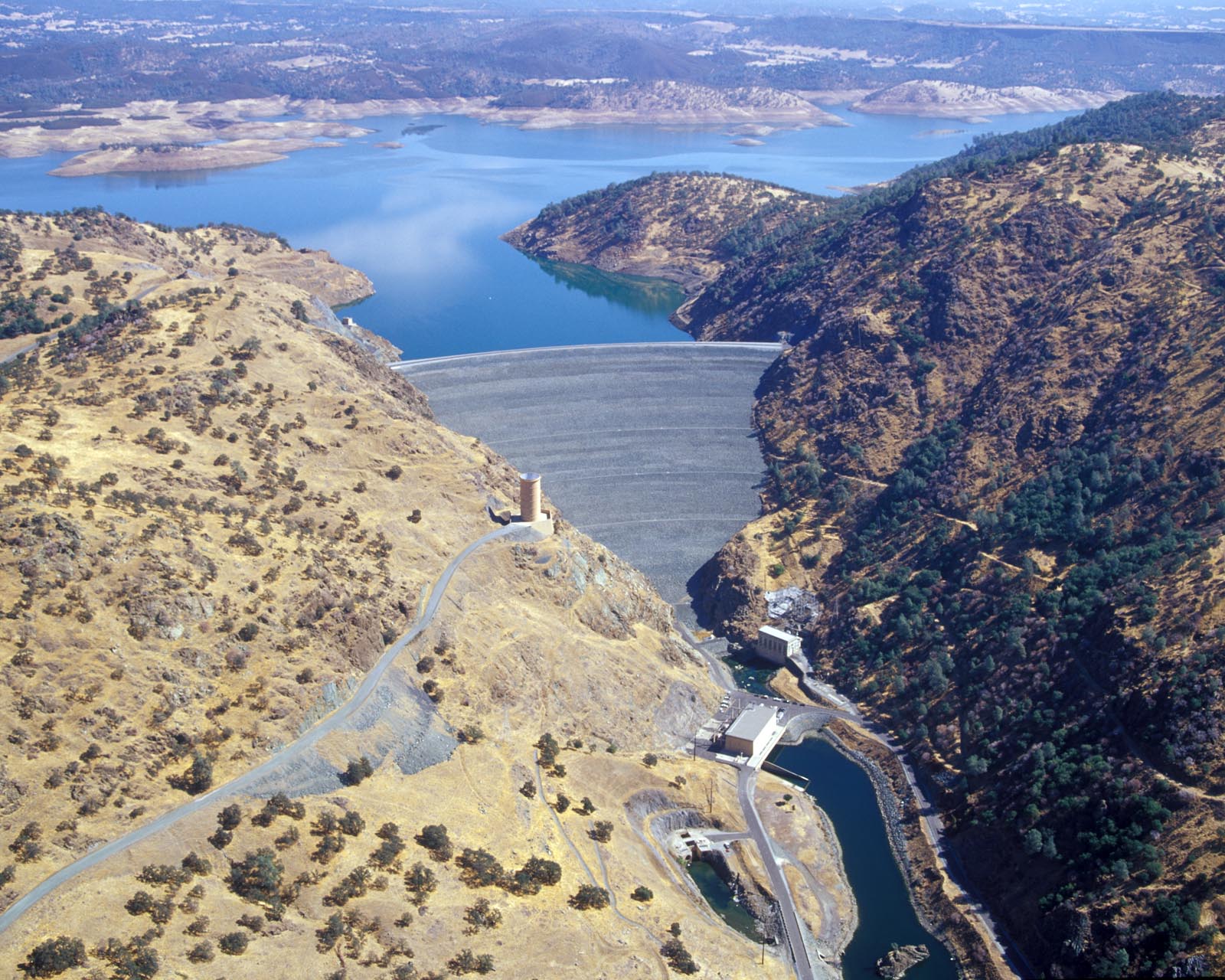
New Melones Dam
In 1979, Mark Dubois chained himself to rocks in a hidden location along the Stanislaus River, forcing the U.S. Army Corps of Engineers to halt the filling of New Melones Lake until they could find and free him. His dramatic protest captured national attention, but the river he fought to save would ultimately disappear beneath 2.4 million acre-feet of water. New Melones Dam stands as the second tallest earthfill dam in the United States, yet the Bureau of Reclamation calls it 'a case study of all that can go wrong with a project.' Since its completion, no dam of its size has been built in America.
A Canyon Drowned
The Stanislaus River once flowed through the deepest limestone canyon in the western United States, with cliffs rising hundreds of feet above whitewater rapids. Extensive limestone caves harbored endemic species found nowhere else on Earth, including Banksula melones, the Melones cave harvestman. More than one hundred archaeological and historical sites, left by Native Americans and Gold Rush settlers, dotted the canyon. Whitewater rafters considered it one of California's premier runs. All of it now lies beneath the reservoir's surface, emerging only during the most severe droughts when water levels drop low enough to reveal the old Melones Dam, submerged since 1978, and the ghostly outlines of the original canyon.
The Battle for the Stanislaus
The fight over New Melones Dam galvanized the river conservation movement in California. Friends of the River formed in the early 1970s to push Proposition 17, a ballot measure that would have designated nine miles of the Stanislaus as a National Wild and Scenic River and stopped the dam's construction. Development interests - PG&E, the California Chamber of Commerce, and dam contractors - spent millions opposing it. Their slogan 'Stop the Wild River Hoax!' argued the river was ineligible because dams already existed upstream and downstream. The proposition lost 52.5% to 47.5%. When protesters couldn't stop construction, they chained themselves to rocks as the water rose. One woman moved into a cave above the rising waterline, refusing to leave until sheriff's deputies carried her out.
Nature Decides
Political maneuvering delayed the reservoir's filling for years. Governor Jerry Brown vetoed legislation allowing the dam to fill completely, and environmental studies suggested a smaller reservoir would actually better serve salmon populations and flood control. Friends of the River agreed to a compromise allowing partial filling. Then nature intervened. The winter of 1982 was one of the wettest in the twentieth century. The Stanislaus swelled beyond what the dam's outlets could safely release, and the reservoir rapidly exceeded its temporary limit. The following winter pushed water to the lip of the emergency spillway - a level never surpassed since. In March 1983, with the lake full, California lifted the temporary restrictions. The debate was over. The valley was gone.
The Over-Allocated Lake
New Melones Dam has never lived up to its promises. The water yield calculations, based on stream flow data from 1922 to 1978, may have reflected a wetter-than-normal period. In an average year, the reservoir cannot meet all demands placed on it. Environmental regulations now require substantial releases for salmon and steelhead, leading local farmers to derisively nickname it the 'green dam' because policy favors fish over agriculture. The old Melones Dam, never demolished, sits submerged far below the surface, partially blocking the movement of cold water from the reservoir's depths. This forces warmer surface water through the outlets, sometimes making it impossible to maintain temperatures cold enough for spawning fish while simultaneously providing irrigation water.
The Last Great Dam
The controversy over New Melones changed American water policy. The Reclamation Reform Act of 1982 set stringent new standards for federal water projects, 'distancing federal policy from the dams-everywhere approach of the past.' Several California rivers - the Eel, Klamath, and others - gained protection under the National Wild and Scenic Rivers System. A proposed hydroelectric project on the nearby Tuolumne River was cancelled less than two years after New Melones was completed. Yet the lack of new water storage has strained California's system, which now serves 15 million more people than it did in 1979. An estimated 800,000 people visit New Melones Lake each year for boating, fishing, and camping, though droughts periodically close facilities due to low water levels.
From the Air
New Melones Dam is located at coordinates 37.947N, 120.528W on the Stanislaus River near Jamestown, California. The massive earthfill structure is clearly visible from the air, as is the distinctive blue-green reservoir stretching upstream through the Sierra Nevada foothills. Best viewed at 3,000-5,000 feet AGL. Nearby airports include Columbia Airport (O22) approximately 6 nm east and Oakdale Airport (O27) about 18 nm west. The dam marks the boundary between Calaveras and Tuolumne Counties. Watch for varied water levels depending on season and drought conditions.