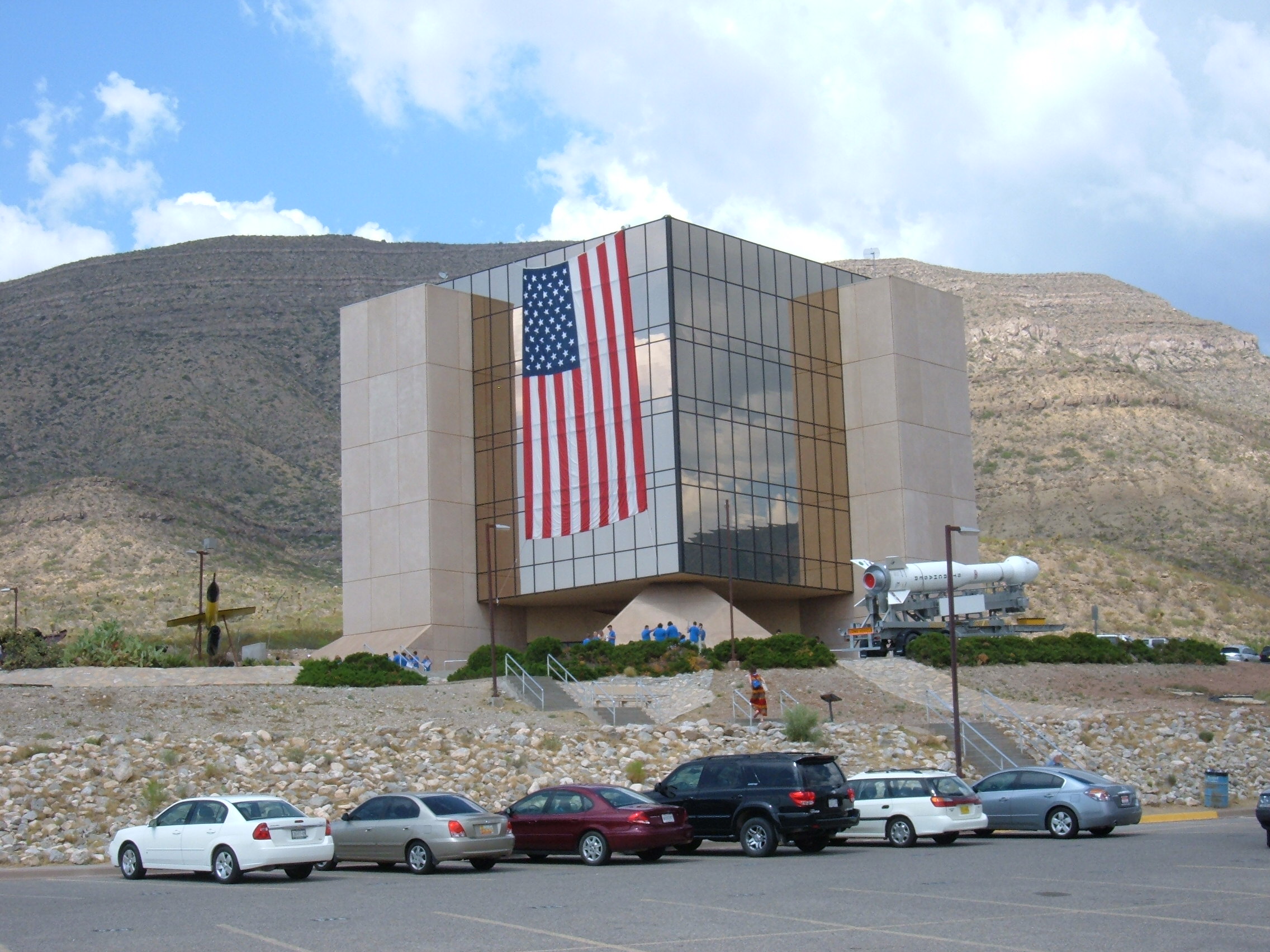
New Mexico Museum of Space History
On a slope overlooking the Tularosa Basin, a golden cube rises from the desert - the New Mexico Museum of Space History, keeper of artifacts from humanity's leap beyond Earth. This is fitting ground for such a museum. The basin below witnessed the first American rocket tests, the birth of missile technology, and experiments so dangerous they could only be conducted far from civilization. Buried in front of the museum's flagpoles lies Ham, the chimpanzee who rode a Mercury capsule into space in 1961, proving that a primate could survive the journey before any human tried.
A Mayor's Cosmic Vision
In 1973, Dwight Ohlinger, the former mayor of Alamogordo, visited the National Baseball Hall of Fame in Cooperstown, New York, and came home with an audacious idea. If baseball deserved a hall of fame, surely spaceflight did too - and where better to build it than Alamogordo, where so much of the developmental work for the space program had been done?
Ohlinger rallied support from local officials, state legislators, and members of Congress. Governor Bruce King embraced the idea and placed it under the New Mexico Office of Cultural Affairs. The museum opened in 1976 as the International Space Hall of Fame, inducting pioneers of spaceflight each year. The golden cube visible from miles away became a landmark, housing exhibits that trace humanity's journey from Robert Goddard's early rocket experiments through the Apollo missions and beyond. The museum has been accredited by the American Alliance of Museums since 1993, one of eight museums administered by the state's Department of Cultural Affairs.
Ham the Astrochimp
Before John Glenn orbited Earth, before Alan Shepard rode Freedom 7 into the history books, a 37-pound chimpanzee named Ham proved the mission was survivable. On January 31, 1961, Ham launched from Cape Canaveral aboard Mercury-Redstone 2, experiencing six minutes of weightlessness and pulling levers in response to flashing lights to demonstrate that cognitive function remained intact in space.
Ham's capsule splashed down in the Atlantic after a flight lasting 16 minutes and 39 seconds. He had traveled 157 miles into space and survived forces of nearly 15 G during reentry. After his historic flight, Ham lived at the National Zoo in Washington, D.C., then at the North Carolina Zoo, where he died in 1983 at approximately 26 years old. His remains were brought to Alamogordo - the region where he had trained - and buried at the museum with full honors. A simple marker in front of the flagpoles commemorates the first great ape to fly into space.
The Sonic Wind and Murphy's Law
The John P. Stapp Air and Space Park, an outdoor exhibit area adjacent to the museum, holds artifacts from an era when rocket scientists tested equipment - and human endurance - with terrifying directness. The centerpiece is Sonic Wind No. 1, the rocket sled that Colonel John Paul Stapp rode to fame and near-destruction.
In a series of experiments at Holloman Air Force Base during the 1950s, Stapp strapped himself to rocket sleds and experienced forces that should have killed him. On December 10, 1954, Sonic Wind No. 1 accelerated him to 632 mph in five seconds, then decelerated so violently that he experienced 46.2 G - the highest G-forces ever voluntarily endured by a human. His eyeballs hemorrhaged, his body was covered in bruises, but he survived, proving that pilots could survive ejection at supersonic speeds. The experiments also gave the world Murphy's Law, which first gained public attention at a press conference about the rocket sled testing program.
From IMAX to Interstellar
The museum complex includes the Clyde W. Tombaugh IMAX Theater and Planetarium, named for the astronomer who discovered Pluto. The facility's dome serves double duty as a planetarium projector screen and an IMAX theater, screening films about space exploration daily. Tombaugh, who spent his final years in nearby Las Cruces, was a fitting namesake for a facility dedicated to inspiring the next generation of space explorers.
The Hubbard Space Science Education Building holds the museum's library and archives, while the Museum Support Center prepares artifacts for display. Outdoors, visitors can see a Little Joe II rocket, Lockheed X-7 test vehicles, and the whisper dishes that demonstrate acoustic physics. The Astronaut Memorial Garden honors those who died in the Apollo 1 fire, the Challenger explosion, and the Columbia disaster. In 2014, the museum became the official repository for materials dealing with Spaceport America, the commercial spaceport being built 30 miles to the north, tying the museum's past to humanity's commercial space future.
The Buried Ataris
In 2014, the museum became custodian of one of gaming's strangest artifacts. In September 1983, Atari secretly buried millions of unsold game cartridges - including copies of the notorious E.T. the Extra-Terrestrial game - in the Alamogordo landfill. The burial became urban legend, dismissed for years as myth. Then, in April 2014, a documentary film crew excavated the site and confirmed the legend was true.
The dig recovered approximately 1,300 games, many still in their original packaging. The New Mexico Museum of Space History was designated the curator for the collection, and several cartridges went on display. The museum auctioned others to fund preservation efforts. It was an unexpected addition to the collection - but perhaps not so strange for a museum in a region where experimental technology often ends up buried in the desert, waiting to be rediscovered.
From the Air
The New Mexico Museum of Space History is located on the western slope of the Sacramento Mountains at 32.92N, 105.92W, overlooking Alamogordo and the Tularosa Basin. The distinctive golden cube is visible from miles away and serves as a landmark on the approach to Alamogordo-White Sands Regional Airport (KALM), approximately 5 nm to the southwest. Elevation at the museum is approximately 4,500 feet MSL. Holloman Air Force Base lies 8 nm to the southwest; expect military traffic and potential TFRs. White Sands Missile Range occupies the basin floor to the west - the restricted airspace (R-5107) extends across most of the valley. The museum sits at the foot of the Sacramento Mountains, which rise to over 9,000 feet to the east. Visual approach to KALM offers excellent views of the museum complex and the entire space history corridor of the Tularosa Basin.