New Mexico State University
On September 17, 1888, a schoolteacher from Indiana named Hiram Hadley opened the doors of a two-room adobe building in the dusty town of Las Cruces and called it a college. It was not a college in any meaningful sense, just an elementary school, a prep school, and a business course crammed under one roof. Within a year, the Territorial Assembly designated it the land-grant agricultural college for New Mexico, and within a century, a faculty member named Clyde Tombaugh would discover Pluto while teaching here. Today, New Mexico State University sprawls across a core campus of 900 acres at the base of the Organ Mountains, operating the Sunspot Solar Observatory, leading NASA's Space Grant program for New Mexico, and generating over a billion dollars annually for the state's economy.
From Adobe Walls to R1 Research
The transformation happened faster than anyone expected. In 1891, McFie Hall opened on a new campus three miles south of Las Cruces, the first permanent building for what was then called the New Mexico College of Agriculture and Mechanic Arts. Locals called it Old Main until fire destroyed it in 1910. The cornerstone still stands near the flagpole in the middle of the Horseshoe, the U-shaped drive that remains the heart of campus. Today, NMSU holds the Carnegie Classification of R1, signifying doctoral universities with very high research activity. The university operates five campuses across New Mexico and maintains a presence in all 33 of the state's counties through its Cooperative Extension Service. It enrolls more than 22,000 students from 71 countries and fields athletic teams called the Aggies, a nod to its agricultural roots.
Eyes on the Universe
The astronomy department here has punched well above its weight for decades. Clyde Tombaugh joined the faculty in 1955 after his discovery of Pluto at Lowell Observatory. NMSU now operates the Apache Point Observatory and the Sunspot Solar Observatory in the Sacramento Mountains, including the site of the Sloan Digital Sky Survey, one of the most ambitious mapping projects of the visible sky. The university serves as the lead institution for New Mexico's Space Grant Program and has reached NASA's platinum level of service in the Space Alliance Technology Outreach Program, the highest designation offered. The Physical Sciences Laboratory has even studied technology for a British single-stage-to-orbit spaceplane. For a school that started in an adobe, NMSU has traveled remarkably far.
Chile Peppers and Swainson's Hawks
The campus reflects its land-grant mission in unexpected ways. The Chile Pepper Institute conducts research, teaching, and outreach from the Fabian Garcia Science Center south of the main campus, helping New Mexico maintain its claim as the chile capital of America. Nearby vineyards and greenhouses support plant research projects ranging from algal biofuels to grape cultivation. The Leyendecker Plant Science Research Center sits on 203 acres six miles south of campus. But perhaps the most striking natural presence is the nesting population of Swainson's hawks. These federally protected raptors have claimed the Las Cruces campus as breeding territory, and during nesting season, pedestrians on Stewart Street are advised to watch the sky. The birds can be aggressive.
Traditions at the Base of the Organs
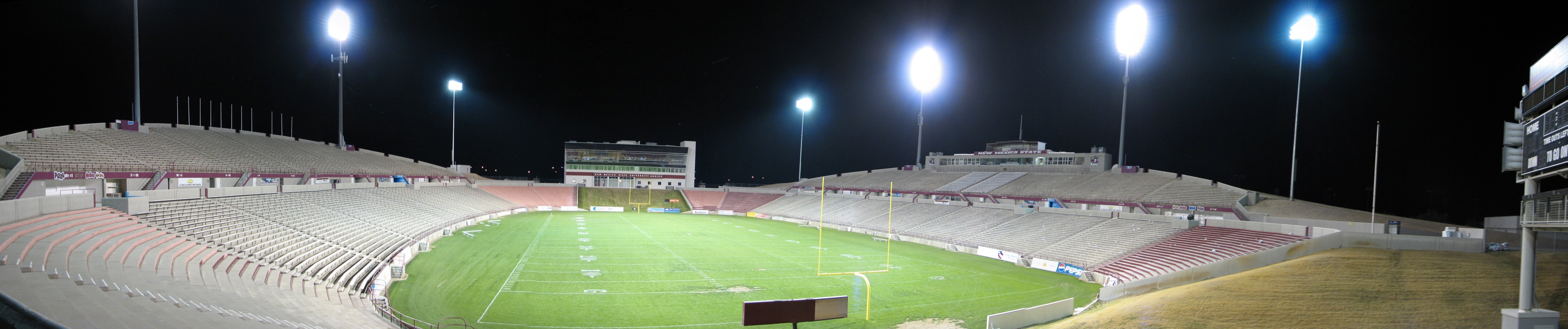
The Victory Bell, a gift from the Class of 1939, originally rang from an open-sided structure on the Horseshoe to announce Aggie wins. Now permanently mounted behind the south goalpost at Aggie Memorial Stadium, it still rings after every touchdown. At kickoff of home games, fans wait for the Wonder Dog to retrieve the kicking tee, a tradition that began in the mid-1990s with a border collie-Australian shepherd mix named Smoki who later appeared alongside Kevin Costner in the film Wyatt Earp. Each December, the Noche de Luminarias lights more than 6,000 candles in paper bags from the Educational Services Building to the Corbett Center Student Union, one of the largest luminaria displays in the state. And every graduate receives a class ring featuring the majestic Organ Mountains on one side and the Aggie Memorial Tower on the other, worn facing inward until graduation, then turned outward to face the world.
The View From Above
From cruising altitude, the NMSU campus appears as a dense cluster of buildings and athletic fields pressed against the western base of the Organ Mountains. Interstate 10, the main east-west highway across the southern United States, borders the campus on the west, while Interstate 25 runs to the east. The Horseshoe is visible as a U-shaped open lawn surrounded by buildings near the center of the academic core. To the south, green fields mark the horse farm and the Chile Pepper Institute's gardens. The Pan American Center, the largest arena on campus, stands out clearly, as does the Aggie Memorial Stadium. The Organ Mountains rise sharply to the east, their granite needles reaching nearly 9,000 feet and providing a dramatic backdrop for the university that has called this valley home since 1888.
From the Air
New Mexico State University is located at 32.283N, 106.748W in Las Cruces, NM, at approximately 3,900 feet MSL. The campus is clearly visible at the base of the Organ Mountains, bounded by I-10 to the west and I-25 to the east. Las Cruces International Airport (KLRU) is approximately 8 nm west. The Organ Mountains rise dramatically to the east, with peaks reaching nearly 9,000 feet. Best viewed from the west or southwest at 5,000-6,000 feet to appreciate the contrast between the campus, the Rio Grande valley, and the mountain backdrop. Watch for military traffic from White Sands Missile Range to the northeast.