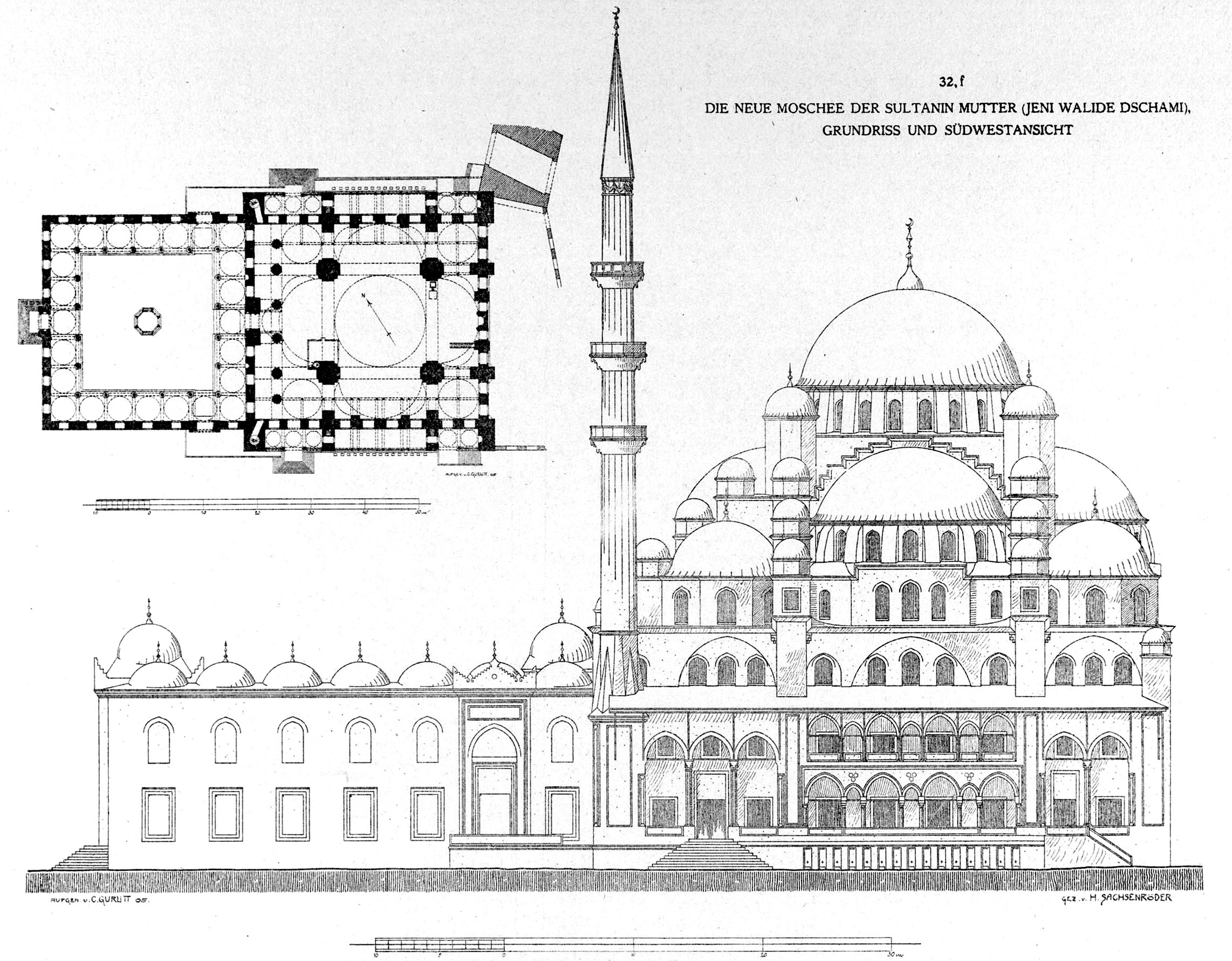
New Mosque, Istanbul
Two women, born more than half a century apart, built this mosque between them. Safiye Sultan ordered it laid down in 1597. She had been born in Venetian-ruled Albania, captured as a girl, brought to the Ottoman harem, and risen to become the favored consort of Sultan Murad III and the mother of Sultan Mehmed III. By the time she commanded the mosque's foundations, she effectively ruled the empire from behind her son's throne. When her son died in 1603 and her power vanished overnight, the half-built mosque was abandoned. It sat as a ruin for 57 years. Then another queen mother, Hatice Turhan Sultan, picked up where Safiye had left off and finished it in 1665.
The Sultanate of Women
Ottoman historians coined the phrase to describe a roughly 130-year period when the imperial harem became the de facto seat of power. Sultans were often young, sometimes mentally fragile, and frequently overshadowed by their mothers and senior wives, the Valide Sultans, who controlled palace finances, court appointments, and foreign correspondence. Safiye Sultan was one of the most influential. She corresponded directly with Queen Elizabeth I of England, exchanged gifts, and shaped Ottoman policy toward European powers. Building a great imperial mosque was a traditional act of sultanic piety; for a woman to commission one in her own name was extraordinary. Eminonu, the busy commercial waterfront where the mosque rose, was deliberately chosen to extend Islamic religious presence into a quarter then dominated by Jewish merchants. The site selection itself was a political act.
The Half-Built Ruin
Mehmed III died in 1603 with the mosque only partially constructed. His successor, Ahmed I, pushed Safiye into the Old Palace and lost interest in completing his grandmother's project. He had his own mosque to build, the great Blue Mosque finished a few years later. Safiye's foundations and lower walls sat exposed to weather and neglect for more than half a century. Eminonu's residents watched the half-mosque become part of the landscape, a kind of architectural ghost. Architects came and went. Then on 24 July 1660, the Great Fire of Istanbul tore through the district, destroying thousands of buildings and severely damaging the abandoned structure. Out of the ashes, the mosque got its second chance.
Turhan Finishes the Work
Hatice Turhan Sultan, mother of the young Sultan Mehmed IV, was offered the chance by the imperial architect Mustafa Aga to complete the project as an act of piety after the fire. She accepted, and from 1660 to 1665 the mosque rose to its present form. Turhan also commissioned the adjacent Spice Bazaar, the L-shaped covered market that became part of the religious complex and remains one of Istanbul's most visited places. By the time the mosque was inaugurated, it had taken 68 years and the determined work of two queen mothers across two generations to bring it into being. People started calling it Yeni Cami, the New Mosque, because at the time it was the youngest of the great imperial mosques. The name stuck even as four centuries passed and other mosques came and went.
Where Land Meets Water
Stand at the foot of the Galata Bridge today and the New Mosque is the first thing you see. Its grey lead-covered domes cascade down toward the water, the two slender minarets piercing a sky usually busy with seagulls. Behind it, the historic peninsula of Old Istanbul rises in layers. In front, the Golden Horn opens out, packed with ferries shuttling commuters across to Karakoy and Beyoglu, the European modern city. The mosque marks the threshold between worlds: the medieval Ottoman core to the south, the 19th-century Pera district to the north, the Bosphorus and the Sea of Marmara meeting somewhere in the middle distance. Pigeons by the hundreds settle on the courtyard. People feed them. People always have.
The Tomb of Queens
Behind the mosque stands the turbe, the imperial tomb. Inside lie Hatice Turhan Sultan herself, her son Mehmed IV, and five later sultans: Mustafa II, Ahmed II, Mahmud I, Osman III, and the troubled Murad V, deposed after only 93 days for mental instability. Around them are the graves of dozens of princes, princesses, and royal women, some of them children who died young. The tomb of Abdul Hamid II's mother, Tirimujgan Kadin, is here. So are daughters and sons of Abdulmejid I and Abdulaziz. Each name carries a fragment of imperial history, of women who lived inside palaces most of the world never saw, of children who never grew up to inherit anything. The mosque their grandmothers built shelters them now.
From the Air
The New Mosque sits at 41.0169 N, 28.9721 E on the Eminonu waterfront, at the southern foot of the Galata Bridge where the Golden Horn meets the lower Bosphorus. From above, look for the cluster of grey domes immediately south of the bridge, with the Spice Bazaar's long L-shape just inland and the larger Suleymaniye Mosque crowning the hill behind. Istanbul Airport (LTFM) is 35 km west-northwest; Sabiha Gokcen (LTFJ) is 35 km southeast on the Asian side. Recommended viewing altitude 1,500 to 3,000 ft AGL; expect dense controlled airspace and heavy traffic over the historic peninsula.