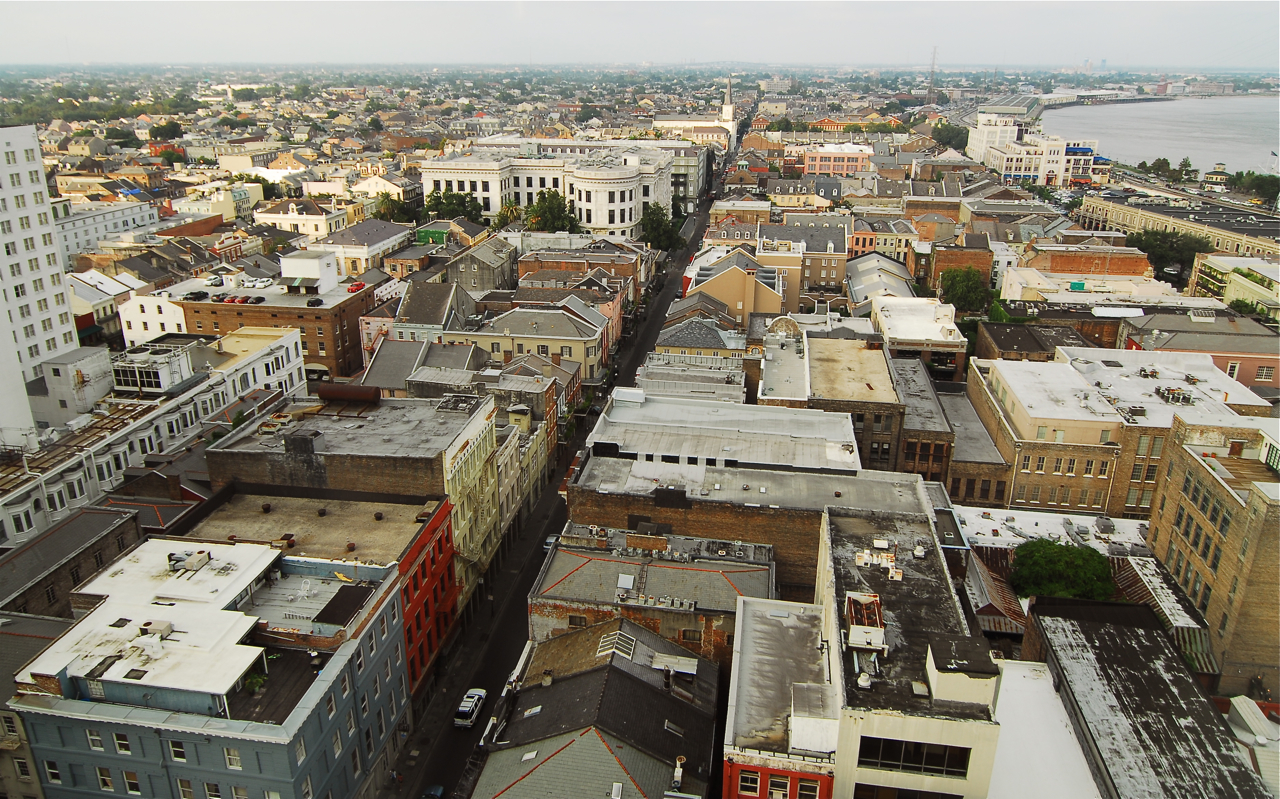
French Quarter: Where America Learned to Party
The French Quarter isn't French. Two catastrophic fires during Spanish rule destroyed the original French colonial buildings; the Spanish rebuilt with the iron balconies and courtyards that define the district today. But the name stuck, along with the attitude: 300 years of refusing to behave like the rest of America. Jazz emerged from Storyville's brothels, just outside the Quarter's boundaries. Voodoo queen Marie Laveau lived and practiced here. Tennessee Williams wrote 'A Streetcar Named Desire' in an apartment on St. Peter Street. The Quarter survived when other American downtowns demolished their history; it survived Hurricane Katrina when the rest of New Orleans flooded. Bourbon Street's neon excess obscures the truth: this is the oldest continuously occupied neighborhood in the nation, still living on its own terms.
The Founding
Jean-Baptiste Le Moyne de Bienville founded New Orleans in 1718, laying out the original grid that remains the French Quarter today. The site was terrible: below sea level, surrounded by swamp, prone to floods, hurricanes, and disease. But it controlled the Mississippi River, making it strategically invaluable. The French ceded Louisiana to Spain in 1762; fires in 1788 and 1794 destroyed most French colonial buildings. The Spanish rebuilt in their style: thick-walled brick structures with interior courtyards and iron balconies. The French returned in 1800, then sold to America in 1803. The architecture remained Spanish; the name remained French; the culture became something entirely new.
The Music
Jazz didn't start in the French Quarter, but in Storyville, the legalized red-light district adjacent to it. From 1897 to 1917, Storyville's brothels and dance halls employed musicians who blended ragtime, blues, and brass band traditions into something unprecedented. Jelly Roll Morton played piano in Storyville houses; Louis Armstrong grew up nearby, absorbing the sounds. When the Navy closed Storyville in 1917, the musicians dispersed - many to Chicago, spreading jazz nationally. The French Quarter's Preservation Hall, opened in 1961, became a shrine to traditional jazz. The music born in New Orleans brothels became America's art form.
The Voodoo
Marie Laveau, the Voodoo Queen of New Orleans, operated from the French Quarter in the mid-1800s. She combined African spiritual practices with Catholic ritual and shrewd networking - she worked as a hairdresser to wealthy white women, gathering information she'd use to make her 'magic' startlingly accurate. Laveau held ceremonies in Congo Square, sold gris-gris charms, and wielded genuine influence in a society where Black women had almost none. Her tomb in St. Louis Cemetery No. 1 draws pilgrims who mark X's and leave offerings. The voodoo shops on Bourbon Street are mostly tourist kitsch, but the tradition Laveau embodied - syncretic, adaptive, powerful - remains part of New Orleans' spiritual landscape.
The Survival
The French Quarter survived when similar districts across America were demolished for urban renewal. Its narrow streets defeated expressway planners in the 1960s; preservationists defeated them politically. The district survived Hurricane Katrina in 2005 - built on slightly higher ground, it escaped the catastrophic flooding that devastated newer neighborhoods. The storm's aftermath exposed inequalities the Quarter's party atmosphere usually obscures: the city's poorest residents suffered most while tourists returned to Bourbon Street. The Quarter's survival is partly luck, partly geography, partly the stubborn insistence that old buildings and old ways matter, that some places are worth keeping.
Visiting the French Quarter
The French Quarter is located in downtown New Orleans, bounded by the Mississippi River, Rampart Street, Canal Street, and Esplanade Avenue. Jackson Square, with St. Louis Cathedral, anchors the riverside; Bourbon Street runs parallel, the main tourist strip. The Cabildo and Presbytere museums flank the cathedral. Cafe Du Monde serves beignets 24 hours. Preservation Hall offers traditional jazz. The French Market runs along the river. Magazine Street and the Garden District offer alternatives to Bourbon Street excess. The Quarter is walkable but hot; summer brings steam-bath humidity. Mardi Gras transforms everything; book accommodations far in advance. The city rewards exploration beyond the obvious.
From the Air
Located at 29.96°N, 90.06°W on the Mississippi River in New Orleans. From altitude, the French Quarter appears as a dense grid of small blocks on the river's east bank, distinct from the surrounding urban fabric. The Mississippi's curve defines the city's crescent shape. Jackson Square is visible as a green rectangle; St. Louis Cathedral's spires mark its edge. Bourbon Street is invisible from altitude - just another narrow street in the grid - but it's there, three centuries of complicated history packed into a few blocks. The levees and floodwalls that protect the city are visible; so is the lower elevation of surrounding neighborhoods that flooded when the Quarter didn't.