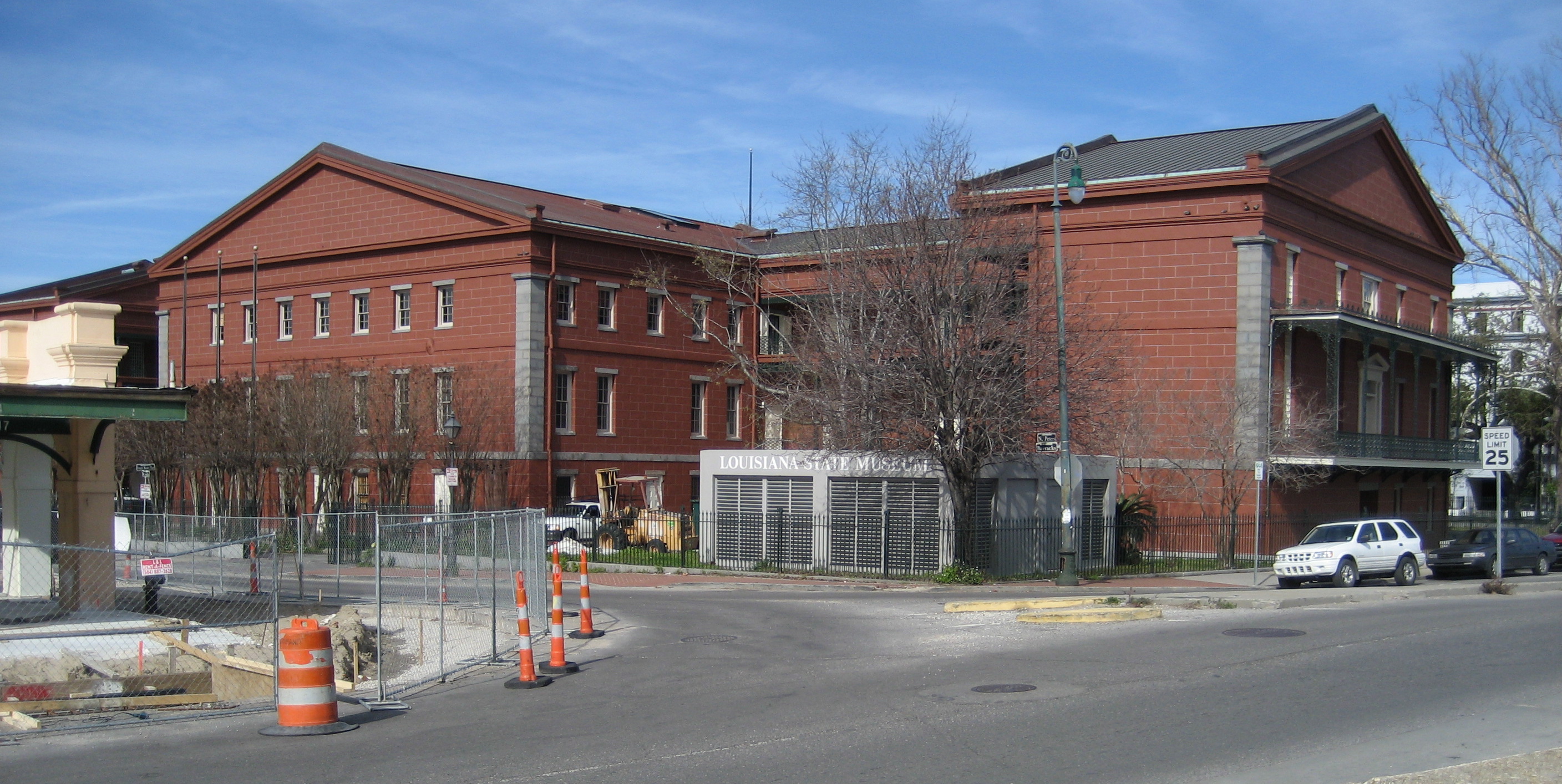
New Orleans Mint
Only four Confederate half-dollars struck with an alternate reverse die are known to exist today. One of them once belonged to Jefferson Davis himself. They were minted here, at the edge of the French Quarter, inside a Greek Revival building that has spent its nearly two centuries as a factory for money, a barracks for rebel soldiers, a federal prison, a Cold War fallout shelter, and now a jazz museum. The New Orleans Mint, standing at 400 Esplanade Avenue since 1838, is the oldest extant structure to have served as a United States Mint, and its biography reads like a compressed history of America itself.
Born from a Panic
The Mint owes its existence to Andrew Jackson's war on banks. When Jackson vetoed the rechartering of the Second Bank of the United States in 1832 and demanded all land transactions be conducted in cash through his 1836 Specie Circular, the nation found itself short of coined money. The Panic of 1837 deepened the crisis. Congress established three branch mints in 1835:: Charlotte, Dahlonega, and New Orleans. The first two handled only gold from nearby mines, but New Orleans, the fifth-largest city in America and its busiest foreign trade port, was chosen to produce both gold and silver in quantities that made it the most important branch mint in the country. Architect William Strickland, who had already designed the Philadelphia Mint, drew plans for a red-brick Greek Revival structure with a central Ionic portico supported by four monumental columns. The W-shaped footprint enclosed two interior courtyards, and fired-clay jack arches on steel I-beams gave it the bones of an industrial warehouse dressed in neoclassical finery.
The Gambler on the Flagstaff
The Mint operated continuously from 1838 until Louisiana seceded on January 26, 1861, when Confederate authorities seized the facility and its vault containing $483,983 in gold and silver coins. Confederate minters struck 962,633 half-dollars before the bullion ran out in April. After Admiral David Farragut's Union fleet recaptured the city in 1862, U.S. Marines raised the American flag on the Mint's roof. A professional steamboat gambler named William Bruce Mumford climbed up, tore the banner to shreds, and stuffed the pieces into his shirt as souvenirs. Union General Benjamin Butler, the military governor already despised as "Spoons" for allegedly pocketing citizens' silverware, ordered Mumford hanged for treason. On June 7, 1862, Mumford was executed from a flagstaff projecting horizontally from the building. Jefferson Davis demanded Butler be executed if captured. The Mint itself was silenced for nearly two decades, reopening only in 1879 after new equipment arrived to produce mainly silver coinage, including the famed Morgan dollar.
Silver Dust and Shut Windows
The Mint's second life, from 1879 to 1909, brought a workforce that included forty-four women, many sent from Philadelphia to train local hires. Thirty-nine worked as adjusters, sitting at long narrow tables filing coin planchets to precise weight, wearing special aprons with pouches at the sleeves and waist to catch excess silver dust. The work demanded absolute stillness in the air, since even a light draft could throw off the delicate scales or scatter precious metal filings. In the sweltering New Orleans climate, this meant windows and doors stayed shut. Workers relied on water coolers to survive. The coins they helped produce, identifiable by the "O" mint mark on their reverse, earned a reputation for mediocre striking quality with flattened centers and dull luster. Paradoxically, this imperfection makes well-struck New Orleans coins prized among collectors today. In 1907, the Mint even produced over five and a half million silver twenty-centavo pieces for Mexico, one of America's more unusual numismatic footnotes.
Nine Lives on Esplanade Avenue
After the Treasury closed the Mint in 1909 and shipped its machinery to Philadelphia (where it was subsequently lost), the building embarked on a remarkable series of reinventions. It served as a Treasury assay office until 1932, then became a federal prison until 1943. The Coast Guard used it for storage, though in practice the building sat largely abandoned and decaying. During the Cold War, officials designated it the best fallout shelter in the city. Louisiana took ownership in 1965 with a fifteen-year deadline to renovate or face demolition. The state met that challenge, and since 1981 the building has housed exhibits on its minting history, Mardi Gras traditions, Newcomb Pottery, and, most prominently, the New Orleans Jazz Museum with instruments played by the city's legendary musicians. Hurricane Katrina damaged the roof in 2005, allowing water to reach about three percent of the jazz collection, but after two years of repairs the museum reopened in October 2007.
Where Money Met Music
The site has been significant since before the building existed. Under Spanish rule, Governor Carondelet erected Fort San Carlos here in 1792. The fort was demolished in 1821, and the area was later named Jackson Square after the general who repelled the British at the Battle of New Orleans in 1815. Today the Mint anchors one corner of the French Quarter, operating as both a museum and a live jazz performance venue in partnership with the New Orleans Jazz National Historical Park. The Louisiana Historical Center on its third floor holds colonial-era manuscripts and maps, including French and Spanish records. P.G.T. Beauregard, who fireproofed the building in the 1850s, went on to order the first shots of the Civil War at Fort Sumter. The building that once rang with the percussion of coin presses now resonates with trumpet and clarinet, its Greek Revival columns framing a story that stretches from Jackson's fiscal crisis to Katrina's floodwaters.
From the Air
Located at 29.961N, 90.058W at the downriver edge of the French Quarter, on Esplanade Avenue near the Mississippi River. The red-brick Greek Revival structure is identifiable from low altitude. Nearest airport: Louis Armstrong New Orleans International (KMSY), approximately 11 nm west. Lakefront Airport (KNEW) is closer at about 5 nm north. Best viewed at 1,500-2,000 ft AGL on approach from the river side. The French Quarter grid and the curve of the Mississippi provide clear visual references.