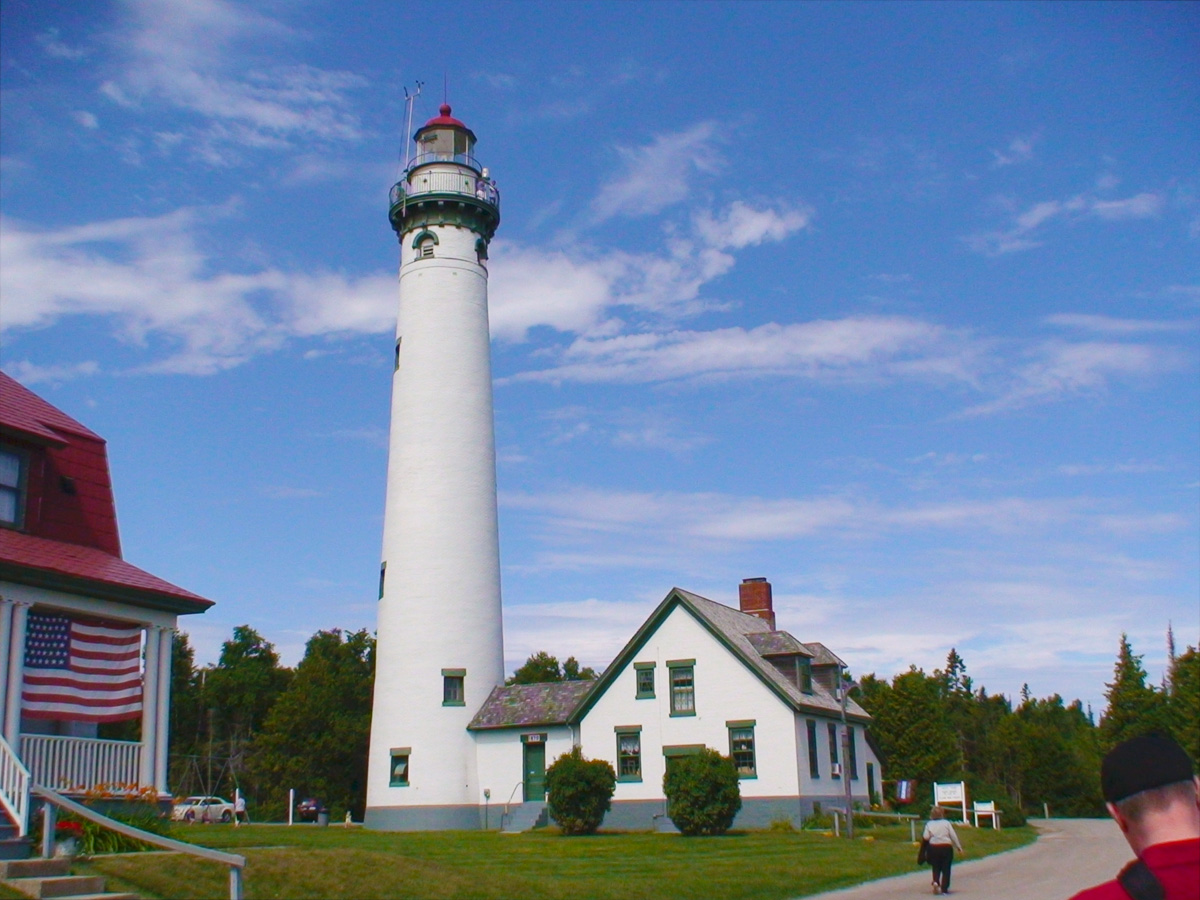
New Presque Isle Light
Abraham Lincoln appointed Patrick Garraty to keep the old light at Presque Isle. Garraty never left. When a taller, grander tower rose beside the old one in 1871, he became its first keeper too, and his family would tend the beacon for the next six decades. The New Presque Isle Light stands on Michigan's northeastern shore, one of 149 lighthouses scattered along the state's coastline, more than any other state in the nation. But this particular tower earned a distinction beyond longevity: its design was so admired that it became the pattern for lighthouse construction across the Great Lakes.
A War Engineer Turns to Light
Major Orlando M. Poe had served as General William Tecumseh Sherman's chief engineer during the famous March to the Sea. After the Civil War, the U.S. Army Corps of Engineers put Poe's talents to peacetime use on the Great Lakes. He drew plans for the new Presque Isle tower with the same precision he had applied to military bridges and fortifications. The total construction cost ran $21,000 over the previous appropriation, a figure Poe considered modest compared to the staggering sums he would soon spend building Spectacle Reef Light offshore. The tender Warrington delivered workers and materials in the summer of 1870. By early summer 1871, a tower of double-walled brick rose from the peninsula, its base nineteen feet wide tapering gracefully toward the gallery. A spiral cast iron staircase climbed 138 steps to the top. The design proved so elegant that it inspired lighthouses at Outer Island and Au Sable Point on Lake Superior, and Big Sable Point and Grosse Point on Lake Michigan.
Bending Light Across the Water
At the tower's summit sat a six-foot-tall third-order Fresnel lens, manufactured by Henry LePaute Cie. of Paris. The Fresnel lens represented a revolution in lighthouse technology. Earlier systems, like the one designed by former sea captain Winslow Lewis, used parabolic reflectors behind a hollow-tube wick, producing only the light of six or seven candles. The Lewis system was also notoriously difficult to clean and maintain. The Fresnel lens solved both problems through concentric glass rings that bent and focused light into a single powerful beam visible to ships miles away on Lake Huron. Though Fresnel lenses had been invented in France decades earlier, American lighthouses did not widely adopt them until the 1850s. Presque Isle's light was installed as a steady beacon, without any flashing mechanism, though the option was left available. Captains of lake freighters and passenger steamers caught in Lake Huron's sudden storms would have seen that unwavering glow as a lifeline.
The Garraty Dynasty
Patrick Garraty ran the new station with his wife Mary serving as assistant keeper. A sixteen-foot covered passageway connected the tower to their two-story dwelling, a necessity when Lake Huron blasted the peninsula with winter gales. A full cellar beneath the house stored personal belongings and lamp oil. The keeper's life was relentless: daily lens cleaning, wick trimming, sweeping, snow shoveling, all completed before ten in the morning. Every two months the lens got a wash; every year, a special polish. The Garratys kept a garden to supplement their diet between visits from lighthouse tenders. In 1886, Patrick's eighteen-year-old son Thomas took over the position. Thomas Garraty tended the light until 1935, meaning the family served at Presque Isle for roughly seven decades. The Lighthouse Board sent unannounced inspectors to check standards, but the installation of telephones at stations around the lakes let keepers warn each other when visitors were coming. Last-minute scrambles to tidy lenses, clean stations, and change into presentable clothes became a shared ritual among lighthouse families.
Steam, Coal, and Fog
As Great Lakes shipping expanded, the station grew with it. In 1889, Congress funded a steam fog signal: a loud horn that could pierce weather too thick for any light to penetrate. The problem was preparation time. Firing a boiler and building steam pressure could take forty-five minutes, a dangerous delay for a vessel already in trouble. Compressed air eventually replaced steam, cutting response time dramatically. In June 1890, the steam barge Ruby arrived with workers and materials to build the fog signal building and a tramway for hauling coal from the dock. Feeding those boilers proved so demanding that a district inspector reported the station needed more than two keepers. Congress funded a second dwelling, completed in September 1905, but four years passed before a second assistant keeper actually arrived. In 1912, an incandescent oil vapor system replaced the old wick, vaporizing kerosene into a brilliantly burning mantle. The technology worked on the same principle as a Coleman camping lantern.
From Keepers to County Park
The Lighthouse Service transferred to Coast Guard control in 1939. Indoor plumbing and electricity arrived at last, and the fog signal building came down. In 1970, the Coast Guard automated the light and boarded up the keeper's quarters. The station that had known human voices for a century fell silent. In the 1990s, the tower received an additional course of brick, making it visibly wider than it appears in old photographs. The property was leased to the county as Presque Isle Park and eventually transferred to full county control in 1998. Today the New Presque Isle Light ranks among the tallest towers on the Great Lakes, its beacon still visible far out on the water. The lighthouse is listed on the National Register of Historic Places, a permanent record of Poe's wartime precision repurposed into peacetime grace.
From the Air
New Presque Isle Light sits at 45.357N, 83.492W on a peninsula jutting into Lake Huron from Michigan's northeastern Lower Peninsula, east of Grand Lake. The tall white brick tower is visible from altitude against the dark green tree cover. Look for the peninsula shape and the cleared lighthouse grounds. Nearest airport: Presque Isle County Airport / Rogers City Airport (KPZQ) approximately 6nm west. Best viewing at 1,500-3,000 feet AGL. Lake Huron weather can bring sudden fog and low visibility.