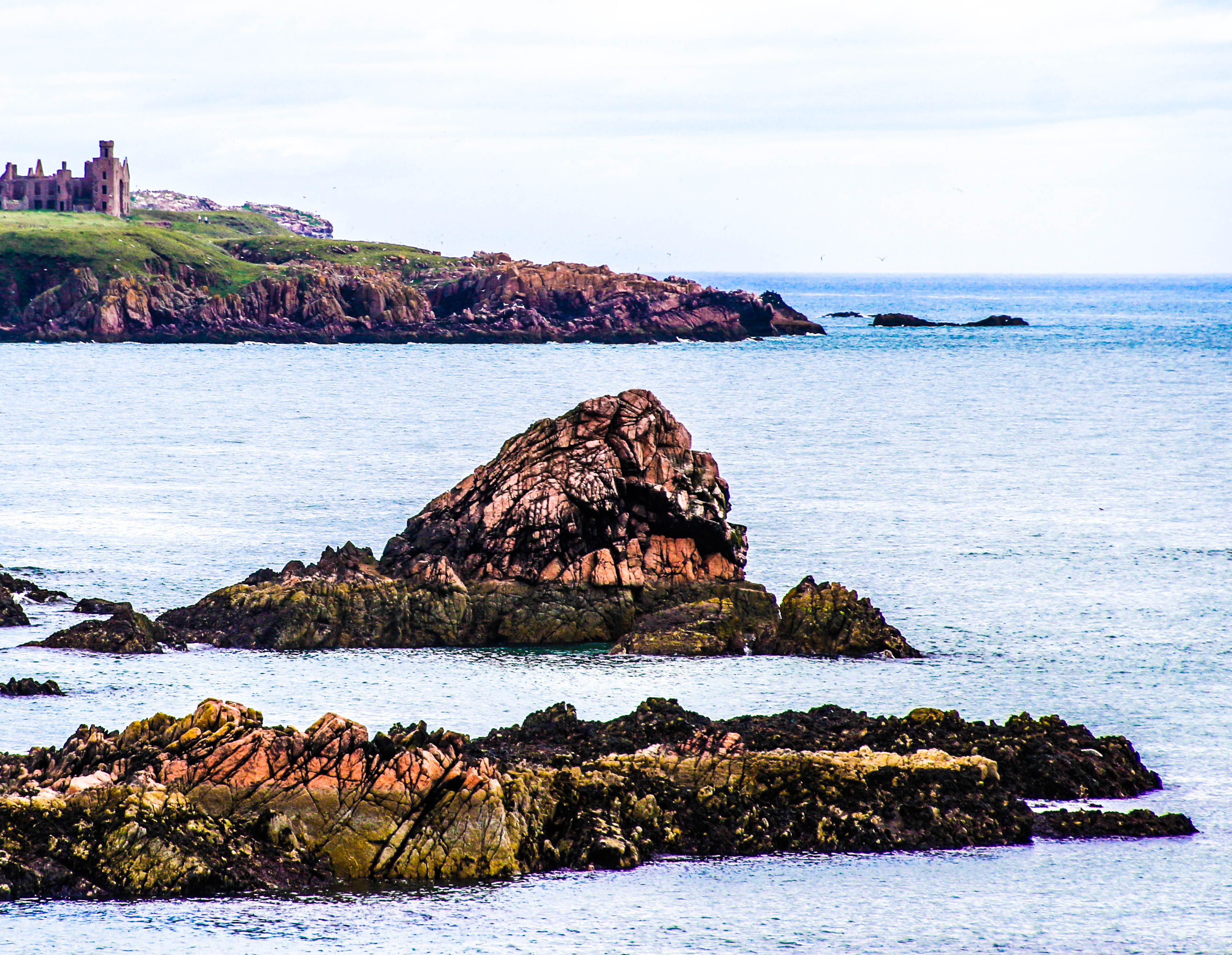
New Slains Castle
James Boswell could not sleep. The fire blazed, the North Sea roared against the cliffs below his window, and the pillows were stuffed with sea-fowl feathers that smelled disagreeable. Lying in his elegant room at Slains Castle in 1773, Boswell began to imagine the ghost of Lord Kilmarnock -- beheaded in 1746 -- might appear to him. The thought did not last long, and he fell asleep. What Boswell did not mention in his journal was that his host and the host's brother had fought on opposite sides at Culloden. This castle, perched on the cliffs east of Cruden Bay, has always attracted drama.
Built from Betrayal
The castle began as Bowness, constructed in the 1590s for Francis Hay, 9th Earl of Erroll, after the original Slains Castle was destroyed on the orders of King James VI. Erroll's crime had been conspiring with Catholic nobles and signing the Spanish Blanks -- documents left for Spain to fill in with the terms of military aid against the Protestant Scottish crown. Declared a traitor in 1594, Erroll lost his ancestral seat eight kilometres southwest at Collieston. But he built again on a sea cliff near Cruden Bay, naming his new residence for the double rock arch at the north end of the peninsula, which resembled a bow. The castle was extended in 1664 with a gallery and courtyard wings, renamed New Slains Castle, and given a new entrance front in 1707.
Nest of Jacobite Intrigue
Three successive Countesses of Erroll used New Slains as a base for Jacobite conspiracy. Lady Catherine Carnegie smuggled letters in and out of Edinburgh Castle during the 1689 siege, eventually escaping to France to serve as governess to the infant James Francis Edward Stuart. In 1705, the French secret agent Nathaniel Hooke landed at the castle, brought from Dunkirk by a fourteen-gun frigate, to plan a rebellion. He returned in 1707 -- the year of the Act of Union -- using Slains as his base while touring Scotland to gather military intelligence for a combined French and Jacobite invasion. His report was read to Louis XIV at Versailles. The king authorised the invasion, and in 1708 a fleet of 28 ships carrying up to 6,000 men sailed for Scotland, only to be chased off by the British navy. Mary Hay, 14th Countess of Erroll, later recruited Aberdeenshire men for the 1745 rebellion.
Stoker's Visual Palette
Bram Stoker was a regular visitor to nearby Cruden Bay between 1892 and 1910, and the castle appears in two of his lesser-known novels. The connection to Dracula is more atmospheric than direct: the castle did not inspire the novel's plot, but it is feasible that the clifftop ruin provided a visual vocabulary when Stoker began writing in Cruden Bay in 1895. One distinctive interior feature -- the octagonal hall -- may have inspired the octagonal room in Castle Dracula: 'The Count halted, putting down my bags, closed the door, and crossing the room, opened another door which led into a small octagonal room lit by a single lamp, and seemingly without a window of any sort.' The association has made the castle a pilgrimage site for Dracula enthusiasts, adding a gothic gloss to its already dramatic biography.
From Prime Ministers to Demolition
Before its decline, New Slains hosted a remarkable guest list. Robert Baden-Powell rented it in 1900. Prime Minister H. H. Asquith stayed in 1903 and 1908, and Winston Churchill spent two nights as Asquith's guest. In 1820, the 18th Earl married the illegitimate daughter of King William IV, and in the 1830s he commissioned architect John Smith to remodel the castle in Scots Baronial style with granite facings. But by 1925, the 20th Earl was an absentee, and demolition began. An advertisement in the Aberdeen Press and Journal offered battens, flooring, slates, doors, baths, and stable fittings. When demand proved weak, a second sale added water closets and bedroom grates. New Slains Castle is now a roofless shell, its outer and inner walls standing to full height above the North Sea cliffs -- a building stripped to its skeleton but still commanding the coastline.
From the Air
Located at 57.42N, 1.83W on dramatic sea cliffs 1 km east of Cruden Bay. The roofless castle ruin is clearly visible from low altitude on the exposed clifftop. Nearest airport: Aberdeen (EGPD), approximately 20 miles south. Peterhead is roughly 8 miles north.