New Valamo
The monks arrived at a mansion in Heinävesi, eastern Finland, homeless and searching. It was 1940, and 190 of them had been evacuated from their centuries-old monastery on the islands of Valaam in Lake Ladoga as Soviet forces advanced during the Winter War. They were looking for a sign, and they found one: an icon of St. Sergius and St. Herman of Valaam, the monastery's legendary 12th-century founders, already hanging in the Papinniemi estate. The monks took this as divine confirmation. They stayed. New Valamo has been the spiritual heart of Finnish Orthodox monasticism ever since -- the only monastery for men in the Finnish Orthodox Church, and one of the most visited religious sites in the country.
An Exile's Inheritance
The Valamo monastic tradition traces its roots to the late 14th century, when it was established on the Valaam archipelago in the northern reaches of Lake Ladoga, in what is now the Republic of Karelia in Russia. After Swedish forces left the monastery desolate for over a century, Peter the Great ordered its restoration beginning in 1717. For the next two centuries the monastery flourished, accumulating icons, manuscripts, and a reputation that drew pilgrims from across the Orthodox world. Then the Winter War shattered everything. The Soviet army occupied the islands shortly after hostilities began in November 1939, and the monks fled to eastern Finland with whatever they could carry. They were soon joined by evacuees from the Konevsky and Pechenga monasteries, consolidating three displaced communities into one. The estate at Papinniemi became their refuge, and a tradition that had grown for centuries on a Karelian island began again in a Finnish mansion.
Stone, Fire, and Rebuilding
For decades the monastery made do with the existing estate buildings. Then in 1977, to mark the 800th anniversary of Orthodoxy in Finland, a stone Transfiguration Cathedral was built to a design by architect Ivan Kudrjavzev. It gave the community a proper center of worship for the first time since their exile. But the old Papinniemi main building -- constructed in 1840 and the monastery's first home -- remained in use until disaster struck. In March 2012, a fire gutted its attic. Investigators traced the cause to cracks in a chimney attached to a furnace whose use had been prohibited for years. The valuable artifacts from the lower floors were rescued, but the damage reached 1.6 million euros. It was yet another chapter in a history defined by loss and reconstruction.
Whisky, Wine, and Monastic Enterprise
Orthodox tradition holds that a monastery should support itself fully, and New Valamo has taken that principle in unexpected directions. Over 160,000 visitors come each year, making tourism the primary source of income. But the monastery's most surprising enterprise is its distillery -- the largest in Finland, with an annual capacity of 120,000 litres. The operation, run through a majority-owned subsidiary called Viiniherman Ltd, produces wines, spirits, and whisky. Some of the whisky matures in church wine casks, a distinctly monastic touch. A modern 500-square-meter warehouse in Ilomantsi stores the distillates during aging, with capacity for 450,000 litres. The monks also produce peated and unpeated malt whisky, placing a Finnish Orthodox monastery in the improbable company of Scottish and Japanese whisky makers.
Icons and Endurance
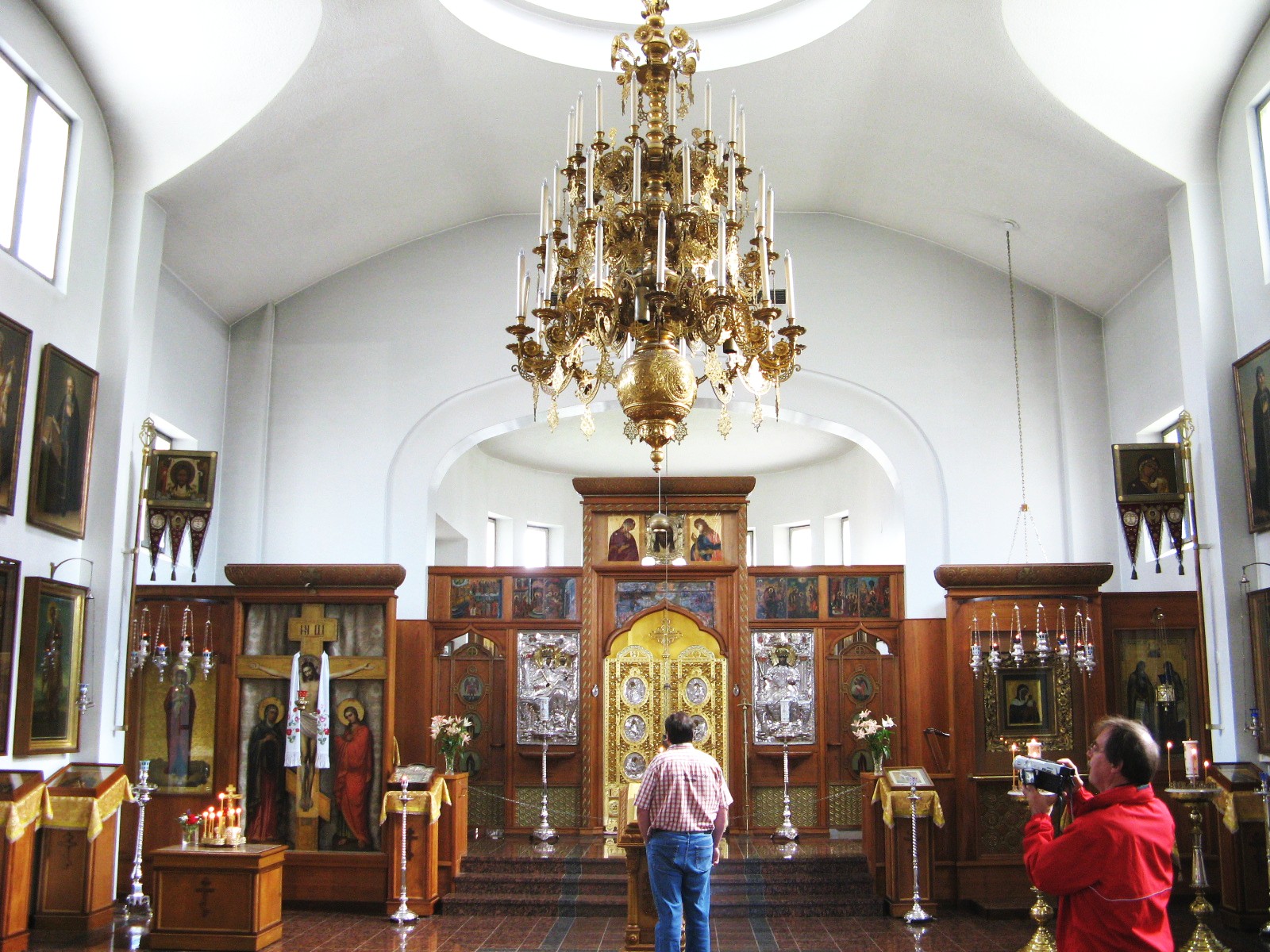
The spiritual treasures of New Valamo survived the journey from Ladoga. The monastery's best-known miracle-working icons -- the Mother of God of Konevitsa and the Mother of God of Valamo -- are displayed in the main church, drawing Orthodox pilgrims who regard them as objects of genuine spiritual power. The monastery also hosts the nearby Lintula Holy Trinity Convent, the only Orthodox nunnery in the Nordic countries, situated 18 kilometers away in Palokki. Together, the two communities represent the entirety of Finnish Orthodox monastic life. What began as a desperate evacuation in 1939 has become something durable: a living center of faith, culture, and community, built on the conviction that a sign found in a country mansion meant these monks were exactly where they were supposed to be.
From the Air
Located at 62.56N, 28.79E in Heinävesi, eastern Finland. The monastery complex is visible as a cluster of buildings including the stone Transfiguration Cathedral, set among the forests and lakes of the Finnish Lakeland region. Nearest airport is Joensuu (EFJO), approximately 110 km northeast. Savonlinna Airport (EFSA) is roughly 80 km south. The surrounding landscape is classic Finnish Lakeland -- dense boreal forest with numerous interconnected lakes visible from altitude. Lintula Convent is 18 km to the west.