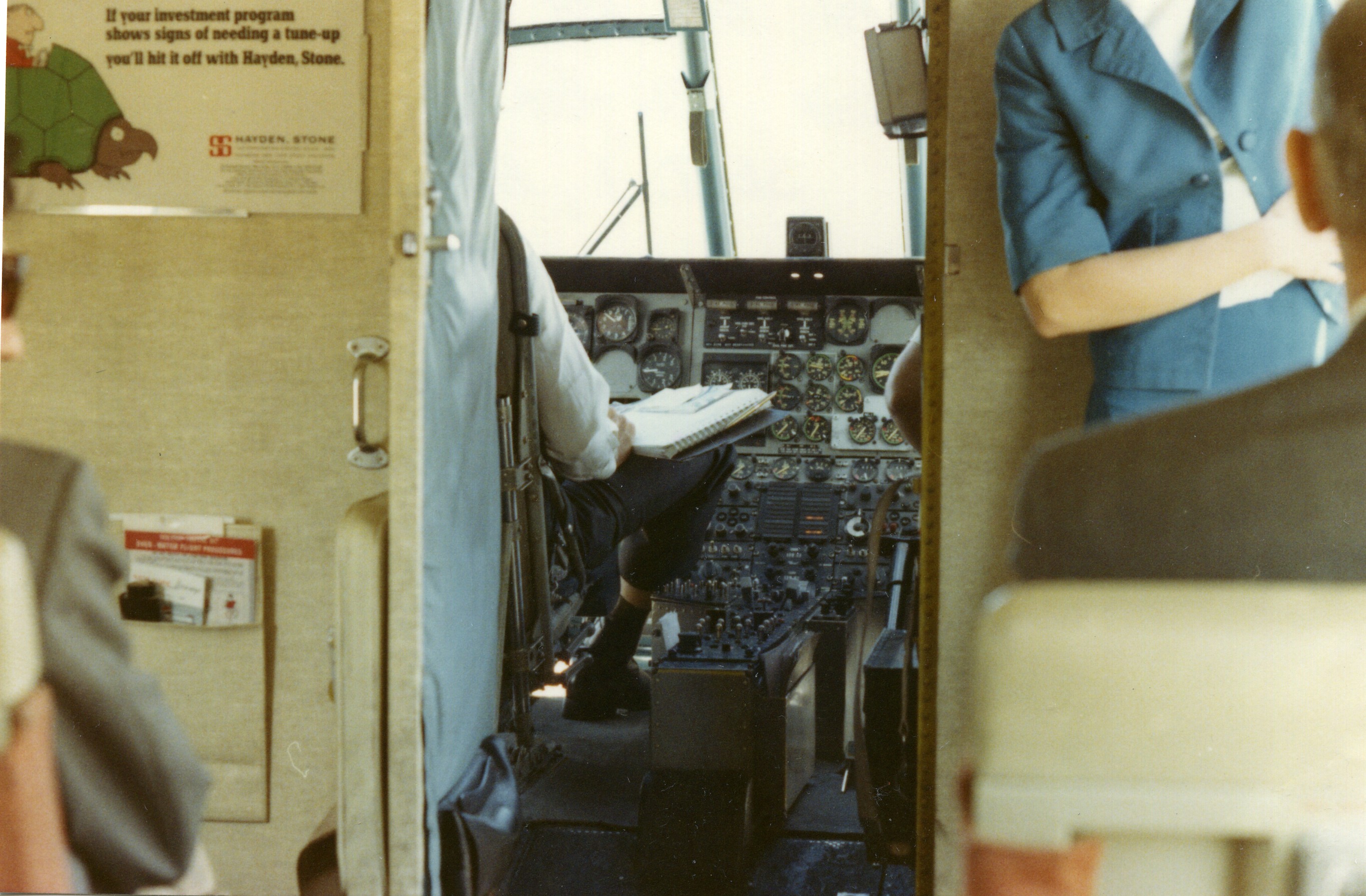
New York Airways
For $4.50 in 1955, you could step aboard a Sikorsky S-55 at LaGuardia Airport, lift off over the East River, and touch down at Idlewild -- now JFK -- ten minutes later. No traffic. No tunnels. No bridges. Just the city rolling beneath you like a living map. New York Airways made this possible, operating as the nation's first scheduled helicopter passenger airline from 1953 until a sequence of disasters ended the service in 1979. At its peak, the airline ran 48 weekday departures from a single rooftop in Midtown Manhattan, threading helicopters between the airports and heliports of the New York metropolitan area with the regularity of a bus line.
Rotors Over the River
Founded in 1949 as a mail and cargo carrier headquartered at LaGuardia Airport, New York Airways began carrying passengers on July 9, 1953, likely becoming the first scheduled helicopter airline in the United States. The early fleet consisted of Sikorsky S-55 helicopters, workhorses that gave way to the larger Sikorsky S-58 by 1956 and then to the 15-seat Boeing Vertol V-44 in 1958. By 1962, the airline had transitioned to the twin-turbine Boeing Vertol 107-II and later the Sikorsky S-61, machines powerful enough to maintain the demanding schedule of inter-airport hops and Manhattan rooftop landings. The first scheduled passenger flights to Manhattan arrived in December 1956 at the West 30th Street Heliport, and by 1960 service had shifted to the downtown heliport on East River Pier 6.
The Rooftop Era
In December 1965, New York Airways began something audacious: scheduled helicopter service from the roof of the Pan Am Building -- now the MetLife Building -- in the heart of Midtown. Businessmen could check in at the rooftop counter, board a Sikorsky S-61, and arrive at Pan Am's terminal at JFK in ten minutes. By April 1966, twenty-three daily nonstop flights connected the rooftop to JFK alone, with additional service to LaGuardia and Newark. The airline partnered with 24 international and domestic carriers, turning the building into a de facto urban airport. In June 1964, it was running 32 daily flights between JFK and Newark, all stopping at the Wall Street Heliport. The era also produced a civil rights milestone: on February 5, 1957, Perry H. Young became the first African American airline pilot in the nation, flying for New York Airways after previously making history as one of the first Black civilian flight instructors for the Army's Tuskegee Airmen program.
Catastrophe on the Rooftop
The dream began unraveling with tragedy. On October 14, 1963, a Boeing Vertol 107 crashed after takeoff from Idlewild, killing all six aboard -- mechanical failure from contaminated lubricants. Then came May 16, 1977: a Sikorsky S-61L sat on the Pan Am Building rooftop, taking on passengers, when its landing gear collapsed. The helicopter toppled onto its side, and the still-spinning main rotor blades tore into the people waiting to board. Four passengers died, including film director Michael Findlay. A shattered blade fragment plummeted to the street below, killing a pedestrian. The rooftop heliport was permanently closed that evening. Barely two years later, on April 18, 1979, another S-61L lost its entire tail rotor gearbox during climbout from Newark at 150 feet -- three more people died in the uncontrolled crash. New York Airways never flew again, filing for bankruptcy on May 18, 1979.
Ghosts in the Sky
The airline's Boeing Vertol 107s outlasted the company that flew them. All surviving airframes ended up with Columbia Helicopters in Aurora, Oregon, where they continue heavy-lift logging work decades later. One of them, N6674D, holds the record for highest flight hours of any helicopter in the world -- more than 82,000 since its construction in 1962. Another, N6682D, appeared in the 1968 Clint Eastwood film Coogan's Bluff, lifting off from the Pan Am Building rooftop during a sequence that now plays like a time capsule of an era when Manhattan's skyline was a working airfield. The rooftop itself has been bare since 1977, a flat expanse atop the MetLife Building that once hummed with turbine engines and the hope that cities might solve their transportation problems by looking up.
From the Air
Located at approximately 40.701N, 74.009W in Lower Manhattan. The Pan Am Building (now MetLife Building) rooftop heliport site is visible at 40.754N, 73.976W, identifiable as the large flat-topped tower just north of Grand Central Terminal. Nearby airports: KJFK (JFK International), KLGA (LaGuardia), KEWR (Newark Liberty), KTEB (Teterboro). The Wall Street Heliport (KJRB) remains active at the southern tip of Manhattan. Best viewed at 2,000-4,000 ft AGL following the East River corridor.