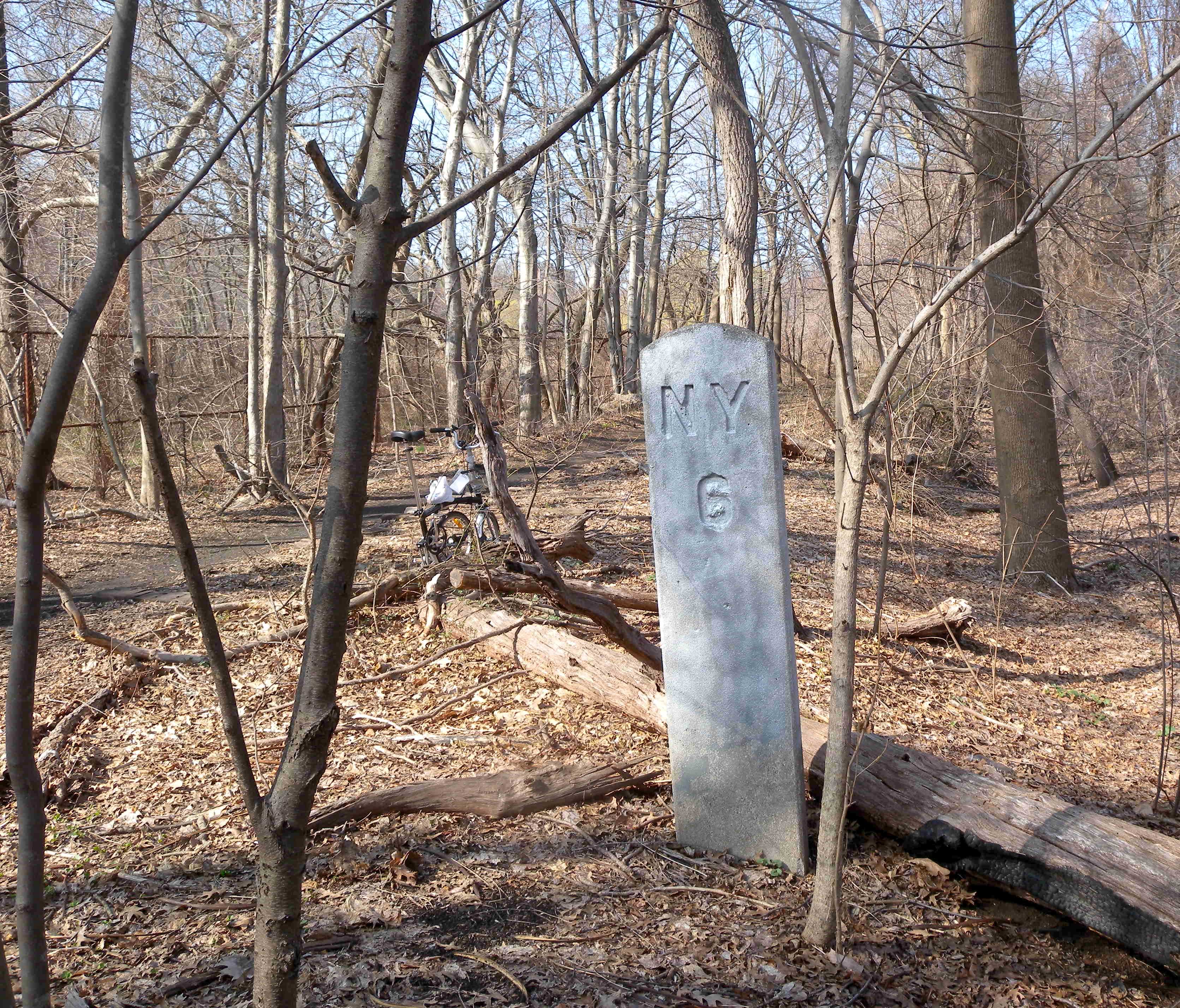
New York and Putnam Railroad
The last customer of the New York and Putnam Railroad was a bakery. Stella D'Oro, the Bronx-based maker of breakfast treats and anise cookies, stopped using the line in 1989, and with that, the Old Put -- as generations of riders had known it -- lost its final reason to exist. What had begun in 1881 as a railroad connecting the Bronx to Brewster, New York, through the rolling hills of Westchester and Putnam Counties ended not with a dramatic collapse but with a slow, quiet fading. Today, most of the Old Put's roadbed has been converted to rail trails, and hikers walk where commuters once rode through some of the most scenic terrain in the lower Hudson Valley.
Five Names Before the First Train
The railroad's origins were a tangle of ambition, financial panic, and corporate reshuffling. It was first chartered in 1869 as the New York and Boston Railroad, intended to connect Highbridge on the Harlem River to Brewster, where passengers could transfer north to Albany or east to Boston. Before a single rail was laid, the company was renamed, consolidated, and reorganized at least four times. The Panic of 1873 killed the grandest iteration -- the New York, Boston and Montreal Railway -- scattering its constituent lines across the region. By 1877, yet another reorganization produced the New York, Westchester and Putnam Railway, which was leased to the New York City and Northern Railroad. That company finally opened the line to Brewster in April 1881, twelve years after the original charter. Along the way, an 80-foot trestle over a marsh-filled valley near Pocantico Hills proved so dangerous that trains had to crawl across it, and the line was rerouted around the valley entirely. The trestle came down in 1883; the valley became the Tarrytown Reservoir.
Morgan, Rockefeller, and the Supreme Court
By 1887 the railroad was bankrupt. J. P. Morgan reorganized it in 1894 as the New York and Putnam Rail Road Company and leased it to the New York Central system. For a time, the line served as a commuter corridor, with the Sedgwick Avenue to Van Cortlandt section and the Yonkers Branch electrified in 1926. But powerful forces were working against it. In 1929, John D. Rockefeller Jr. had the tracks removed from his Pocantico Hills estate, eliminating four stations in the process. The nearby village of East View was effectively obliterated to accommodate the rerouted line. The Getty Square Branch to Yonkers was abandoned in 1943, despite a legal battle by residents that reached the United States Supreme Court. The tracks were torn up in December 1944. What the Old Put lacked -- a second track, full electrification, commuter parking, and direct service to Grand Central Terminal -- the parallel Harlem and Hudson Divisions all had.
The Last Train and the Cookie Factory
By 1956, the New York Central was petitioning to shut the Putnam Division down entirely. Fewer than 500 daily riders remained. The Public Service Commission authorized the end of passenger service effective June 1, 1958, and the last trains ran on May 29 -- a Thursday, because there was no weekend service to provide a more ceremonial farewell. Freight service lingered. Until 1962, the Old Put's lack of tunnels made it the only route capable of handling oversized loads, and it served that role until the West Shore Railroad was upgraded. The A&P warehouse in Elmsford kept the southern end alive until 1975; Stauffer Chemical held on until 1977. Conrail inherited the bankrupt line in 1976 but had no plans for it. When Stella D'Oro stopped shipping cookies by rail in 1989, Conrail began trying to sell the right-of-way to reduce its tax bill.
Ghosts Along the Trail
The Old Put left behind a surprisingly rich landscape of remnants. Skeletal remains of the Van Cortlandt station stand in Van Cortlandt Park, where the 3.4-mile Getty Square Branch right-of-way is now part of the park's trail system. The Yorktown Heights station had its exterior restored and serves as the centerpiece of the town park. The station in Lake Mahopac has been an American Legion hall since 1965. In Elmsford, a former station operates as a restaurant. The Briarcliff Manor station was absorbed into the village library. Old railroad ties still surface along the right-of-way, and bridge abutments mark former crossings at School Street, McLean Avenue, and Lawrence Street. The Getty Square terminus building in Yonkers, once a head house with a train shed, was replaced by an office building ornamented with locomotive imagery. For walkers and cyclists who now use these trails, the Old Put is less a railroad than a corridor through the landscape it once served -- a ghost line whose path still shapes the terrain, even if the trains are long gone.
From the Air
The Old Put's route ran from approximately 40.83°N, 73.93°W (Sedgwick Avenue in the Bronx) northward through Westchester and Putnam Counties to Brewster, NY (41.39°N, 73.62°W). The former right-of-way is visible as trail corridors through Van Cortlandt Park, along the Saw Mill River Parkway, and across the New Croton Reservoir. Nearest airports: KLGA (LaGuardia, 8 nm east of southern terminus), KHPN (Westchester County, near the midpoint).