The Schwarzman Building: New York's Temple of Knowledge
On May 24, 1911, the day after President William Howard Taft cut the ribbon, tens of thousands of New Yorkers streamed into their new public library. The very first reader handed a call slip to the desk at 9:08 in the morning and received his book seven minutes later -- a Russian study of Nietzsche and Tolstoy. That seven-minute delivery time, from a request scrawled on paper to a physical book placed in a reader's hands, was the entire point. Dr. John Shaw Billings, the library's first director, had designed the building around speed: a massive reading room perched atop seven floors of book stacks, connected by the fastest retrieval system money could buy. More than a century later, the Stephen A. Schwarzman Building still delivers. Two and a half million volumes sit beneath the Rose Main Reading Room, eighty-four more miles of shelving extend under Bryant Park, and the first Gutenberg Bible brought to the United States rests in the Rare Book Division upstairs.
Where a Reservoir Once Stood
The building occupies one of the most improbable sites in Manhattan. Until the late 1890s, the block between 40th and 42nd Streets along Fifth Avenue held the Croton Distributing Reservoir, a massive Egyptian-revival stone tank that stored the city's drinking water. By the time the New York Public Library was formed in 1895 from the merger of the Astor and Lenox Libraries, fueled by a bequest from Samuel J. Tilden and $5.2 million from Andrew Carnegie, the reservoir was obsolete. The library's trustees convinced Mayor William L. Strong to hand over the site by showing him studies proving that New York's library collection lagged behind those of many other cities. Eighty-eight architectural designs were submitted. The jury selected the firm of Carrere and Hastings, whose Beaux-Arts plan called for a white marble palace with a colonnaded facade and ornamental sculpture. Workers began digging through the reservoir's thick walls, and by 1901 most of the structure had been excavated. Vermont marble, three feet thick, went up in its place -- sixty-five percent of the quarried stone was rejected and diverted to other buildings, including Harvard Medical School.
Patience, Fortitude, and Fifteen Thousand Guests
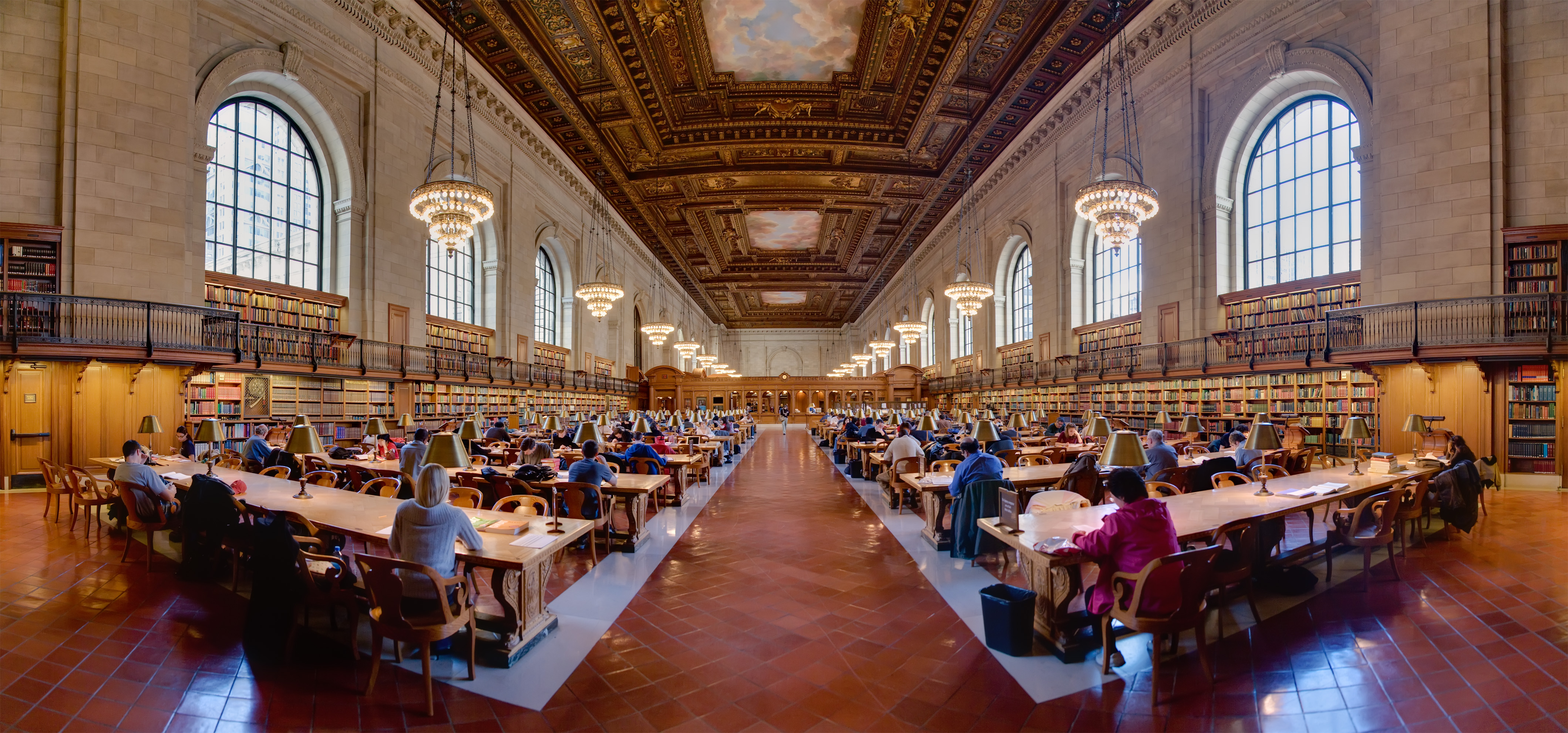
Two stone lions flank the Fifth Avenue entrance, sculpted by Edward Clark Potter and carved from pink Tennessee marble. During the Great Depression, Mayor Fiorello La Guardia named them Patience and Fortitude -- qualities he said New Yorkers needed to survive hard times. The names stuck, and a single lion now serves as the library's official logo. Behind the lions, through a triple-arched portico, lies Astor Hall, a vaulted marble lobby where donor names are inscribed on pillars. Upstairs, the McGraw Rotunda leads to the Rose Main Reading Room, a space so grand that its eighteen arched windows, massive chandeliers, and painted ceiling create the atmosphere of a secular cathedral. The ceiling mural, completed by James Wall Finn in 1911, depicts clouds and sky; it was restored from 2014 to 2016 after a rosette fell to the floor in 2014. Originally the room seated 768 readers; today it accommodates 490. By 1928, four million people visited the Main Branch annually, with up to a thousand readers per hour requesting books during peak times.
A City of Books Underground
The hidden engineering beneath the reading room is the building's most extraordinary feature. Billings's original design placed seven levels of iron-and-steel book stacks directly below the reading room floor. At opening, the stacks could hold 2.7 million volumes. When even that proved insufficient, a $24 million expansion between 1987 and 1991 tunneled eighty-four miles of additional shelving beneath adjacent Bryant Park, with a layer of earth between the park surface and the storage ceiling. Books moved through the building on a chain-and-lift conveyor system, later replaced by a Ferris-wheel-style mechanism in the 1990s, and finally by a modern "book train" system. The library also houses the Lionel Pincus and Princess Firyal Map Division, with more than 433,000 sheet maps dating to the sixteenth century; the Manuscripts and Archives Division, with 700 cuneiform tablets and 160 illuminated manuscripts; and the Rare Book Division, which holds 800 incunabula printed before 1501, the first Native American language Bible, and Walt Whitman's personal copies of his own work.
Crumbling Marble and Billion-Dollar Restorations
By the late 1970s, the building was in serious disrepair. Budget cuts during the 1975 fiscal crisis reduced operating hours to forty-three per week. The main exhibition room had been converted into an accounting office. Wires and ducts hung across ornate ceilings. Metal brackets had been screwed into reading room furniture. A comprehensive master plan by Davis Brody & Associates, architect Giorgio Cavaglieri, and consultant Arthur Rosenblatt launched a decades-long restoration. The Gottesman Exhibition Hall reopened in 1984. The Fifth Avenue terraces were rebuilt in 1988. In 2007, a $50 million exterior renovation tackled three thousand cracks in the weathered marble. Businessman Stephen A. Schwarzman donated $100 million toward the restoration, and the building was renamed in his honor. The most ambitious overhaul came in 2017: a $317 million master plan by Mecanoo and Beyer Blinder Belle that added a new 40th Street entrance, expanded public space by twenty percent, and created new facilities for students and researchers. The entrance opened in June 2023.
The Lions Still Stand Guard
The building has weathered world wars, fiscal crises, falling rosettes, and the digital revolution. During World War II, the Main Reading Room's fifteen large windows were blacked out. During the Depression, a Bryant Park open-air reading room boosted morale. In 2014, a controversial Central Library Plan that would have shipped a million books to a New Jersey warehouse was abandoned after a six-year battle and two public lawsuits. Through it all, the lions have kept watch. They were restored in 1975, again in 2019, at a cost of $250,000. The building declared a National Historic Landmark in 1965, its Main Reading Room designated a New York City landmark in 2017, the Schwarzman Building remains one of the most visited buildings in New York. It appears in films from "42nd Street" in 1933 to Frederick Wiseman's documentary "Ex Libris" in 2017. E. B. White wrote a poem about the lions. And every day, readers still fill out call slips and wait for their books, just as that first patron did at 9:08 on a May morning in 1911.
From the Air
The Schwarzman Building (40.7531N, 73.9819W) occupies the block between 40th and 42nd Streets along Fifth Avenue in Midtown Manhattan, directly east of Bryant Park. The white Vermont marble Beaux-Arts facade is identifiable from altitude as a large rectangular structure with a distinctive colonnade. The building faces Fifth Avenue; Bryant Park extends to its west. Grand Central Terminal is two blocks east. Nearby airports: KLGA (LaGuardia, 6 nm NE), KJFK (JFK, 13 nm SE), KEWR (Newark, 10 nm SW), KTEB (Teterboro, 10 nm NW). Best viewed at 2,000-3,000 ft AGL approaching from the east over the East River. The twin stone lions at the Fifth Avenue entrance are not visible from altitude but the building's massive footprint and adjacent park make it easy to identify.