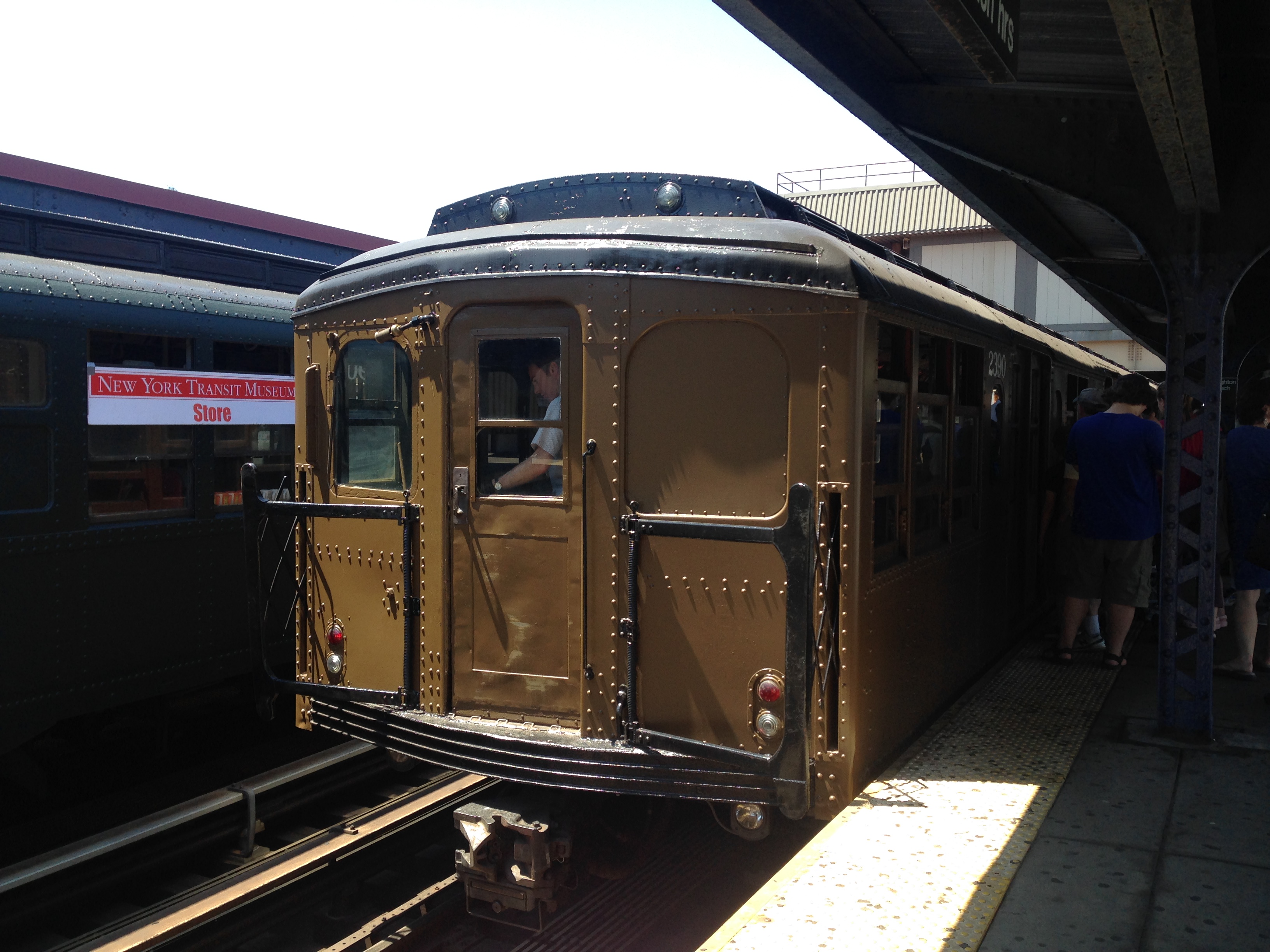
New York Transit Museum
Descend the stairs at the corner of Boerum Place and Schermerhorn Street in downtown Brooklyn, and you enter a subway station that time forgot. The aquamarine tile walls and cerulean blue borders are original. The island platform stretches between two tracks that still carry power. But instead of rushing commuters, the platform holds vintage railcars from every era of New York transit history, most of them still operational, arranged like a timeline you can walk through and board. The New York Transit Museum occupies the decommissioned Court Street station, and it is the only museum in the world where the exhibits can -- and occasionally do -- drive themselves out of the building.
A Station That Couldn't Earn Its Keep
Court Street station opened on April 9, 1936, as part of the city-built Independent Subway System's Fulton Street Line. It was designed to be the northern terminal of the HH Fulton Street Local, but that through-service never materialized. Instead, the station served only the Court Street Shuttle, a one-stop ride to Hoyt-Schermerhorn Streets. The economics were brutal: the shuttle earned $6,700 a year at the time of its closure. Abandonment came on June 1, 1946, saving the city approximately $19,903 annually. The sealed entrances became dumping grounds for garbage. Plans to convert the space into a bowling alley in 1961 went nowhere. But the abandoned station had another life waiting for it -- Hollywood discovered it almost immediately. Three years after closing, it served as a set for the 1949 film Guilty Bystander. By the mid-1960s, the station was hosting nine films in 1964, thirteen in 1965, and twenty-two in 1966.
One Token for Admission
On July 4, 1976, the station reopened as the New York City Transit Exhibit, part of the United States Bicentennial celebration. Admission cost one subway token -- the same fare you would have paid to ride the trains on display. Old railcars that had been preserved by transit enthusiasts and agency staff were rolled in through the tunnel connecting Court Street to the outer tracks at Hoyt-Schermerhorn Streets, the same connection that had once served the shuttle. What began as a temporary exhibition became permanent. In the mid-1990s, the Metropolitan Transportation Authority assumed control from the New York City Transit Authority and expanded the museum's scope to include commuter rail, bridges, tunnels, and bus operations across the MTA region. A satellite annex opened in Grand Central Terminal, offering free admission and an annual Holiday Train Show with operating model layouts.
Railcars You Can Board
The museum's most remarkable feature lives on the platform level, where two fully powered tracks hold a rolling collection of subway and elevated railway cars spanning more than a century. Preserved railcars from the BMT, IRT, and IND systems sit on operational tracks, most still capable of running under their own power. The cars are not roped off or glassed in -- visitors climb aboard, sit in the rattan seats of cars from the early 1900s, and peer through the windows of equipment that once carried millions of New Yorkers to work. A functioning signal tower control room, originally used to monitor the IND Fulton Street and Crosstown lines, remains on display. An original mosaic plaque from the 137th Street station, installed when the subway first opened in 1904, hangs on the wall. Exhibits like "Steel, Stone & Backbone" document the grueling labor of subway construction from 1900 to 1925, while "Moving the Millions" traces the system's evolution from private operators to the modern MTA.
Where Tracks Meet Memory
The museum runs its collection. Vintage subway cars emerge from Court Street for special excursion trips through the active system, allowing riders to experience the sights and sounds of early transit on modern track. The "Train of Many Colors" and holiday-themed nostalgia trains are beloved annual traditions that sell out quickly. Beyond the railcars, the mezzanine level houses rotating exhibits on vintage signage, in-vehicle advertisements, dioramas, and the peculiar history of revenue collection -- including the cloth money bags and sewing machines used to create them for the system's now-retired money trains. An archive of documents, photographs, and artifacts supports researchers investigating the transit history that shaped the five boroughs. The station itself continues to serve as a film set, and private events are held on the platform after hours, making Court Street the rare subway station that generates more cultural value abandoned than it ever did in service.
From the Air
Located at approximately 40.690N, 73.990W at the corner of Boerum Place and Schermerhorn Street in downtown Brooklyn, at the boundary of Brooklyn Heights and Boerum Hill. The museum is underground and not directly visible from altitude, but the intersection is identifiable by the nearby Brooklyn Borough Hall and the cluster of courthouses to the north. Nearby airports: KJFK (JFK International), KLGA (LaGuardia), KEWR (Newark Liberty). Best viewed at 2,000-3,000 ft AGL over downtown Brooklyn.