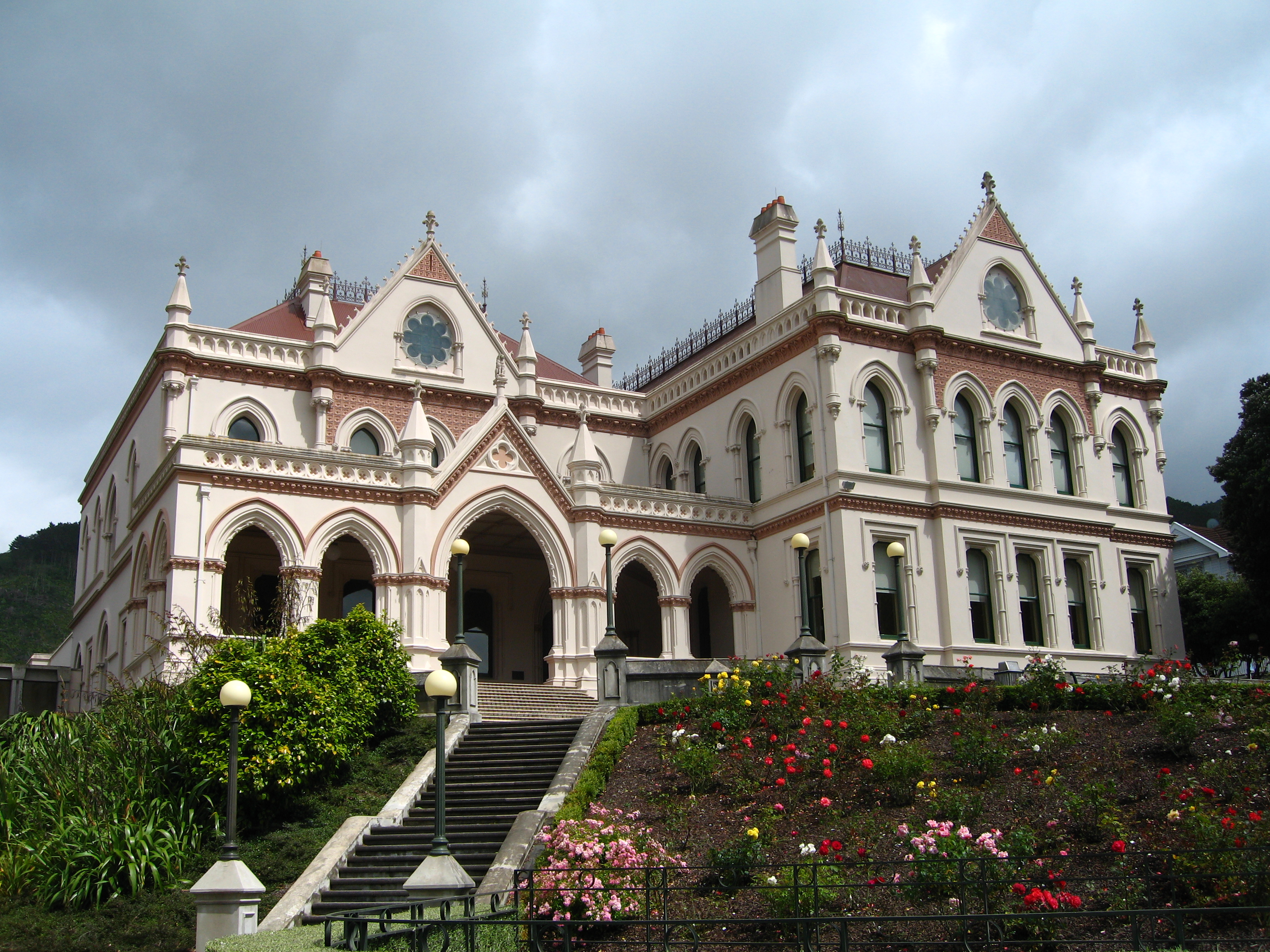
New Zealand Parliament Buildings
An iron fire-door saved a library and, with it, the institutional memory of an entire nation. When fire swept through New Zealand's Parliament on 11 December 1907, consuming the grand Gothic Revival timber building and everything connected to it, the Parliamentary Library stood alone in the ashes, its masonry walls and that one heavy door holding the flames at bay. The library, completed just eight years earlier, became the oldest surviving structure on the parliamentary grounds -- a distinction it holds to this day. From that point of catastrophe forward, every building added to Wellington's parliamentary precinct has carried the weight of what was lost and the ambition of what a small Pacific democracy might become.
Ashes and Ambition
The original Parliament had been a wooden affair, a two-storey Provincial Council Building expanded in the 1870s by architect William Clayton, then replaced by Thomas Turnbull's three-storey Gothic Revival structure in the 1880s. Built with indigenous timbers, it was beautiful and fatally flammable. After the 1907 fire left only the library standing, Parliament decamped to the adjacent Government House for a full decade while the country debated what should rise in its place. Government Architect John Campbell won the design competition, proposing a Neoclassical building divided into two construction stages. Prime Minister William Massey authorized the first stage in 1914, though cost concerns stripped away much of the planned roof ornamentation and domes. The building that emerged -- Parliament House -- was pragmatic where the old one had been ornate, stone where the old had been wood. It opened in 1922, its debating chamber and committee rooms deliberately fireproofed against the memory of what came before.
The Shape That Named Itself
Where Campbell's second stage of Parliament House was meant to stand, something entirely different appeared. In 1964, British architect Sir Basil Spence sketched a circular, tiered executive wing during a visit to Wellington, and the Ministry of Works spent the next thirteen years turning that sketch into reality. Queen Elizabeth II officially opened it in 1977. No one needed to explain the nickname. The building's distinctive round, stepped form -- widening from a narrow base to a broad top in concentric tiers -- looked unmistakably like a beehive, and so "The Beehive" it became. The first parliamentary offices moved in by 1979. Love it or loathe it, the building gave New Zealand's seat of government something that the restrained Neoclassical Parliament House next door never could: instant recognition. Visitors to Wellington can spot it from the harbor, from the hills, from aircraft on approach. It is the building that names itself.
A Library That Outlived Everything
The Parliamentary Library remains the quiet anchor of the precinct, the survivor around which everything else arranged itself. Designed in Gothic Revival style and completed in 1899, it was built of masonry at a time when its neighboring buildings were wood. That construction choice was deliberate frugality -- masonry was the affordable option -- but it proved prophetic. The library's third storey was never built, another cost-saving measure, giving the building a sturdier, lower profile than originally planned. Inside, the iron fire-door that separated the library from the main entrance section became the most consequential piece of hardware in New Zealand's parliamentary history. It still houses Parliament's working library today, its shelves holding collections that stretch back to the colonial era, the oldest continuously operating element of a complex that has otherwise reinvented itself every few decades.
Building for the Next Earthquake
Wellington sits on one of the most seismically active zones on Earth, and every generation of parliamentary builders has grappled with that reality. The newest addition to the complex, announced in 2022 by then-Speaker Trevor Mallard, is a six-storey building behind Parliament House on Museum Street, replacing what was formerly the parliamentary carpark. It is designed to house Members of Parliament who can no longer fit in the existing buildings. What makes it architecturally notable is its construction from engineered timber, combined with base isolation technology -- the building sits on flexible pads that allow it to move independently of the ground during a quake. Wood, the material that doomed the original Parliament in 1907, returns here as a seismic asset: lighter and more flexible than concrete, it absorbs and dissipates energy rather than cracking under it. The irony is deliberate and the engineering is serious.
A Precinct Without a Plan
Seen together from the air or from the waterfront, the Parliament Buildings form a timeline of architectural fashion with no unifying thread. The Gothic Revival library of 1899 sits beside the Edwardian Neoclassical Parliament House of 1922, which stands next to the Brutalist-inspired curves of the 1977 Beehive, all within sight of the timber-and-glass modernity of the building now rising on Museum Street. Across Bowen Street, the 22-storey Bowen House -- connected to the complex by an underground tunnel with a travelator -- served as parliamentary offices from 1991 until 2020. Critics have noted that the overall setting has "little aesthetic or architectural coherence." But that incoherence is the point, or at least the honest record. Each building reflects the era that needed it and the crisis that demanded it. No master plan guided the precinct because no master plan could have anticipated the fires, the earthquakes, the growth of a democracy from colonial outpost to modern nation. The buildings are messy because the history is messy. Wellington would not have it any other way.
From the Air
Located at -41.278, 174.7768 on the northern end of Lambton Quay in central Wellington. From the air, look for the distinctive circular tiered shape of The Beehive adjacent to the rectangular Parliament House. The complex sits at the base of the Tinakori Hills, near Wellington Harbour. Nearest airport is Wellington International (NZWN), approximately 6 km southeast. Best viewed at 2,000-3,000 feet on approach from the harbor side.