Newark Abbey
In 1854, a mob of roughly 2,500 people attacked St. Mary's Church on a hill in Newark, New Jersey. The attackers — members of the Newark Lodge of Orangemen and affiliates of the nativist Know-Nothing movement — killed two men and destroyed most of the church interior. They were targeting the German Catholic immigrant community that had gathered there. The community rebuilt. Within three years, a new and far larger church rose on the same site, designed in the Rundbogenstil style with a 125-foot campanile that made it the most visible structure on the Newark skyline. The monks who had come to run the parish were Benedictines from Saint Vincent Archabbey in Pennsylvania, and they did not leave. More than a century and a half later, they are still there.
The German Parish That Became an Abbey
The story begins in 1842, when a German-speaking priest named Nicolas Balleis founded a small parish community for Newark's German Catholic immigrants, housed in a modest wood-framed church dedicated to the Immaculate Conception. Balleis was, by contemporary accounts, a difficult personality — an Austrian nationalist whose political opinions made him enemies within and outside the parish. But the community he founded survived him and grew. By 1857, Benedictine monks sent from Saint Vincent Archabbey in Latrobe, Pennsylvania, had established the community known as Saint Mary's Priory. The new church they completed that year was a serious architectural statement: a basilica-style structure seating 1,000 people, its nave laid out in the Rundbogenstil style recently fashionable in Bavaria — semicircular arches, iron pillars, whitewashed walls, a semi-domed apse facing east. The architect was eventually identified as Henry Engelbert, a German-American who also designed New York's Grand Hotel.
Ora et Labora: The School
In 1868, the local bishop asked the monks for a school — specifically, one that would serve the children of Newark workers who couldn't afford to send their sons away to boarding school. The monks said yes. What became Saint Benedict's Preparatory School has operated, with one notable interruption, ever since. In 1972, facing demographic changes in the city and disagreements within the monastic community, the monks briefly closed the school. They reopened it in 1973, electing a 26-year-old monk named Edwin Leahy as headmaster. Under his leadership, the school built a national reputation for its work with Newark's predominantly Black and Latino student body. In 2016, a 60 Minutes profile titled 'The Resurrection of St. Benedict's' spent a year documenting what the school had become. A 2020 documentary produced by Stephen Curry followed the school's basketball team. Today, Saint Benedict's enrolls approximately 1,000 students across four divisions, including girls beginning in 2020.
The Church Above the City
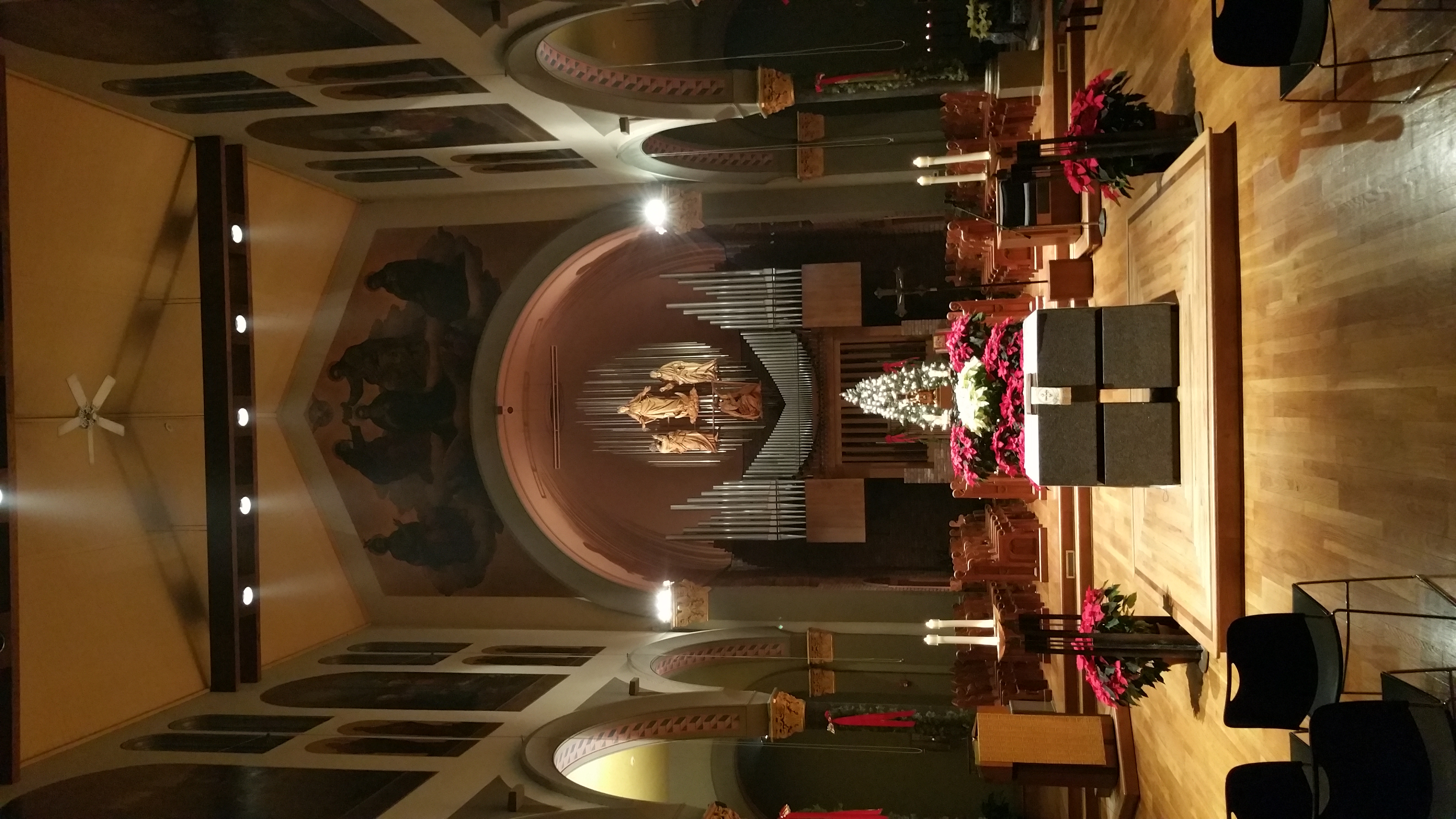
St. Mary's Abbey Church still stands on its hill. The 125-foot campanile that once dominated the Newark skyline has been joined by taller neighbors over the decades, but the church's position at the crest of its hill above the downtown commercial district still gives it a commanding presence. Inside, the decorative program assembled by generations of Benedictines is intact: an 11-image cycle of murals depicting the life of the Virgin Mary, painted by William Lamprecht and culminating in the Crowning of Mary as Queen of Heaven high in the apse; stained glass windows imported from Munich in 1907; statuary on the high altar including the Virgin Mary, Isaiah, David, and John the Apostle flanked by Saints Benedict and Boniface. St. Mary's has been on the National Register of Historic Places since 1972.
Fourteen Monks in an Urban Monastery
As of 2024, Newark Abbey's community consists of fourteen monks, including ten priests. It is one of only a handful of urban Catholic monasteries in the United States, and it operates in a city that has tested the Benedictine vow of stability — the commitment to stay put — more severely than most. In the 1980s, facing declining vocations, the abbey ran advertisements in secular publications seeking potential monks. The community's relationship with its city has been the subject of multiple books, including Miracle on High Street: The Rise, Fall, and Resurrection of St. Benedict's Prep and The Short and Tragic Life of Robert Peace, Jeff Hobbs's account of a Benedict's alumnus who went to Yale and died young. The abbey endures at the top of its hill, teaching, praying, and holding the line.
From the Air
Newark Abbey and St. Mary's Abbey Church are located at approximately 40.74°N, 74.18°W, on a hill overlooking the downtown Newark commercial district. The 125-foot campanile is a visible landmark from low-altitude flight over central Newark. Newark Liberty International Airport (KEWR) is approximately 4 miles to the south. The abbey sits in the dense urban core of Newark; best observed from 1,500–2,500 feet AGL on a westbound approach with views toward the hilltop church spire.