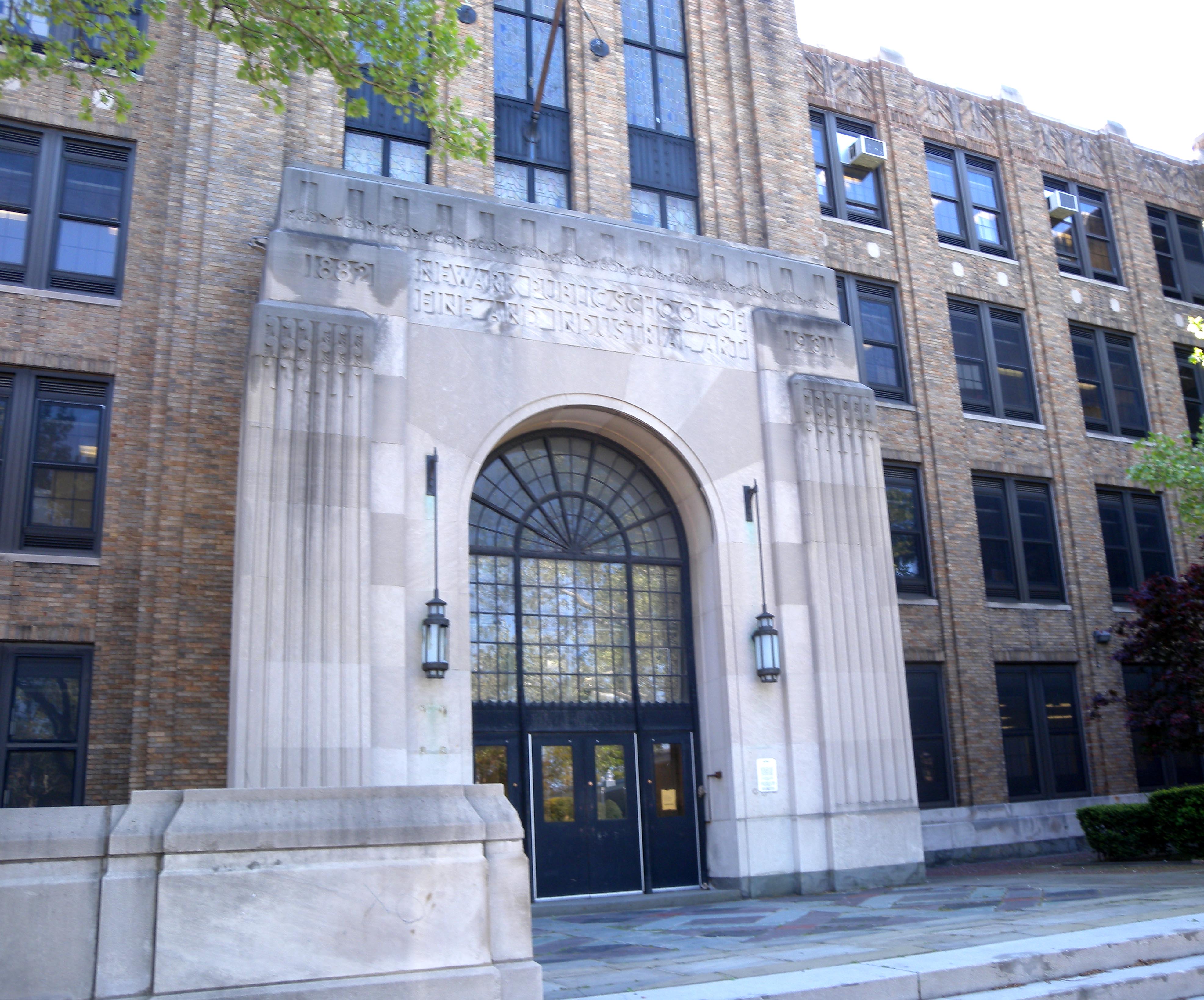
Newark School of Fine and Industrial Art
Don Martin drew the most magnificently absurd sound effects in the history of American cartooning — SPLOOSH, KACHUNK, SKLORTCH — for MAD Magazine's readers over five decades. Bill Sienkiewicz painted comic book pages with such hallucinatory intensity that the medium was never quite the same after. Eli Reed photographed wars, famine, and the human cost of the 20th century for Magnum Photos. Grif Teller created the iconic Pennsylvania Railroad calendar paintings that made the Horseshoe Curve look like a cathedral. What connected them? All attended the Newark School of Fine and Industrial Art, a city-run institution that opened in 1882 as an evening drawing school for working people — and for more than a century quietly trained some of American art's most distinctive voices.
An Evening School for Workers
The school began as the Evening Drawing School in 1882, when Newark was a manufacturing powerhouse whose factories needed workers with drafting and design skills. The 'industrial' in its name wasn't decorative — the curriculum was meant to link artistic training to economic productivity, equipping students with skills useful in leather goods factories, jewelry workshops, and commercial printing houses. It was a democratic institution: tuition was free, classes ran in the evenings so working people could attend, and the curriculum spanned everything from mechanical drawing to fine art. The name changed twice — to the Fawcett School of Industrial Arts in 1909, then to the Newark Public School of Fine and Industrial Art in 1928 — before settling into its final form. In 1931 it moved into a new Art Deco building, the physical expression of the school's ambitions for a new era.
A Faculty of Working Artists
What distinguished the school was its faculty — practicing artists, not academics. Reuben Nakian taught sculpture there before his modernist bronze figures brought him international recognition. Grigory Gurevich and Joseph Konzal joined him in the sculpture department. Painters like John R. Grabach and Gustave Cimiotti Jr. — who served as director from 1935 to 1943 — taught alongside portrait painters and printmakers. Henry Gasser, whose watercolors of Newark streets became an affectionate record of mid-century urban life, ran the school as director from 1946 to 1954. The German immigrant artists who arrived in the early 20th century brought European academic traditions; the later faculty brought modernist influence. A student passing through the school between the 1930s and 1960s encountered the full range of American art's competing currents.
The Alumni List
The roll call of notable graduates spans an improbable range of disciplines. Grif Teller's railroad paintings for the Pennsylvania Railroad defined an era of American travel illustration. Don Martin's cartoon characters for MAD Magazine bent and folded in ways that anatomically should have been impossible. Bill Sienkiewicz brought painterly abstraction to superhero comics with such force that publishers had to reconsider what the medium could contain. Eli Reed documented the civil rights movement, the Lebanese civil war, and Haitian poverty for Magnum Photos — work of sustained moral seriousness. Carla Dunlap won the Ms. Olympia bodybuilding title in 1983. Charles Waterhouse painted the Marine Corps's history in exhaustive, luminous detail. The breadth suggests a school that didn't sort students into predetermined categories, but let them find their own direction.
A Quiet Closure
In 1997, Newark's public school system faced a budget crisis. Officials decided that public schools would only operate kindergarten through 12th grade. The School of Fine and Industrial Art, which functioned as a post-secondary institution, didn't fit that mandate. It closed. A New York Times headline from January 12, 1997 captured the moment with a kind of wry sadness: 'Going Once, Going Twice: A School of Art.' The building had shared space with Newark Arts High School for years; in the early 1990s, the school had already been displaced to Lyons Avenue due to funding pressures. By the time the closure came, the institution had been diminished by circumstance for years. Fifteen years after closing, the building that housed it — the 1931 Art Deco structure — remained standing in Newark, a monument to a more ambitious civic commitment to the arts.
From the Air
Coordinates: 40.7147°N, 74.2238°W, in the heart of Newark, New Jersey. Newark Liberty International Airport (KEWR) lies approximately 3 miles to the southeast. At low altitude on final approach to KEWR, the Newark urban grid is visible below — the school's former building sat in the city's core, near the intersection of major surface streets. Downtown Newark's remaining Art Deco architecture is visible from 1,500 feet.