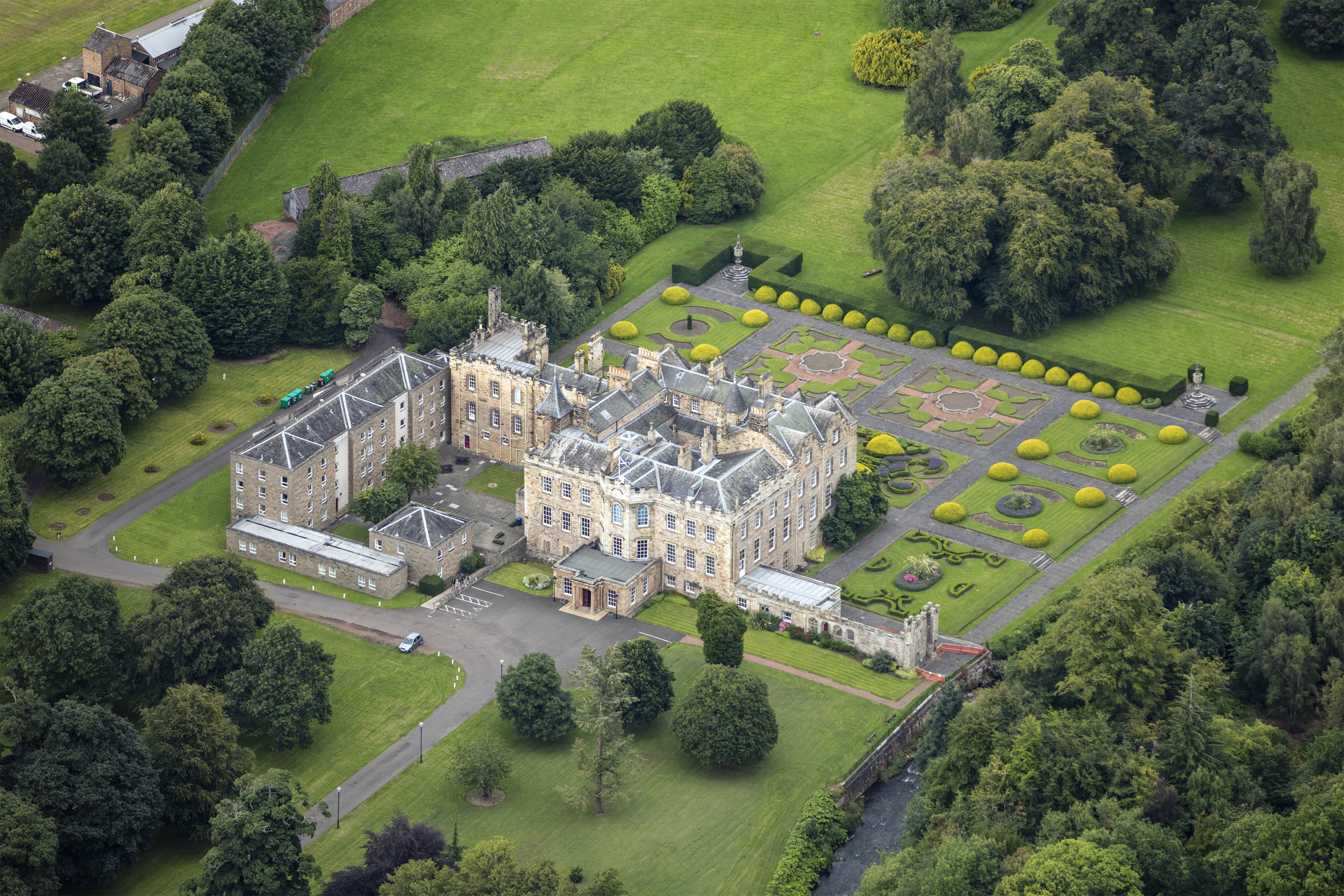
Newbattle Abbey
Before the Industrial Revolution, before coal powered empires, Cistercian monks in white robes were digging it from the earth along the River South Esk. Newbattle Abbey, founded in 1140 in a valley south of Edinburgh, holds a distinction that no amount of subsequent reinvention can obscure: the earliest mention of coal in Scotland appears in a charter granting these monks a mine. While other monasteries accumulated land and livestock, Newbattle accumulated something far more modern -- mineral wealth.
Sons of Melrose
Newbattle was a daughter house of Melrose Abbey, itself descended from Rievaulx in Yorkshire, placing it firmly within the Cistercian family that spread across medieval Europe like a franchise of faith and farming. King David I of Scotland served as patron, and the monks took their vocation seriously under Rudolph, their first abbot, a man described as a strict observer of the rule. The church they built was cruciform, 240 feet long, and at the community's peak some 80 monks and 70 lay brothers lived and worked within its walls. Scottish kings visited regularly, scarcely one failing to stop in and provide generous endowments. Twenty-six altars stood inside the church, each donated by a different benefactor or guild, each representing a private mass said in perpetuity for the donor's soul.
Monks Who Mined
The coal connection is what makes Newbattle singular among Scottish monasteries. An Earl of Winchester granted them a mine, and by 1526 King James V had approved their petition to build a harbour at Morrison's Haven for shipping the fuel. In 1531, Newbattle's abbot struck an arrangement with the Abbot of Dunfermline to work a coalmine at Prestongrange, engineering the drainage of water from neighboring mines to the sea. These were not monks dabbling in industry -- they were running sophisticated mining operations centuries before coal became the backbone of the British economy. The harbor, the drainage engineering, the inter-abbey agreements: all of it speaks to a monastic community that understood commerce as well as contemplation.
Burning and Surviving
English forces burned Newbattle in 1385, scattering the monks to other monasteries. It took forty years to repair the damage. Then in 1544, the Earl of Hertford's army destroyed parts of the complex again, though this time the damage was largely confined to the church. By the time of the Reformation, few monks remained. The last commendator, Mark Kerr, made a pragmatic conversion to Protestantism and kept the lands. His son became Lord Newbattle in 1596 and Earl of Lothian a decade later. The monastery became a stately home, absorbing medieval stonework into successive renovations by John Mylne in 1650, William Burn in 1836, and David Bryce in 1858. King George IV visited during his Scottish tour of 1822, and the King's Gate was built in his honour.
A Second Life in Learning
In 1937, Philip Kerr, 11th Marquess of Lothian, gave Newbattle Abbey to the nation. Not as a museum or a monument, but as a college -- specifically for adults returning to education, overseen by trustees from Scotland's four ancient universities. The vaulted undercroft that may date from the original 12th-century abbey now serves as a chapel with a 16th-century font and parquet floors made from estate wood. The oak-lined library features a 17th-century moulded ceiling. When the Secretary of State for Scotland threatened to withdraw funding in 1987, the college found new sources of support and survived. It is a place that has reinvented itself across nearly nine centuries: from monastery to manor to school, from prayer to coal to education, the abbey endures.
From the Air
Newbattle Abbey lies in the South Esk valley at 55.89N, 3.07W, about 7 miles southeast of Edinburgh city centre. From altitude, look for the estate grounds along the river near the village of Newbattle in Midlothian. Nearest airport: Edinburgh (EGPH), approximately 12 nm northwest. Best viewed at 2,000-3,000 ft in clear conditions.